Academic Programs at Reid Hall
The 1950s were "the harbinger of a golden age of study abroad that began in the aftermath of the Second World War and continued for three decades, sending thousands of American students into French homes and French universities" (Kaplan).
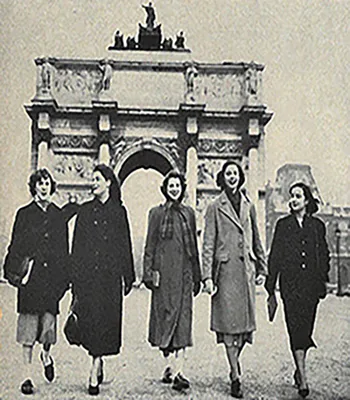
Beginning in 1947, Reid Hall hosted several undergraduate and graduate study-abroad programs in literature, language, and art history. Students enrolled in classes at Parisian universities, and their studies were bolstered by trips to other regions of France, and visits to châteaux, museums, and other cultural and educational sites. But how did all these American students travel to Paris to embark on their rich programs of study? In the aftermath of WWII, passenger ships between the U.S. and Europe resumed their Atlantic crossings. Cohorts of American students sailed to France on a number of majestic ocean liners, the S.S. United States being especially popular (retired in 1969).
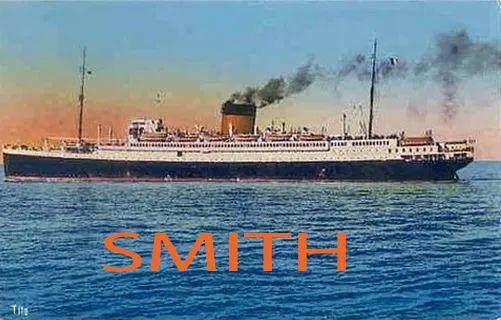
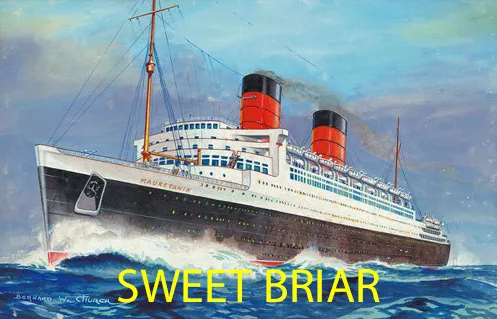
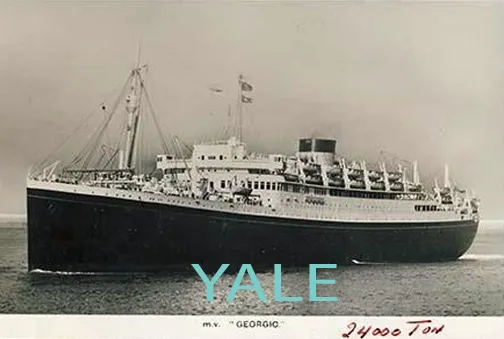
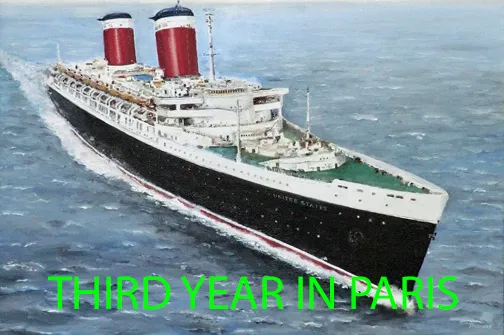

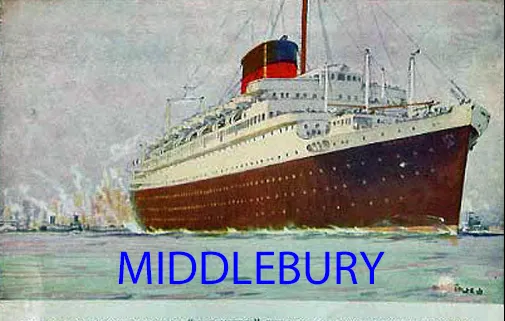
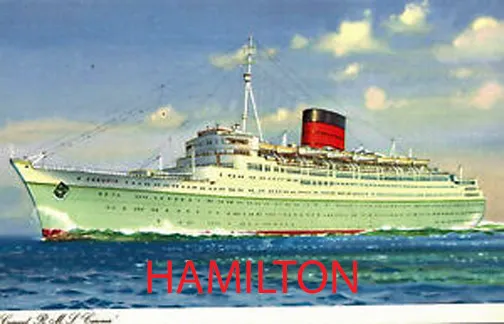
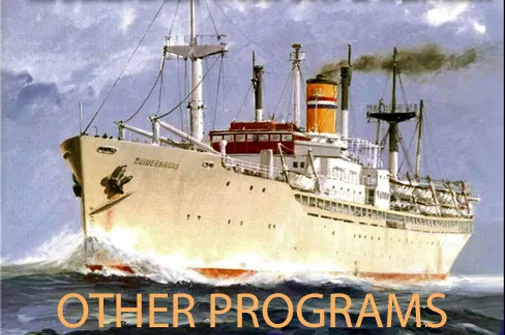
The students' departure from the United States was always a festive occasion, frequently feted by the French Consul in New York or other dignitaries, with luncheons, photo shoots, and newspaper coverage. In September 1957, for example, The New York Herald Tribune described "a tea for fifty...at the Hotel Westbury, Madison Ave. and 69h St., prior to their departure tomorrow on the liner United States for a year's study in Paris. They will be accompanied by their director, Miss Alice Ross Bennett." (September 18, 1957, pg. 17). In 1963, Charlotte Girard, director of the Third Year in Paris program, had this to say about the tea, also held at the Westbury:
“[...] the tea at the Westbury was nice, but I think the arrangements of small tables has its drawbacks, people settle and don’t move. They do not meet others. The theory of less seats than people for the purpose of mixing might be invoked. I made a short announcement about seeing me on board, gave my cabin and reminded each girl that she should have some sort of receipt for any trunk shipped ahead” (Report of Activities, C. Girard, 1963. Barnard Archives).
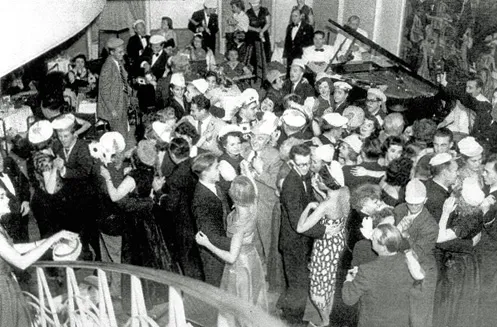
On board these vessels of discovery, significant efforts were made to prepare students for their experiences abroad. Emphasis was placed on cultural and linguistic immersion, which would ultimately lead to linguistic proficiency and increased confidence, and would thus transform them into informed citizens of the world. Cabin and dining room arrangements facilitated interaction between students, ensuring that those who came from the same junior college would be separated in order to meet other young people. Interviews with their program director and orientation sessions introduced them to their academic expectations, life in France, travel opportunities, housing rules and regulations, and readings. At these orientation sessions, vocabulary books, the Michelin guide, brochures, and other documents were distributed. Entertainment on the ships included dances and singalongs of popular French songs.
In her 1963 report on preparations for the crossing on the SS United States, Charlotte Girard, head of the Third-Year in Paris program, had this to say about the dining arrangements:
”On the way over, I made a point of contacting the Dining Room Steward about the arrangements for meals and it was agreed that a sufficient number of tables would be reserved for us and that within these few tables we would be able to move. I assured him that the waiters would not lose in tips. When I check with him on the 13th, he had received something from “Head Office” which ordered him to put the girls three by three at tables with young men. He had it all worked out and it seemed impossible to change all his plans. It was agreed, however, that we could move within these tables. I gave all the girls all the numbers, but they were confused, sat five at a table where only three Reid Hall girls should have been, or at altogether the wrong tables, the waiters made a fuss, the assistant Steward likewise. The net result was that, after the second day, when the table numbers disappeared, no one moved to more than one table and the people who lived in the same cabin, stayed together for meals. I think we should really insist on our arrangements for the dining room as well as the cabins. If the U.S. Lines wants to play cupid and bring young men to the tables, they might at least put the girls at these mixed tables in the same area of the dining room. Needless to say it makes it very hard for the Directrice too, to meet all the girls, since she does not, either, have a mystic sense of direction in the dining room.”
She also commented on the general brouhaha upon leaving the vessel:
“The girls were to meet me in the Smoking Room at a specific time so we could leave together, but some “forgot” and we lost much time in trying to find them. We did, in the end, by the train. The half-hour at Le Havre is really very difficult. The U.S. lines officials want to chat about the trip and find out how all went etc., the girls are excited to a pitch, can’t find their luggage, porters mill around in search of huge tips and it is impossible to have a really orderly handling of the luggage…."
Sources
- Dougherty, David M. “The Value of a Year of Study in France for Undergraduates.” The French Review, vol. 23, no. 4, February, 1950, pp. 304-307. Stable URL: www.jstor.org/stable/382465
- Institute of International Education (New York, N.Y.) New York, 1958. www.hdl.handle.net/2027/uiug.30112068495149
- Gildersleeve, Virginia C. “Reid Hall in Paris.” The American Society Legion of Honor Magazine, 1951.
- Girard, Charlotte. “Report of Activities.” 1963. Barnard Archives.
- Grossman, Joan Pines Abeshouse. "Les Petites Smiths, 1950-2000, A Scrapbook." 2000. Smith Archives.
- Leet, Dorothy, Flagg. Reports to Members of the Reid Hall Board, 1948-1963. Barnard Archives.
- Pace, Robert Charles. “The junior year in France; a evaluation of the University of Delaware-Sweet Briar College program.” Syracuse University Press, 1959. www.hdl.handle.net/2027/mdp.39015056780573
- Stallings, Sylvia. “Paris for a Campus.” Harper's Bazaar, vol. 84, Iss. 2867, October, 1950, p. 258.
- Toy, Stewart. “Exporting Students: U.S. Colleges Expand Programs for Study in Foreign Countries.” Wall Street Journal, December 9, 1960, p. 1. ProQuest Historical Newspapers.