University of Maryland Graduate Study Group
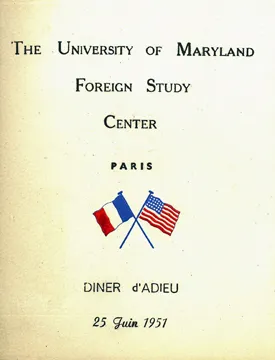
The University of Maryland (UMD) inaugurated its program at Reid Hall in the spring of 1947, but only remained for a few years. Their Paris Foreign Study Center is nevertheless worthy of note because it represented the first study abroad program for American graduate students. UMD also established a center in Zurich, and later one in Munich. Graduate students, mainly those specializing in language training, history, or political science, could earn the degree of Master of Foreign Study by passing several exams and presenting a thesis to the University of Maryland once they had completed their year abroad. While some students opted for a "certificate of foreign studies" (which only required regular course attendance), the majority earned the Master of Foreign Studies.
As with so many other programs abroad, the Master of Foreign Study was based on the premise that learning another language on-site would increase one's understanding of other cultures and thereby benefit world peace, especially when reinforced by courses in comparative literature, international relations, and world history.
Dieter Cunz, who headed the Zurich center in 1947-1948, published a summary of the programs' objectives and framework:
"Any student who has completed his undergraduate work and has taken at least two years of the language spoken at the foreign university which he plans to attend may apply for admission to the Foreign Study Center through the Graduate School of the University of Maryland. The major fields offered at the present time are limited to languages, literature, history, geography, political science, psychology, and sociology. The Foreign Study office is attached to the Foreign Language Department and is headed by A. E. Zucker; the director of the program is Edmund E. Miller, who is in charge of the administration of the centers at Zurich and Paris" (31).
According to Cunz, a professor from the Foreign Language Department was selected as resident dean who supervised the academic work of the students, assisted by one or two other professors from Maryland.
The first three weeks of the program served as an orientation period that introduced students to the country, city, and university where they had elected to study. Students also received intensive language training prior to attending local university courses. The UMD professors also attended the university classes so they could then deliver tutorials through which the students, whose language skills were initially wanting, could process the material covered in class. While these tutorials were not needed in the spring term, the UMD professors continued attending classes so they could generate coursework that met with UMD standards and requirements (tests and papers were not required in the European universities).
Students were also urged to make the most of their experience abroad by engaging in site visits and sociocultural activities on their own or organized for them:
"[...] the purpose of the whole project would be defeated if the student should spend all his time behind books, and in lecture halls, libraries, and archives. The 'living experience' in a foreign country should not be neglected - it is perhaps the greatest gain of his graduate year abroad. The student should have sufficient time for outside activities which - abroad more than at home - will widen his horizon" (Cunz 34).
In Paris, the program began with 10 students and ended with 42; many were veterans whose education was financed through the G.I. Bill of Rights.
- 1947-1948: 10 students (resident dean: William F. Falls). Only one student was actually from the state of Maryland.
- 1948-1949: 33 students, five of whom were women (resident dean: William R. Quynn, together with his wife Dorothy MacKay Quynn). In his 1949 article, Hardie declares: "[...] 35 students, many of whom have never seen the Maryland campus or realized that their university has a football team, are taking part in a new and interesting experiment in American higher education. So far signs are favorable." UMD established its administrative headquarters at Reid Hall, in the “maison verte,” which had once housed a medical clinic. Hardie describes it as "[...] a small wooden building in a garden just off Boulevard Montparnasse.”
- 1949-1950: 42 students (resident dean: L. Clark Keating)
According to Dorothy Leet's report to the Reid Hall Board, the Paris Foreign Study program was cancelled in 1950-1951 because: "The University of Maryland is devoting its entire attention to a school for the Army, and has therefore been obliged to close its civilian courses temporarily" (RH Report 1950-1951, Barnard Archives). Leet was referring to UMD’s College of Members of the Armed Forces Overseas, which began in c. 1947. Described as "the University of the World," the College served 4,000 G.I.s in 52 European centers in 1951. By 1957, it was operating 200 centers in 19 countries. The program enabled many soldiers to complete their college work while serving in the US armed forces.
UMD never returned to Reid Hall, but established other study centers throughout Europe, including programs for undergraduates.
Sources
- Fowle, Farnsworth. Special ot the New York Times. "College Brought to G.I.'s in Europe: Higher Education Is Provided by the University of Maryland." New York Times, May 6, 1951, p. 20. ProQuest Historical Newspapers.
- Cunz, Dieter, "The Maryland Foreign-Study Centers." The Journal of Higher Education, January, 1950, vol. 21, no. 1, pp. 31-34 Published by: Taylor & Francis, Ltd. Stable URL: http://www.jstor.com/stable/1976293.
- Hardie, Tom. "Maryland U. Has an Outpost in Paris." The Washington Post, July 24, 1949, p. L5. ProQuest Historical Newspapers.
- Harwood, William B., "'University Of The World' - Maryland Operates 200 Centers In 19 Countries." The Baltimore Sun, June 9, 1957, p. A1. ProQuest Historical Newspapers.
- Leet, Dorothy. Reports to members of the Reid Hall Board (1947-1963), Barnard Archives.
- "Maryland Gives Courses For 4,000 G.I.'s Abroad." New York Times, May 27, 1951, p. 129. ProQuest Historical Newspapers.
- Ross, Albion, Special to the New York Times. "6,500 G. I.'s Attend Overseas College: U.S.Troops in Britain, Europe, ..." The New York Times, December 27, 1954, p. 19. ProQuest Historical Newspapers.
- "35 Students Going Abroad: Groups From U. Of M. To Study German And French." The Baltimore Sun, Aug 11, 1947, p. 12. ProQuest Historical Newspapers.
- Toynbee, Arnold. "Maryland Abroad: Noble Experiment." The Washington Post, June 14, 1964, p. E6. ProQuest Historical Newspapers.
- Ward, Paul W. "Officials Differ Over U. Of M's. Profit By Foreign Study Plan." The Baltimore Sun, November 9, 1948, p. 32. ProQuest Historical Newspapers.