Middlebury at Reid Hall (1949-2003)
Of the numerous American colleges and universities for which the study of foreign languages has been crucial to the academic curriculum, Middlebury College stands out as the most progressive and proactive. The College founded the first advanced summer schools of modern languages in the United States, beginning with the German school in 1915, followed by the French School in 1916, and the Spanish School in 1917. These discrete programs aimed to educate graduate students and teachers not only in language instruction but also in cultural competence. In later years, Middlebury also established summer schools for Italian, Russian, “Chinese,” and Japanese.

As early as 1923, the French School had also taken the lead in training students abroad. While the Middlebury programs in Vermont strove to immerse their students in the culture of the language they were studying by offering a comprehensive experience that included residing, dining, and socializing, they also encouraged a period of study in the foreign country itself. Living and studying abroad were deemed indispensable for any student attempting to acquire mastery of a foreign language or true knowledge of its society and culture.
To bolster the French school's activities and publicize its pedagogical know-how, Edward D. Collins, Director of the Summer Schools, printed a brochure written and designed by renowned author, scholar, and French aficionado Dorothy Canfield Fisher. Self-avowed skeptic of French teaching in the United States, Fisher had transformed her thinking when she visited the Middlebury campus. Her brochure lauds Middlebury’s French School as "rare" and of "incalculable value." She ends her praises with a call for financial support: “Personally, I can’t imagine any better way of helping along good relations between the United States and France, than in helping Middlebury College keep intact the remarkable treasure it has in its French School” (October 15).
The French School initially did not thrive due to professional jealousies compounded by departmental quarrels and gossip, but the storms subsided in 1925 when André Morize, Harvard professor from 1918-1951 and “unofficial cultural ambassador of France to the United States (Freeman 64) was appointed as Director of the Middlebury French Summer Session, a position he retained until 1946. Stephen A. Freeman, Dean of the French School who worked closely with Morize and succeeded his tenure, noted that: “Under his direction, the French Summer School became the model for all the Middlebury Schools, and was imitated by all other summer language schools” (63).
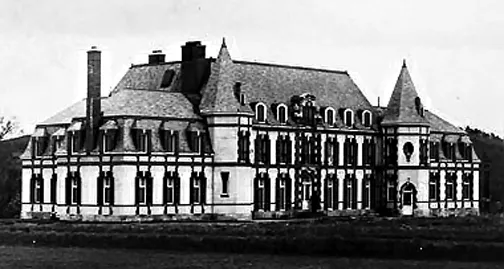
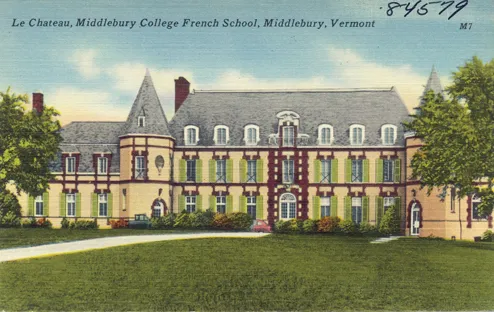
Another key to the French School’s success beside Morize’s appointment was the inauguration of the “Château,” Middlebury’s French house, a residential, teaching, and cultural facility with a 70-person dining room. The “Château” became the physical lynchpin of all French activities on campus, a veritable island where students, faculty, and staff spoke, ate, and dreamed in French. Additionally, equipment for an experimental language lab was bought by the French School in 1926 and upgraded by 1933. In 1936, a “state of the art” phonetics center allowed 200 students to work daily on pronunciation and intonation exercises. Other schools followed suit and the technical equipment was regularly upgraded and integrated into the curriculum of each program.
Stephen A. Freeman, who began teaching French at Middlebury in 1925 and served as director of the Language Schools starting in 1946, felt it was fundamental to the pedagogical objectives of their French program to go beyond recommendations and establish a formal plan to prepare American teachers for their careers by studying in France. Armed with advice from Vincent Guilloton of Smith College, and from his own experience with the U.S. Army University in Biarritz (1945-1947), Freeman submitted a proposal to Middlebury’s Board of Trustees in October of 1948 for a year-long Master program in French in Paris:
“Briefly stated, the proposal was to select a limited group of graduate students planning to teach French, to prepare them by a preliminary summer of study at the French School in Middlebury, and to send them to Paris in early October. They would spend the academic year from October to June in a coordinated and approved program of advanced instruction on French linguistics, phonetics, literature, history, institutions and culture. These courses would be followed in various institutes or schools of the University of Paris. The students would work under the close personal supervision and guidance of a resident Director of Studies representing Middlebury College. At the end of the year, final examinations would be administered under his direction by the French professors. The successful candidates would receive the Middlebury College Master of Arts degree, in addition to any French certificats or diplômes they might have been able to earn.
The plan was clearly an endeavor to secure for the students the best of both systems. They would be subjected to the discipline and stimulus of a different intellectual climate. They would be expected to adapt themselves to and profit from the peculiarly French methods and approaches. In the formal lectures, travaux pratiques and explications de textes, they would be treated on the same basis as the French students, candidates for the license. The final examinations would be prepared and graded by the French professors, and follow the French tradition. At the same time, they would be subject to all the regular requirements of Middlebury College for its Master’s degree in French. They would be guided by the Director of Studies familiar with both systems, and they could rely on his wisdom and support in any problems which might arise” (223-224).
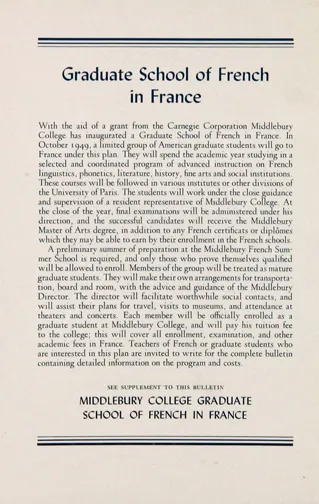
Freeman’s plan met with approval: in November 1948, the Carnegie Corporation awarded Middlebury College $6000 to establish a Graduate School of French in France. The 1949 Magazine of Higher Education announced the program’s objectives:
[…] solve problems facing the American graduate student who is preparing to teach French. After a summer of preparation at Middlebury 's French Summer School, students enrolled in the Graduate School will then leave for France to study for a year at the Sorbonne or some other French university. The studies of the Middlebury students in various schools and institutes of the French national system will be under French University professors and will be supervised by a residential representative of Middlebury College. Final examinations will be administered under the direction of the Middlebury staff, and successful candidates will receive the Middlebury master of arts degree” (166)
Prior to their studies in Paris, students would attend a preliminary summer of screening and preparation on campus at Middlebury.
The full implementation of Freeman’s project required a host of organizational strategies and a finely-tuned plan of action, including:
- Ensuring that students could enroll in the French University system as non-matriculated students, selecting specific courses of interest to their studies.
- Establishing procedures to obtain grouped student visas from the French prefecture de police.
- Establishing a network of potential housing: with French families or dormitory spaces at the Cité universitaire and the Foyer International des Étudiantes.
- Securing administrative office space in Paris. In preparation for the opening of its Graduate School, Middlebury College secured two administrative offices at Reid Hall in 1949 and later increased its footprint at the Hall when space became available.
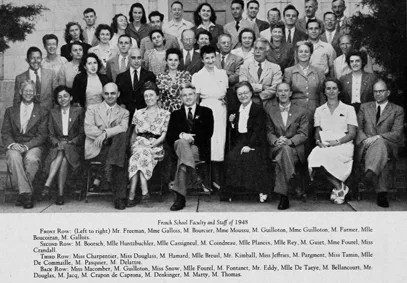
The model proposed in 1949 was followed for many years, with adjustments and adaptations based on student needs and the evolving French university system.
Resident directors were appointed by Middlebury and generally stayed in Paris for the fall semester. By 1951, a permanent director of studies was named for the Spring semester. These directors were responsible for overseeing the entire academic experience, which required “initiating our students into a different educational philosophy, and showing them that this was why they were in France” (Freeman 230). They advised students and ensured they had a balanced course of study adapted to their needs and Middlebury’s requirements; they also arranged final examinations and liaised with French faculty, administrators, and government officials. The program required 30 points of credit comprising: an advanced course in written French, phonetics, literature, geography or history, and general culture courses. No two student programs were necessarily alike, since each individual devised a tailor-made curriculum of classes at the Institut de Phonétique, École de Preparation (later called the Institut des Professeurs de Français a l’Étranger), the Institut d’Études politiques, the École du Louvre, the arts and letters section of the Sorbonne, and the Institut Britannique. Students also signed a pledge to make French their language of “habitual communication” (Freeman 226). Since French universities did not offer extracurricular activities, these were also organized by the program, with information sessions, concerts, conferences, group excursions around Paris, and visits to other regions of France.

The Graduate School of French in France was a great success, attracting a large number of graduate students, some of whom eventually became professors at Middlebury. The directors were usually from Middlebury and other U.S.-based colleges and universities while French university professors were regularly invited to teach at Middlebury’s campus in the summer.
“A great honor came to the French School in June 1963, the award of the Gold Medal Prize of the French Language by the Académie Française. The diploma and medal were officially presented through the French Cultural Counselor, M. Morot-Sir, by Maurice Genevoix, Secretary of the Académie. In his letter to President Armstrong, Morot-Sir expressed his congratulations for the special distinction, ‘Thanks to Middlebury’s French Summer School, its group of Studies in Paris, and the remarkable work of its French Department’” (Freeman 278).
In 1975, a program for juniors was developed alongside the graduate program, and as the program grew, agreements with several French institutions of higher learning were established, including: Paris X – Nanterre, Université Paris 1 Panthéon-Sorbonne, Université Sorbonne Nouvelle Paris 3, Université Paris Diderot- Paris 7, Institut d’Études Politiques de Paris (Sciences Po). Special arrangements were made for qualified undergraduate students to take courses at École Spéciale d'Architecture (ESA) (for Architecture majors only), École Normale de Musique de Paris Alfred Cortot (ENM) (for Music majors only), Schola Cantorum, École des Psychologues Praticiens (EPP) (for Psychology majors only), Institut Catholique de Paris (for Religion majors only), École des Hautes Études en Sciences Sociales (EHESS). The number of juniors participating in the program increased regularly, eventually outnumbering the graduates. Though many of the students majored in disciplines other than French, the core commitment to language and cultural immersion remained.
Click here for a brief overview of the various Middlebury programs at Reid Hall by academic year from 1949 through the late 1970s.
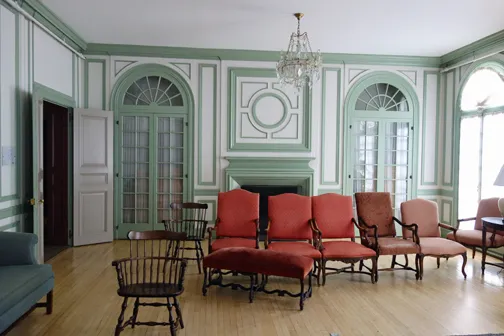
The Middlebury programs left Reid Hall in 2003 to set up their own headquarters near the place de la Madeleine; Michael R. Katz, Dean of Language Schools and Schools Abroad, sent the Director of Reid Hall, Danielle Haase-Dubosc, a rather curt letter announcing their departure:
“More than 30 years ago, Middlebury became a part of Reid Hall and has been one of its staunchest supporters throughout the years. However, for the past several years, Middlebury has come to the realization that its location at Reid Hall no longer corresponded to the goals for which the Middlebury students and faculty strive; that is total immersion in a French-speaking environment in order to achieve advanced fluency in the French language and a true understanding of French culture. It has become increasingly difficult to achieve this goal at Reid Hall. Furthermore, as tuition has risen in the U.S., Middlebury has found a growing discrepancy between student and faculty expectations of services and facilities, and those that Reid Hall has been able to provide. In spite of these difficulties, Middlebury continued, if occasionally with some inconsistency to support Reid Hall in the hope that improvements were forthcoming” (RH Archives).
Around the same time, Middlebury’s French mecca in Vermont was “recast for its new role in 2004” (Andres). While « Le Château » still houses the Department of French, its classrooms, salon, and residential floors now serve a broader constituency, and its dining hall has been converted into a performance space (Andres). Though no longer a fixture at « Le Château », the “language tables” were nevertheless continued at other dining facilities on campus. And the place de la Madeleine site continues to enjoy a growing number of dedicated afficionados of “everything French.”
Sources
*Enrollment figures vary according to the accounts; those identified here stem from Freeman’s book, which represents a very comprehensive and dense history of Middlebury’s foreign language Schools.
- Andres, Glenn M. “A Walking History of Middlebury,” designed and edited for the Web by Anne Callahan. http://midddigital.middlebury.edu/walking_history/college_campus/page_5.html
- Binzen, Peter, “Taking the Middlebury Pledge, » Change , Jan., 1978, vol. 10, no. 1, Report on Teaching: 5 (Jan., 1978), pp. 42-44 Published by: Taylor & Francis, Ltd. Stable URL: https://www.jstor.org/stable/40162848
- Freeman, Stephan A. The Middlebury College Foreign Language Schools, 1915-1979: The Story of a Unique Idea, Middlebury College Press, Middlebury, Vermont, 1975. https://archive.org/stream/mls_1915-1970/1024_djvu.txt
- “Graduate School of French.” Higher Education, volume 5, no. 14, March 15, 1949, p. 166.
- “Middlebury College Graduate School of French in France.” Higher Education, volume 6, no. 10, January 15, 1950, p. 119.