Sweet Briar JYF (1948 - 2020)
"Since 1948, over 7,200 students representing more than 280 colleges and universities have been enrolled in the JYF program" (Sweet Briar Alumni Magazine, 2016).
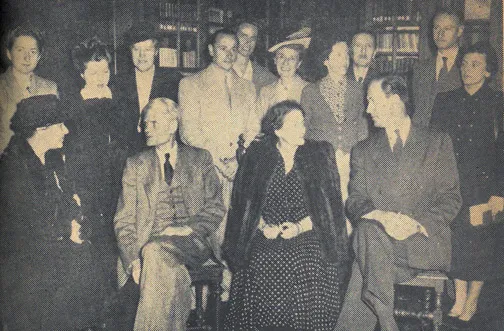
The Institute of International Education authorized Sweet Briar College to take over the University of Delaware Foreign Study plan, which had begun in 1923, born out of an American soldier's experience in France (NYHT, Jan 18, 1948). The initial Delaware group had 8 students; by 1933, it had 90 participants. Like Smith College, the program ceased all activities during WWII, but resumed in Geneva in 1946. Leet had written to George Brinton of the Delaware group to see if they might return to France; he told her that they had opted for Geneva as a safe site for their students, and that he would not be able to send students to France until March 1947 (Brinton, March 14, 1946). Delaware remained in Geneva through 1948.
Due to a lack of funding, the program was shut down in 1948. Joseph Barker, a professor at Sweet Briar who had headed the Delaware Study Plan in 1934-1935, suggested that Sweet Briar take over the reins. Once the takeover was approved, he and his wife came to France in the summer of 1948 to secure host families, tutors, and lecturers.
Of the 82 admitted students, only 67 men and women went to Paris in the 1948-1949 academic year, with 11 residing at Reid Hall and the others with French families. Students originated from an extraordinary range of colleges and universities: Redlands University, Wellesley College, Penn State University, Yale University, Mills College, Pembroke College, Cornell University, Bryn Mawr College, Amherst College, Hood College, Sweet Briar College, Dartmouth College, University of Wisconsin, Columbia University, Mount Holyoke College, Lafayette College, Goucher College, New Jersey College for Women, Connecticut College, Kenyon College, University of Oregon, Barnard College, Vanderbilt University, George Washington University, Carleton College, Knox College, Brown College, Swarthmore College, University of Wisconsin, Haverford College (NYHT, September 8 1948). The director was Dr. Theodore Andersson of Yale, assisted by Dr. Marion Monaco, of Connecticut College.
Sweetbriar established its administrative headquarters at Reid Hall. The academic curriculum was based in the French university system, which began long after the students had arrived in Paris. It was preceded by a six-week intensive orientation course at Reid Hall that acclimated students to the French language and to their new surroundings.

In 1949-1950, 73 students (53 women and 20 men) sailed on the SS Mauretania on September 8. They resided either at Reid Hall or with French families; the program preferred host-family-housing for its students and mainly used Reid Hall as its administrative headquarters and tutoring site. Two scholarships were granted by the French government to JYF for that academic year. The students represented 21 states and 26 universities and colleges, mainly Vassar College (8), Bryn Mawr College (6), Sweet Briar College (5), and Mt Holyoke College (5). Others came from: Baldwin-Wallace, Barnard, Bowdoin, Cornell, Dartmouth, Fresno State College, Haverford, Hollins, Middlebury, Oberlin, Scripps, Skidmore, Swarthmore, University of Delaware, University of Maryland, Vanderbilt, Washington University, Wheaton, Whitman, Wilson, and Yale. The director was Dr. Blanchard L. Rideout, assistant dean of the College of Arts and Sciences at Cornell, assisted by Dr. Mary Lane Charles, professor of French at Western College, Oxford, Ohio.
Of the eleven different majors, there were 28 students in French, 7 in political science, 8 in art, and 4 in history. Of the 20 men in the program, 4 came through the G.I. Bill (NYHT, June 16, 1949). After their six-week intensive in French language (phonetics, grammar, composition, dictation, explication de texte, etc.), students followed courses at the Sorbonne, École du Louvre, and Sciences Po. Their tutorials were held at Reid Hall (Richmond Times Despatch, April 19, 1949). According to Andersson:
"The class of 1950, consisting largely of veterans of World War II, was in the opinion of many of us the best class ever, and the flexible program provided in the Cours de Civilisation Française, Faculté des Lettres, Institut de Phonétique, École du Louvre, Sciences Po, as well as Reid Hall, provided ample room for freedom of choice.The theater, museums, concerts, and the inexhaustible resources of Paris all added to the education and to the opportunities for self-education of this superior group of students" (JYF Newsletter, 1977, 8).

"On June 30, 1951, the Sweet Briar group withdrew to other quarters due to its policy of placing all of its students in French families" (RH Report 1950-1951, Barnard Archives). Since the agreement between Reid Hall and Sweet Briar stipulated that they could only hold classes and use common spaces at Reid Hall if they housed at least 10 of its students at the Hall, the program moved their headquarters to the building of the Carnegie Endowment for International Peace at 163 Bd. St. Germain. That year, 74 students were enrolled in the program and the 6-week intensive was held in the city of Tours, returning to Paris for their classes at Sciences Po, the École du Louvre, and Faculté des Lettres. The director was Dr. Charles A. Choquette, of Colgate University, assisted by Dr. M. Annette Dobbin, of New York State College for Teachers at Albany.


To this day, the program followed the 1957-1958 model with an orientation at the Institut de Tourraine (Tours), followed by classes in Paris. Its reputation grew as did the student body, with over 100 students in residence in any given year. Details about the curriculum, activities, and stories on student and faculty experiences can be found in their Alumni Magazine and Alumni Newsletter. Over the years, the largest numbers of students came from Bryn Mawr, Carleton, Cornell, Dartmouth, Holyoke, Princeton, Radcliffe, Sweet Briar, and Yale.
In a 1960 article in the Wall Street Journal on the controversies raised by the large number of students studying abroad, psychologist Dr. Robert Pace of Syracuse University claimed that the impact of the program on the intellectual and social maturity of Sweet Briar students was significant, and that it also perfected their understanding of international affairs (Toy 1960).

The program moved its headquarters several times between the 1950s and early 1960s, from the Bd. St. Germain, to Reid Hall, to the Alliance, then back to Reid Hall where it remained until 1974. At that time, it moved to its own space in the Alliance Française building on Bd. Raspail:
“The JYF headquarters has moved to a new address in Paris. After ten years at Reid Hall, we are now located in quarters originally planned for the Junior Year in France some twelve years ago by Dr. R. John Matthew and M. Marc Blancpain, Secretary-General of the Alliance Française. Located on the seventh floor (French style) of the Georges Duhamel Annex of the Alliance Française, 34 rue de Fleurus, 75006 Paris, the locaux consist of administrative offices and secretariat, two classrooms, a seminar room, a reading room and a large terrace which we hope will help replace partially at least the garden at Reid Hall. It presents a delightful view of the chimney-pots of the Latin Quarter; the trees of the Luxembourg Garden, and the dome of the Pantheon are visible in the easterly direction and what some refer to as the "Awful Tower" (the 60 storey, Tour Maine-Montparnasse) is visible in the westerly direction. The new quarters face the apartment that Gertrude Stein lived in for so many years and of which Ernest Hemingway wrote in A Moveable Feast. Those students who remember the old Alliance Française quarters of the JYF in the 50' s and early 60' s will no doubt also recall the long climb to the fifth floor offices there. They will be pleased to know that we have a large ascenseur available now to the seventh floor” (Alumni Newsletter, 1974, 17).

The JYF program returned to Reid Hall in 2016 and remained through Spring 2020, when the program was cancelled, despite its long and successful career. The Sweet Briar website announced a significant shift in priorities:
"Sweet Briar’s junior year abroad program in France is among the oldest and most venerable of such programs in the country. Its endowment has largely supported students through scholarships. In recent years, the support has gone mostly to students from colleges other than Sweet Briar, as the number of Sweet Briar students interested in the French language and culture has dwindled.
Now in the midst of the COVID-19 pandemic that has led to suspension of study abroad programs in France and elsewhere, Sweet Briar College is embracing more effective ways, other than the traditional study abroad programs, to expose its students to the dynamism of a global cultural experience. 'Global exposure for students has been shifting from spending an entire academic year or semester in a foreign country to more rapid immersion activities, global internships and study in Europe and elsewhere,' said President Meredith Woo. Sweet Briar College has two three-week terms built into its calendar that are uniquely suited for an immersive study abroad"' (https://sbc.edu/jyf/).
Sources
- "American Students arrive for a Year of Study in Paris." Herald Tribune, 1949. (RH Archives).
- Barker, Joseph, E. The French Review, vol. 26, no. 6 (May, 1953), pp. 446-450. American Association of Teachers of French. jstor.org/stable/382496
- Brinton, George E. Letter to Leet, March 14, 1946. Family Papers, Reid Hall, 1939-194è, Box 94A.
- "50 Students Sail to Study in Paris: Pracity of Spending Junior Year..." New York Times, Aug 29, 1948, p. 5. ProQuest Historical Newspapers.
- "Five Local Students Among 53 Leaving For Study In Paris." The Hartford Courant, Sep 6, 1949, p. 7. ProQuest Historical Newspapers.
- "Heads France Study Plan." New York Herald Tribune, March 28, 1948, p. A8. ProQuest Historical Newspapers.
- "Hewlett Girl Named for Study in Paris." Newsday, May 1, 1953, p. 70. ProQuest Historical Newspapers.
- “Junior Year in France.” Alumni Newsletter, no 2, November 1975. p. 17.
- “Junior Year in France.” Alumni Newsletter, no 4, November 1976. p. 8.
- https://archive.org/stream/junioryearinfran16unse/junioryearinfran16unse_djvu.txt
- Pace, C. Robert. "The junior year in France: A Evaluation of the University of Delaware-Sweet Briar College program. Published for Sweet Briar College by Syracuse University Press,1959. HathiTrust https://hdl.handle.net/2027/mdp.39015056780573
- "Paris to Honor 73 students of U.S.Colleges: Offer Vin d'Honneur Today at Hotel de Ville Today to Sweet Briar Group." Herald Tribune 195?
- "68 American Students to Pass Year in Paris." New York Herald Tribune, June 6, 1948, p. A4. ProQuest Historical Newspapers.
- Summers, Eileen. "Study Abroad Opens Way to Good Citizenship." The Washington Post and Times Herald, May 30, 1954, p. S6. ProQuest Historical Newspapers.
- Sweet Briar Adopts Foreign Study Plan: Taking Over Delaware U. Year-in-France Course." New York Herald Tribune, January 18, 1948, p. 3. ProQuest Historical Newspapers.
- Sweet Briar Alumnae Magazine, fall 2007, vol. 78, no. 3.
- "Sweet Briar College, JYF in Paris." Alumni Magazine, no. 43, December 2016.
- "Sweet Briar College shifts the endowment of its study abroad program in France to support global programming." sbc.edu/jyf/ consulted October 2020.
- Sweet Briar Plans Study Group in Paris." New York Times, January 13, 1948, p. 23.ProQuest Historical Newspapers.
- "Sweet Briar to Acquire An International Aspect." The Washington Post, August 27, 1950, p. L2. ProQuest Historical Newspapers.
- Toy, Steward. Staff Reporter. "Exporting Students: U.S. Colleges Expand Programs for Study in Foreign Countries." Wall Street Journal, December 9, 1960, p. 1. ProQuest Historical Newspapers.
- "Trinity Sophomore To Study in Paris." The Hartford Courant, May 18, 1961, p. 29. ProQuest Historical Newspapers.
- "Va. College Sponsors Foreign Study Plan." The Washington Post, January 13, 1948, p. B13. ProQuest Historical Newspapers.