Smith in Paris
"In my opinion, the Junior Year Abroad is [...] the most valuable year spent in college. The students not only get a mastery of a foreign language and the contents of the usual number of courses but acquire a higher degree of maturity and breadth of view. It is an important means of creating understanding of people of another country and so it is part of our campaign for better international relations." -William Allan Neilson, 1934
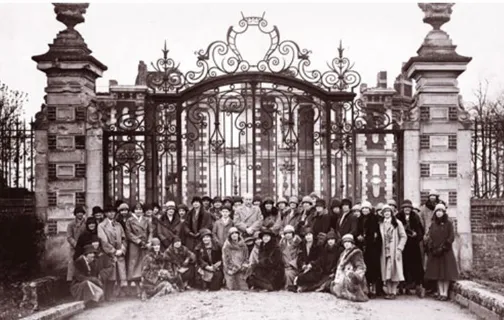
Following the successful implementation of the "Delaware Foreign Study Plan" in 1923, Smith College established their Paris program in 1925. Smith was already deeply connected to France, as a group of courageous alumnae led by Harriet Boyd Hawes had volunteered to serve in the French countryside during WWI. Called the "Smith Relief Unit," the group was assigned to the village of Grécourt in the Somme, just fifteen miles from the vicious battle raging between the Germans and the Allies on the front. The Smith Relief Unit transported food and medical materials; cooked and delivered meals; cared for children; and tended to the sick. Ruth Gaines wrote a memoir of her wartime experiences, Ladies of Grécourt: The Smith College Relief Unit in the Somme.
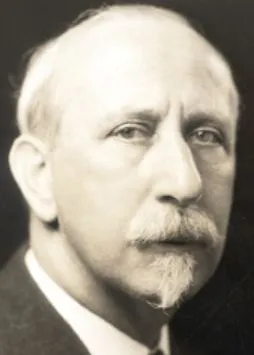
Smith's president during those early tumultuous decades of the 20th century was William Allan Neilson, a firm believer in international cooperation as a means of achieving world peace. He had supported the Smith Relief Unit in their efforts and instituted a "Committee on the Exchange of Students with Foreign Countries" in 1919 to oversee the fellowships extended by the French government to Smith students at the École normale supérieure de Sèvres (Gantrel 8). In 1935, he was decorated with the French Legion of Honor in recognition of his work on student exchange programs.
Correspondence preserved in the Smith College Archives between President Neilson and Barnard's Dean Gildersleeve, Director of the Reid Hall Board, demonstrates the close relationship between the two educators and their shared vision for the international education of women. It is therefore not surprising that Reid Hall became the focal point of Smith's study abroad initiatives.
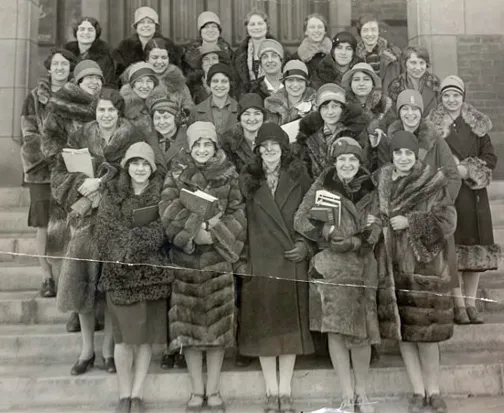
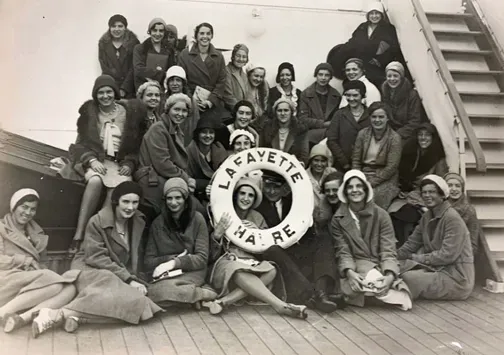
The Committee's work expanded as President Neilson and Professor Hélène Cattanès of the French department formulated a proposal for the program that would become Smith's Junior Year Abroad (JYA) in Paris. Despite concerns from the faculty about the safety of the "girls" in a foreign country and about the sustainability of such an endeavor, the Paris Plan of Study passed a faculty vote in January 1925 and the first group of 32 Smith students, all French majors, boarded a transatlantic liner bound for Le Havre in August of that year. Prof. Cattanès traveled with the students and served as the program's first director. Though the JYA students did not live at Reid Hall as part of their year abroad, they were frequent guests at the University Women's Club and were cherished members of the community.
One major reason that Smith students were not domiciled at Reid Hall was the program's support of the construction of an American dormitory at the University of Paris's Cité Universitaire, to be housed between the English and Belgian dorms in a sort of educational village. Personal preference also factored into the students' decisions to live with French families and not at Reid Hall. A memo from Smith's Professor Byam dated February 6, 1935 notes that Smith students did not live at Reid Hall because "not a single student was satisfied with the rooms at that place, the chief reason being that the building is too similar to an American dormitory" (Junior Year Abroad-France, Smith JYA Records, B50F6, folder 32, Smith College Archives).
Like all other American study abroad programs, Smith in Paris was forced to shut down during WWII. Upon the resumption of "normal" activities across Europe, Smith's JYA program was revived in 1946, constituting the first group of American students on European soil since the end of the war. They studied in Geneva because the socioeconomic situation in France in the aftermath of war was still quite uncertain.

In 1947, a group of 35 young women sailed to Le Havre via the SS De Grasse, which would serve as the favored Smith ocean liner for years to come. Since Parisian families were still struggling with food shortages, Reid Hall became the best alternative to full immersion. The students, who averaged 20 years of age, represented different women's colleges on the East Coast: Smith, Bryn Mawr, Russell Sage, New Jersey College of Women, Barnard, Wilson, etc. (The Herald Tribune, November 29, 1947). Most students were French major, but some majored in music, history, or art history. They studied mainly at the Sorbonne, the Institut d’études politiques, and the Louvre. Madeleine Guilloton, who had headed the Smith program in the 1930s, accompanied the group to Paris and directed their academic and social life, ensuring that students upheld the French-speaking pledge at all times.
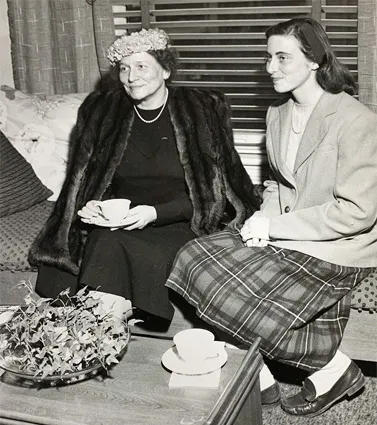
Dorothy Leet visited Smith College in April 1948 (New York Sun, April 21) to talk about France, Reid Hall, and meet potential candidates for the JYA program. Her presence generated great enthusiasm on Smith's campus, and the program firmly established its headquarters at Reid Hall.
In the 1948-1949 and 1949-1950 academic years , there were 38 and 35 students respectively, with around 25 living at Reid Hall, under the supervision of Marthe Sturm, translator and Associate Professor of French at Smith. An increased number of classes taught by French university professors were held on-site:
"The Smith College Group follows its autumn courses at Grenoble but is holding at Reid Hall an increasing number of winter and spring courses, given by distinguished university professors. This is due to the fact that Junior Year students are not qualified to follow regular classes for French students at the Sorbonne and must, therefore, enter only classes arranged for foreigners in the "Cours de Civilisation Française," which are below the academic standards of the Juniors, and which are crowded with Americans who are not obliged to fulfill any academic requirements for entrance to these courses" (RH Report, 1949-1950, Barnard Archives).
In 1949-1950, the program adopted a new residency pattern: for the first six weeks, students lived with families in Grenoble. They then went to Paris, where the group was split in two, with one cohort living at Reid Hall in the fall and the other in Parisian households. The two groups swapped residences in the Spring semester.
At Reid Hall or with French families, students followed a strict code of conduct. Below is an excerpt from the “Règlement à l’usage des Familles et des Étudiantes” for 1959-1960:
- Students have an 11pm curfew, but they are permitted to stay out until 1am three nights per week. Any outing past 1am can only be accepted by the host if the student presents written authorization from the the program director.
- Hitch-hiking is forbidden.
- Riding a Vespa is forbidden.
- Water and electricity are very expensive in France and students must avoid all waste (i.e. leaving a room without turning off the lights or turning on the lights without reason). Two baths a week are allowed; students will be billed for additional baths.
- Men are not allowed to visit bedrooms. Host families can offer a salon or common room for socializing.
- No alcohol is permitted in bedrooms.
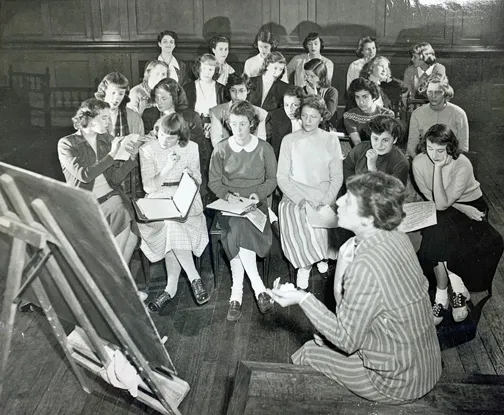
In 1950-1951, 34 juniors participated in the program, which was directed by Jeanne Saleil, Smith professor of French who, during the war years, had headed the French house (Dawes House) on Smith’s campus. She led the JYA program through 1961 and other professors from Smith, like Guilloton, taught French grammar, phonetics, etc. The program averaged some 30 students each year. By 1960, the president of Smith College remarked that their program was "so popular we have to turn down one out of every three applicants" (Toy 1960).
As time passed, the Smith students increasingly chose to live with French families, using Reid Hall for classrooms, receptions, and as their administrative hub. Correspondence in the Smith Special Collections document students’ attachment to their French host families, with whom they formed bonds that went beyond their year in France.

Even after Columbia had taken over the property, Smith's JYA program was calling Reid Hall home in every sense of the word. In the 1960s, Three Smith professors were particularly active in developing the program and overseeing its academic and cultural objectives:
- Josephine Ott: After working as assistant director of the Sweet Briar College program in 1956-1957, she began leading the Smith program in 1961. Throughout her career at Smith, she was dedicated to the Paris program and served as its director on seven separate occasions.
- Patricia Weed, herself a graduate of the program, was also a frequent and enthusiastic Director of the Junior Year in France.
- Marie José Delage
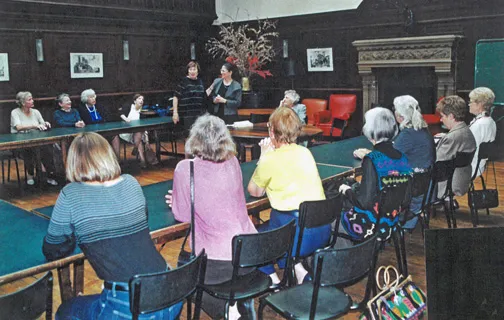
Numerous Smith alumnae have returned to Reid Hall since their formative year in France, which remained indelible in their mind, and, for many, French became a second language. Alumnae came together at Reid Hall to celebrate the program’s fiftieth year. One alumna edited a scrapbook, which is housed in Smith's archives, based on the photos and mementos of the time they spent in France. In 2015-2016, yet another group celebrated the program’s ninetieth year. Several of the women had remained in France, married French men and/or established careers in Paris. Others had returned to the U.S. but regularly visited France or invited members of their French host families to America.
Reid Hall is still the program's academic home and headquarters. In fact, it occupies the same space secured by Smith so many years ago. In 2020, the program's emphasis remains immersion in French society, language, and culture:
"It is a year‐long program; students start the year with an orientation during which they take classes in French language and methodology, and learn about the history and culture of France; they live with families and study at French universities; and they are under the supervision of a faculty member who belongs to their home institution and serves as their academic adviser" (Gantrell 11).
Sources
Mah, Ann. "A Year in Paris That Transformed Jacqueline Kennedy Onassis." The New York Times, June 30, 2019. https://www.nytimes.com/2019/06/23/travel/paris-jacqueline-bouvier-kennedy-onassis-college.html
Toy, Steward. Staff Reporter. "Exporting Students: U.S. Colleges Expand Programs for Study in Foreign Countries." Wall Street Journal, December 9, 1960, p. 1. ProQuest Historical Newspapers.
Vickery, Margaret Birney and Nina Antonetti. Smith College, Princeton Architectural Press, 2007. pp. 162.