Art Exhibitions (1893 - 1914)
"[...] all of the students of the quartier drop in, full of the chat of the ateliers, of gay American chaff, endless art projects. The place is at once both American and foreign, and it is unique in Paris. From the outside the club is a reserved, severe looking building, flush with the street; but within, a quaint old-fashioned grace hovers round the old court with its ordered French garden, and overall is the eternal charm of the dear old "Quartier" which never fails to sing its siren song to the art student" (de Forest 1900).
Just a few months after the the official opening of the American Girls' Art Club, its first public exhibition debuted in December 1893. Featuring work by 60 women artists and art students, many of whom were residents at 4 rue de Chevreuse, the exhibition was well attended by members of the American colony in Paris, as well as by French critics and atelier masters. The overwhelming success of that first show quickly transformed the event into a highly-anticipated annual tradition.
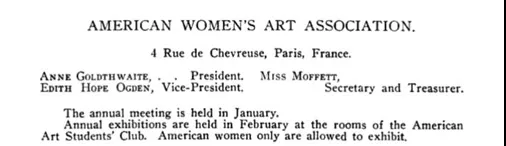
The American Woman’s Art Association (AWAA) was founded in 1895, primarily to organize the exhibitions at the Club. These shows enabled up-and-coming women artists to publicly share their paintings, sculptures, drawings, miniatures, and engravings, especially those which had not been accepted at any of the prestigious Paris Salons. In 1900, its inauspicious beginnings were described in Harper's Bazaar:
"The American Woman’s Art Association has been so far held together by a somewhat fragile thread. It has no stable organization, it has no permanent officers, and it has no fixed place of exhibit. Every new season the surviving members left over from the year before have met and elected new officers, and there has been another exhibition. But now the utility of such an association has come to be so widely recognized that an effort is being made to arrange for having the officers elected in the summer for the following year. In this way there will be a perpetual chain [...] (January 13, 33).
Over the course of its nearly 20-year existence, the AWAA mounted around 30 exhibitions, many of which were reviewed by the French and American press. On November 21 1909, The San Francisco Call reported:
"The American Woman's Art association holds its annual exhibitions at the club, and they are ever the magnet tor drawing big crowds to the quiet looking old building. The fourteenth exhibition of the kind has been held only lately, and in the course of the years that have passed many an American girl artist has had the delight of selling her first canvas and getting a start through attention directed to her work at one of these annual exhibits."
Among the Association's notable leaders were:
- Elizabeth Nourse: president and exhibit organizer in 1899. She also lived and worked at a studio very near the Club, at 80 rue d'Assas.
- Mary Fairchild MacMonnies Low: long-time member of the association; served as president from 1900-1903. Her first husband, Frederick MacMonnies, taught many of the artists and sometimes served as an exhibition judge.
- Anne Wilson Goldthwaite: directed the Association in 1910 and 1911; lived at the Club in 1911.
- Mary Cassatt: perhaps the most famous of the American women painters in Paris, she was an early member of the Association in its first years. *NEED PROOF*
Around 1910, the Club also began providing the association with a salesroom, which became "a valuable and attractive feature of the Quarter.” (page number, source?) According to Dennison (2005), a charming tradition emerged from the annual exhibition and salesroom: one lucky artist had her picture purchased by the Club for display in its reading room until the next year's exhibition, when a new work would be acquired and featured for the coming year. (page number?) Sadly, most of this art has disappeared from 4 rue de Chevreuse.
Between 1910 and 1914, the last years of the AWAA and the Girls' Art Club, separate sculpture exhibitions were organized to accommodate the influx of women artists working in that medium. In 1914, Mrs. Reid offered a $100 prize for the best sculpture on exhibit, shared between Mrs. Harry Payne Whitney (Gertrude Vanderbilt Whitney) for her two bronzes, and Mrs. Maud Noel (likely Maude Miriam Noel Wright, sculptor and second wife of architect Frank Lloyd Wright) for "two decorative heads" (The New York Times, March 29, 1914).
1893
The inaugural 10-day show opened on December 13, 1893 and was reviewed in Elisabeth Taylor's article, "The American Girls' Club in Paris" (The Churchman, October 20, 1894): "The evening of the opening reception the guests, in passing through the rambling corridors, had an opportunity of seeing many of the students' rooms" (489). Since the Club was still a new entity in Paris, one imagines that there was great curiosity among the reception's attendees about the living quarters of their precious young women students.
In a November 1894 article on the Girls' Art Club, Emily Meredyth Aylward also recalled the excitement surrounding this first exhibition at 4 rue de Chevreuse:
"Of all great holidays in the year by far the greatest and most significant is Exhibition Day. Thus far there has only been time for one, which was held early last December All the students' work for the year is hung in the exhibition gallery, a spacious, finely lit room with polished floor, and divans here and there for visitors, for all artistic Paris, male and female, is invited, and last year appeared in goodly showing. To Exhibition Day the girls look forward all year with intense eagerness, the informal criticisms made en passant by some of the most prominent French artists being followed and listened for as suggestions of priceless value. In the evening there is a reception, supper, and dance to a good Italian string band. Last year the decorations were wonderfully chic and unique, the principal being a frieze painted on common brown paper by some young male students in all sorts of American edible designs. Turkeys and cranberries, oysters on the half-shell, fish fresh caught in the nets, bunches of sweet - corn, groups of tomatoes, were all thrown on in impressionistic style with such capital effect that artists present were all loud in praise. The frieze, intended only for the evening, has since been taken and nailed up permanently in the dining-room. The exhibition-room,which is on the same floor with the reception and other public rooms, is admirably adapted for dancing, and serves the purpose on any fete when male friends are allowed to be invited" (Scribner's Magazine, 604-605).
1894
1895
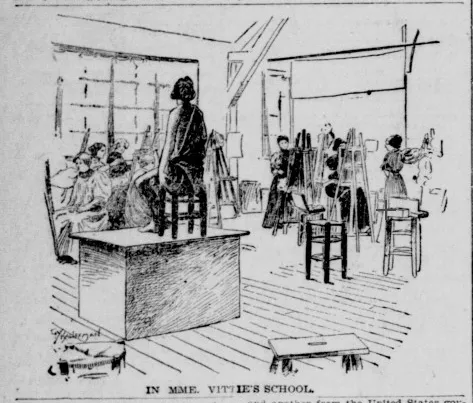
Buried in a January 13, 1895 Chicago Daily Tribune article about Whistler's criticism at the Académie Vitti is a short excerpt on the third annual AWAA exhibition. The author, known only by the initials E.F.P., describes the walls of the salle being "lined with fine specimens in oil, drawings, crayons, etc." Unsurprisingly, the highest praise is reserved for Elizabeth Nourse, who shows several works, most notably "The Morning Toilette." Another artist, Aline Szold, had pictures that were "much admired," but her career as an artist was tragically cut short when she died of typhoid malaria a few months after the exhibition. Pencil sketches by Alice Righter, Marie Gurnee, S.J. West (Sarah J. West), and "other Chicago girls" are praised, as is "a little gem" by Alice Randall depicting the interior of a chapel at Crécy-en-Brie. The article reports that many exhibited works were sold but Randall could not part with hers, as she considered it irreplaceable. She later exhibited that chapel interior in the 1895 Salon des Artistes Français.
1896
The 1896 exhibit, open until December 25, featured 74 paintings and 9 sculptures that were selected by the jury:
- Elizabeth Nourse
- Albert Herter, an American artist and textile manufacturer
- T. Alexander Harrison, an American marine painter based in France

1897
The December 20, 1897 issue of Le Matin covered the exhibition at of some 200 works of art. It listed Laura Bruce as that year's president of the American Woman's Art Association. The review is dismissive and rather critical:
"What can one say of the 200 artworks exhibited rue de Chevreuse? Some modest, banal and without character, are shown alongside others that seem to be interesting endeavors ... as for the art objects and sculptures, exhibited imperfectly, it's best not to mention them" (8, translated from the French).
Despite the reviewer's overall displeasure, several artists were singled out for recognition:
- Jessie Allen (her paintings of Venice were highly praised)
- Elizabeth Nourse
- Laura Bruce
- A. Dickson [probably Mary Estelle Dickson]
- Mary Franklin
- Hawley [Wilhelmina Hawley]
- Miss Wellington Reynolds (Mrs. Virginia Reynolds)
- Alice Beek Engley, (portraits)
A brief mention of the show was published on Feb 6, 1898 in the San Francisco Chronicle. It is not overflowing with praise for the overall quality of the art on display but, once again, highlights "two exquisite miniatures" by Mrs. Virginia Reynolds. She had been named an associate member of the Salon des Artistes Français in 1896 and had also received an honorable mention at the previous miniature exhibition held in New York.
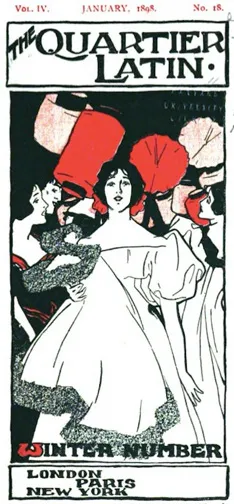
Following the tone of the review in Le Matin, the 1897 exhibition was also panned by a very harsh, misogynist critic named Storrs Lee in volume 2 of Quartier Latin:
"By following the old advice, 'Seek and ye shall find,' the exhibit may be made worthy a visit. Also, don't seek, and you'll stumble against. For the best piece in the exhibit is the poster without the door that advertises the Académie Vitti. It is composed of several feminine figures, well drawn and placed, and suggest very much the intellectual American girl abroad. The artist is Miss Gertrude Weil, of Philadelphia. Placing it outside the exhibition hall reminds one of the old American shoe-store trick of putting a very fine pair of shoes in the window, marked 'cheap,' to get customers to enter" (21).
Lee deigns to compliment the work of a few artists:
- W.H. Hawley, "Girl in Grey," "Study of a Boy's Head," and a landscape
- Elizabeth Taylor,"Whaling Station in North Iceland" and several landscapes and marines of Iceland and the Faroe Islands
- Gertrude Page (maybe Gertrude Partington), a full-length portrait of a young lady
- J. Hammond (Jane Nye Hammond), a well-modeled portrait bust
- H. Strafer (Harriette Strafer)
- M.H. Halliday (Mary Hughitt Halliday)
- Mary Richardson
- Mary Dunlap
Tragically, Gertrude Weil, thought to have so much talent and promise, drowned herself in the Seine a few months after this exhibition. Her suicide sent shock waves through the artistic community in Paris and was widely reported in the American press during the summer of 1897.
1898
Quartier Latin was a short-lived journal published from 1896-1899 by the male counterpart of the AWAA, the American Art Association of Paris (AAAP). Volume 4 of Quartier Latin includes a detailed (and positive) review of the AWAA's "Third Annual Sketch Exhibition." The exhibit opened on December 11, 1898 and, according to the reviewer, "the Association may congratulate themselves on having scored a distinct success." The reviewer also comments on the large crowds who turned out to view the exhibition: "Not only were the walls of the exhibition room generously covered with pictures, but the hat and cloak room downstairs was also crowded with works of art, which necessarily forced each visitor to be his own vestiaire. For this trifling inconvenience, however, he was more than compensated by the merit and excellence of the pictures that caused it" (651)
Of particular note is the reviewer's praise for a painting by Elizabeth Nourse, "Les Terrasses de Tunis," which is described as "conspicuous by reason of its absolute correctness in minutiae and architectural detail, combined with decorative charm and artistic feeling. Refreshing it is indeed, in these days of smudging, to behold so successful a relapse into old time methods- so frank and honest a use of art materials" (652)
Other artists given favorable reviews were:
- Alice Mumford, portait of a young girl
- Wilhelmina Hawley, seven watercolors
- Alice Engley, watercolors
- E. Norcross (Eleanor Norcross), "Interior"
- Mrs. C. Briggs, black and white "Study of a Head"
- Ellen Emmett, double-view portrait
- Mrs. A. DeForest Parsons, studies of Dutch peasants
- Mrs. Virginia Reynolds, miniatures
- Maria Champney, miniature portrait
1899
The judges of the sixth annual exhibition included artists:
Arsene Alexandre published a short review in Le Figaro (December 11, 1899 singling out a few artists by name and concluding that there was "beaucoup de talent".
- R. Deming (probably Mabel Reed Deming Hobart)
- Newman (Willie Betty Newmann)
- Lee-Robbins (Lucy Lee-Robbins)
- Nourse
- E. Burton (perhaps Elizabeth Eaton Burton)
- E-M. Crawford (Esther Mabel Crawford)
Katharine De Forest offered an extensive review of the 1899 exhibition for Harper's Bazaar on January 13, 1900. De Forest describes the show as a "thoroughly delightful collection of pictures" and praises the AWAA's leadership: president Elizabeth Nourse, vice presidents Katharine Gilbert Abbot and Katharine Adams Smith, and secretary/treasurer Charlotte Van Buskirk.
She lists the following exhibitors:
- Mrs. Mac Monnies, painting
- Mrs. Lee Robbins, painting, study of a child in white pastels
- Miss Enid Yandell, pewter tankard sculpture and portrait bust of Miss Baker the "Massière" of Whistler's studio
- Miss Ana Dunlop, china frame
- Miss Katharine Steele, china frame
- Miss Grace Gassette, still life, a yellow blur of chrysanthemums against a background of Japanese blue
- Miss Susan Watkins, "Eugénie," "La Communiante" (had an honorable mention at last year's Salon)
- Miss Sheldon Stone, of Philadelphia, "A Sketch," "A Study"
- Mrs. Antoinette de F. Parsons, "A Young Volendamer"
- Miss Elizabeth Strong, "Cochon d'Inde," "Le Guignol" (12 inches high) that Luckemeyer bought for the Club
- Miss Mary S. Green, of New York, "Waiting"
- Miss Deming, "A Dark Day"
- Miss Crawford of Kentucky, student of Whistler's, "Un Petit Anglais"
- Miss Newman of New York, "The Frugal Meal," "Saying her Beads"
- Mrs. Caroline Houston, "Portrait of Mlle Y.C. a miniature
1900
1901
The Association was assisted by several women artists who were permanent residents in Paris. [who? what is the source?]
1902
Mary Fairchild MacMonnies Low, painter and president of the Association, coordinated the annual exhibition. The judges were H.S. Bisbing (painter and engraver), S. Seymour Thomas (also a painter and engraver), and Henry Ossawa Tanner (renowned African American artist in 19th-century Paris). The show included 200 paintings, as well as pastel drawings, watercolors, and miniatures, all the work of American women.
Among those who exhibited were:
- Inez Eleanor Bate Addams, pupil of Whistler
- Della Garretson (1859-1940), Michigan-born painter who won a medal at the 1902 Paris Salon of the Societe des artistes francais.
- Elizabeth Kruseman Van Elten-Duprez (1876-1934) showed a painting of peasants
- Kathleen (1851-1913) and Eleanor Greatorex (1854- 97), sisters, both exhibited figure studies
- Meta Vaux Warrick Fuller (1877-1968), Philadelphia-born African American artist exhibited "a somewhat Rodinesque sculpture" *source of this quote
- Blanche Dillaye (1851- 1931), painter-etcher trained at the Pennsylvania Academy of the Fine Arts, contributed a watercolor.
1904
A jury of American painters Walter Gay, John Humphreys Johnston, and Edward Simmons selected 93 works for the annual exhibition:
A review was published in The New York Times on March 6, 1904: "This year's exhibition was opened a couple of days ago in the Rue de Chevreuse, and is generally admitted to be an improvement on its predecessors. It contains, of course, examples of that pathetic striving after the unattainable which has ended in irremediable failure, but so do most picture galleries" (4).
Mercifully, the reviewer does not name those artists whose work he considers pathetic, but he does praise works by:
- Mrs. MacMonnies, "The Doll's Tea Party," a painting of her two children on the terrace of the family's home in Giverny
- Miss Hall, the secretary of the Club, group of trees in a desolate landscape
- Mrs. Behanna, group of heads
- Elizabeth Nourse, a deserted church in Brittany
- Miss Van Helten, Vice president of the exhibit, "Un petit déjeuner au jardin"
- Anna Hope Hudson, "Scene in New Jersey"
- Mrs Robinson, sculpture
- Mrs [Mabel] Conkling, sculpture
- [Ella] Hergesheimer, miniature
The exhibit also include submissions by: Frances Quarle Thomason and Alice Schille (1869-1955).
1904
"Paris Art News," New York Times, March 6, 1904
- Elizabeth F. Kruseman Van Elten
- Minerva J. Chapman (1858-1947)
- Mabel Viola Harris Conkling (1871-1966)
- Ella Hergesheimer (1873-1943)
- Harriet Sophia Phillips (1849-1928)
- Marion Powers (d. 1962)
- Alice Blair Ring (1869-1947)
1908
A brief mention of the annual exhibition by Arsene Alexandre appeared in Le Figaro on Feb. 17, 1908. Again, he lists those artists whom he deems most successful in their efforts:
- Mme. Rice (Anne-Estelle Rice)
- Mme. Cronnan
- Mme. Critcher (Catherine Carter Critcher)
- Mme. Hunt (Maud Hunt Squire)
- Mme. Nourse (Elizabeth Nourse)
- Mme. Johansen (probably Myrtle Jean McLane)
- Mme. Richardson (Anna M. Richardson, known for her landscapes)
- Mme. Mars (Ethel Mars, whose engravings are praised by Alexandre)
- Mme. Clements
1909
One of the semi-annual exhibitions was reviewed in The Advance by Miss Kilbourne Cowles. Cowles cites two artists:
- Miss Martha Baker of Chicago, who was widely praised for her miniatures
- Miss Clara Kretzinger, also of Chicago, who received an award from the French government for her 1908 Salon entry. (The Advance, April 1, 1909)
1910
Robert Bacon, American ambassador to France, presided over the 1910 exhibition opening. The judges included Walter Gay and two French artists.
The artists featured in the show included ( see also "Show Women Artists' Work," New York Times, February 13, 1910; and "Ameri- can Women Exhibit in Paris," New York Times, February 20, 1910):
- Marguerite Thompson (later Zorach) (1887-1968)
- Anne Estelle Rice (1879-1959)
- Kathleen McEnery (later Cunningham) (1885-1971),
- Constance Bigelow (Williston) (b. 1873) and
- Cornelia Cowles (Vetter) (1881-1959)
- Wright and Elizabeth Edmond (1887-1918), sculptors
- Maud Squire (1873-1954) printmaker
- Ethel Mars (1876-1956), who recorded Paris scenes such as La coiffure (1908; P1. 19), contributed works on paper to the show.
- Amanda Austin (1856-1917)
- Grace Mott Johnson (1882-1967)
- Katherine Kimball (1866-1949)
- Emma Alice Parker Nordell (1876-1956)
- Adairene Vose Congdon (1865-1918)
- Emily Burling Waite (1887-1980)
- Catherine Watkins (1861-1947)
- Anne Estelle Rice (1877-1959)
The French press also covered the exhibition, with a small review published in La chronique des arts et de la curiosité on March 5, 1910. Alice McClure (incorrectly listed as Alice McClure) is praised for her paintings, including her use of color and her women's figures, as are Minerva J. Chapman for her miniature of a musician, a Mlle E-D. Pattle, for an Oriental miniature, and Alice Morgan Wright for a clay sculpture of a small group.
1911
The New York Times review of the exhibition published on Sunday, February 19, 1911 remarks on the trend toward Impressionism at the well-attended opening: "The newer impressionism runs riot at the annual exhibition of the American Women's Art Association, which opened to-night in the Rue de Chevreuse, with the usual grand reception, attended by the elite of the American colony." The reviewer also notes the increase in works of sculpture, acknowledging pieces by Alice Morgan Wright, Marion Lassey, and Elizabeth Edmond.
Artists mentioned by name were:
- Constance Bigelow Williston
- Ethel Mars
- Maud Hunt Squire
- Adairene Vose Congdon
- Nina Rosabel Hartwell (1861- 1917), a friend of Mary Cassatt
- Frances Lea, daughter of Anna W. Lea who lived in Paris from 1898-1907
- Florence Lucius (Davidson) (1887-1962),
- Emily Burling Waite (1887-1962)
- Catherine Watkins (1861- 1947)
- Fannie E. Duvall (1861- 1934)
- Florence Minard (1886-1985)
Another notice about the exhibition acknowledges AWAA president Anne Goldthwaite's two contributed works, complimenting her "good interior and a portrait" (New International Yearbook 552). It also praises a study of a young woman by Boston artist Mildred Copeland entitled "Vanity," as well as pieces by Alice McClure, Maude Murray, and Anna M. Richardson. An exhibition by the great Mary Cassatt was supposedly held at the Club in March 1911 which "received praise from the French critics" (New International Yearbook 552).

1912
According to the New York Tribune (December 15, 1912), the board of the AWAA included: Mrs. Reid (President); Mrs. Myron T. Herrick, wife of the American ambassador to France (vice-president); Mrs. Robert Blick; Mrs. Stanford White; Mrs. Edward Tuck; Mrs. Charles Laurence; Mrs. George Munroe; Mrs. Henry Ridgway; Mrs. Hamilton Russell; Mrs. Fitzhugh Whitehouse; and Mrs. Walter Gay (9). The 1912 exhibition included 200 works, of which eight were lent by the Luxembourg Museum (ibid.), including three portraits by John Singer Sargent (one of Mrs. Edward Boit, and another of his friend, Jacques Blanche), as well as three watercolors by Whistler. Other major artists, including Auguste Rodin, had also been invited to exhibit.
The show, curated by George Howland (ibid.), was favorably reviewed by The New York Times, which documented its popularity in the American colony: "the great success with which it is attended is striking proof of the activity of American students in Paris." (Special Cable to The New York Times, Dec. 15, 1912).
1913
American Art News (December 17, 1913, 5) covered that year's exhibition at 4 rue de Chevreuse, which was officially opened by Myron T. Herrick, the American ambassador to France, on December 5.
Winners of the competition, included:
- Jane Peterson: Received the 500FR Reid prize for her watercolor sketch, "Boats"
- Ada Gilmore: honorable mention for watercolors
- Maud Squire: honorable mention for pastels
- Bertha Houser: honorable mention for for drawings
- Edna Bois Hopkins: honorable mention for woodcuts
- Ethel Poyntell Canby: honorable mention for etchings
- Pamela Vinton-Strunz: honorable mention for miniatures
Three exhibitors were not in the competition:
- Florence Esté
- Anne Goldthwaite
- Elisabeths (sic!)
Exhibitors of watercolors, etchings, woodcuts
- Blondelle Malone
- Mrs. H. Amiard Oberteuffer
- Frances Rogers
- Louise Venable
- L. Hazlehurst Vintors (misspelling, correct name is Lillian Hazlehurst Vinton)
- Nell Coover
- Mathilde de Cordoba
- Ethel Wars (misspelling, correct name is Ethel Mars)
- Margaret Patterson
Exhibitors of miniatures
- Minerva Chapman
- Bertha Coolidge
- Theodora Larsk
- Katherine McIntire
- Jane Mumford
- Viola Steele
- Mary Lyttleton Wyatt
1914
The last two exhibitions held at the American Girls' Art Club were an exhibit of oil paintings in February and another of sculptures and decorative objects in March (American Art News, December 17, 1913, 5). Exhibitors included:
- Ada Gilmore (1882-1955)
- Blondelle Malone - An article in American Art News states that Malone exhibited more than 100 paintings and watercolors in Paris, representing her work over the past 2-3 years: "She has considerable sense of color, and her watercolors are particularly attractive. Among the paintings the snow scenes may be specially mentioned (January 21, 1914, 5).
- Alice Morgan Wright
- Frances Thomason
- Grace Hill Turnbull: In her autobiography Chips From My Chisel, Turnbull recalled the sculpture exhibit, in which her piece, Mother and Child, was the focal point: "I am undergoing a brief exposure to the limelight that makes my feeble eyes blink. Ambassador Herrick was asked to make the inaugural speech this afternoon at the Private View, and Matisse honored the occasion with his presence; and though from an excess of something or other I did not attend the vernissage, but worked in my studio instead, I took time off to look at the latter from the gallery - a quiet avuncular gentleman, conventionally dressed, not at all what you would expect from his paintings" (39).
- Gertrude Vanderbilt Whitney (1875-1942)
- Phebe Ropes (b. 1890), resident of the Club
- Jane Mumford, resident of the Club
As an aside, Blondelle Malone (4 scenes in gardens), Frances Thomason (20 Parisian scenes), and Edith Fry (7 watercolors) participated in a June exhibit hosted by Miss Blanche Stanley in her studio on rue Notre-Dame-des-Champs, with six other artists (American Art News, July 18, 1914).
Sources
De Forest, Katharine. "An Art Tea at the Paris Girls' Club" Harper's Bazaar, Jan 13, 1900, 33, 2, p. 33. American Periodicals