THE NEIGHBORHOOD
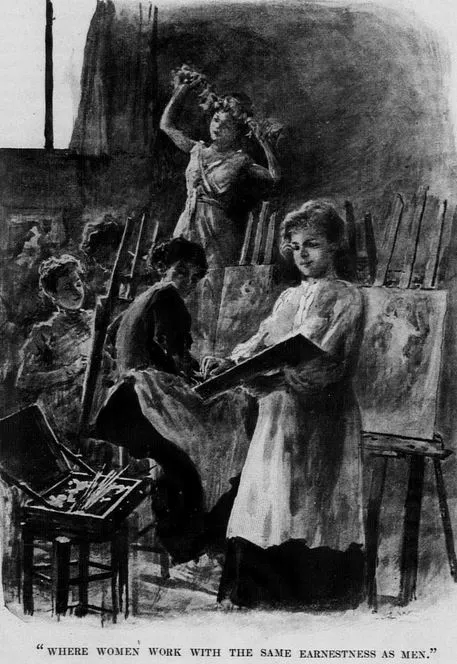
At the turn of the 20th century, large numbers of American artists, both men and women, were drawn to Paris, leading one scholar to even claim that “the most innovative work being done by Americans in the years from about 1907 through 1913 was created in Paris" (Virginia M. Mecklenburg, 2013, page).
The American Girls' Art Club gave its residents security and the comforts of home in what was the epicenter of the art world at that time - Montparnasse. As Butlin rightly described it: "The founding of this facility points to the apprehension North American families had for the welfare of their daughters studying abroad. American periodicals and newspapers expressed concern that, freed from family supervision, these young women would plunge into the bohemian art-student life" (39).
By the 1880s, artists from all over the globe were settling in the studios and apartments of the Montparnasse district. "Although foreign students came to Paris for other studies too (especially medicine [...], by far the largest number were students of fine art, for whom the French capital was routinely described as a Mecca. Its supremacy had emerged gradually during the century. One of the earliest attractions was the Louvre, with its collections of artworks, many of them the fruits of Napoleonic conquests. But Paris could also offer a uniquely dense concentration of artists, teachers and studios, and the long-established annual exhibitions, known as ‘Salons’, offered a pathway to recognition, as did the various ‘alternative’ Salons of the later years of the century" (Reynolds 57).
Private workshops and atelier-style schools were established to protest the official academic styles favored by traditional male-dominated institutions. There were no doctrines or clichés at these new schools, simply the goal of inspiring each participant. Budding artists worked with live models, male or female, and received indispensable technical and critical counsel from celebrated artists who also gave private lessons in their own ateliers. Most importantly, and especially for residents at 4 rue de Chevreuse, these art schools accepted women when others would not (the École des Beaux Arts only began admitting women circa 1897). "Invigorated by a sense of shared experience, by friendships and rivalries with fellow women students, they saw it as the means to achieve their own art practice as professionals on par with their male colleagues" (Butlin 51).
Art Academies

Photo of the Académie Colarossi CITATION INFO?
This private school originated on quai des Orfèvres in 1815. It was founded by M. Suisse, who sold it to a certain Cabressol, who then sold it to the famous Italian model and sculptor Filippo Colarossi. Colarossi moved the school to 10 rue de la Grande Chaumière (now a restaurant) in the 1870s. Many noted artists advised and critiqued Colarossi’s students. In 1902, one of the Club's residents, artist-in-training Geraldine Rowland, characterized the atmosphere at Colarossi:
"A large sign over the doorway indicates its presence, or it might be passed by so easily, so unpretentious is the exterior, and so dilapidated and shabby the rooms within. [...] Invariably, of both men and women, the sketch class presents a heterogeneous gathering. It is wholly unconventional. Those who come early make themselves comfortable in the best positions, while others who are late must be content with some vacant stool which affords and oblique and difficult view of the model. She usually comes in last of all. Finally the clock strikes, and she takes a position. [...] and then, for some twenty minutes, not a sound is heard except for the scratching of many crayons over the paper's surface. During the time four different poses are presented. [...] To this class there is no initiation fee, neither do masters come in to give criticisms. The obligation is paid by simply placing fifty centimes in the plate held by a white-smocked individual who stands near the entrance to the courtyard" (1902, 758-759).
Initially, Raphael Collin and Gustave Courtois, two Salon painters, taught figure drawing and painting, while the sculptor Jean Antoine Injalbert headed the sculpture studio. Geraldine Rowland enrolled in Collin's class as well as the class he taught in his garden at Fontenay-aux-Roses:
"It is Monsieur Collin who has a fondness for painting out-of-doors where the sunlight can find the opalescent tints of the flesh [...]. In his garden [...] there are many flowers, gay in spirit, rich in color; and also there is a secluded corner enclosed by a high wall which might well perplex even a Peeping Tom. Here, during the summer, M. Collin instructs a class. Usually, it boasts several American girls" (760).
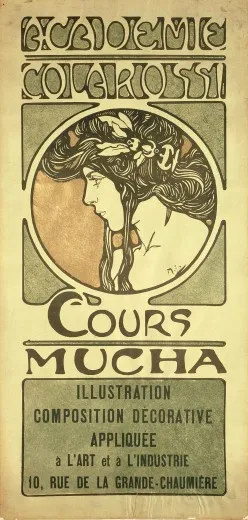
In 1900, Czech painter Alphonse Maria Mucha offered drawing classes, the "Cours Mucha," at Colarossi. Known for his Art Nouveau style, Mucha was also responsible for the storefront design of the legendary crèmerie, Chez Charlotte, at 13 rue de la Grande Chaumière (which has sadly disappeared). In 1910, Colarossi hired the New Zealand painter Frances Hodgkins to teach watercolor classes; she was the Academy's first female teacher, but only stayed one year (Gill, 1993, page).
Artists from many parts of the world attended classes or painted at Colarossi. The list of notable graduates is impressive and includes: Camille Claudel, Jeanne Hébuterne, Bessie MacNicol, Edvard Munch, Amedeo Modigliani, Henry Moore, and Janet Scudder. Colarossi's Bal d'hiver (Winter Ball) was one of the most joyous and raucous yearly events in Montparnasse.
The academy closed in the 1930s and Colarossi's wife supposedly burned the entire archives of the school in retaliation for her husband's philandering.
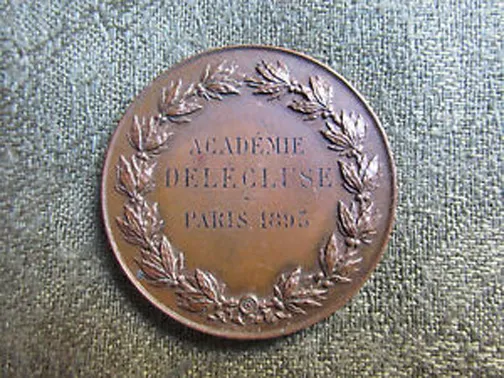
Académie Delécluse, medal won in 1893 by Miss Coddington in a drawing competition (Ebay, consulted March 31, 2020)
This art school was founded in the late-19th century by painter Auguste Joseph Delécluse (1855-1928). Regarded as one of the more reactionary and cutting-edge ateliers, it was especially popular among young American women students, particularly because more space was given to women than men. Canadian painter Florence Carlyle happened upon the first Delécluse studio in the basement of a building and decided to enroll: she preferred its relaxed atmosphere to the severe criticism of Bouguereau at the Académie Julian. Carlyle’s enthusiasm and that of her friends brought more students to the atelier, which enabled the academy to move to bigger quarters in the attic of a building (Butlin 44) at 84 rue Notre-Dame-des-Champs. Teachers included Georges Callot (1857-1903) and Paul Delance (1848-1924). Among the students were Harold Harvey and Simon Elwes.

Plaque of the Académie de la Grande Chaumière
Founded in 1904 by Swiss national Martha Stettler (1870–1946), this atelier still serves the needs of artists from all over the world with a spirit of total independence from the main artistic currents. Artists can enroll in classes or come when they wish to paint or draw from live models. A last remnant of the heyday of Montparnasse, this atelier, which measures 512 square meters, still bathes in the glow of its past, with wooden stools, easels, and drawing tables covered with paint. A scent of turpentine permeates the room:
"Today, the heating is electric, but that seems to be the only change. Atmospheric and inspirational, the light filters in from the large, north facing windows that extend along an entire wall" (Della Drees personal website).
Illustrious former teachers include Antoine Emile Bourdelle, Jacques Emile Blanche, Othon Friesz, Lucien Simon, Fernand Léger, André L'hote, and Ossip Zadkine. The list of students is equally impressive: Alexander Calder, Tamara de Lempicka, Alberto Giacometti, Isabel Rawsthorne, Amedeo Modigliani, Serge Poliakoff, Nano Reid, Balthus, Joan Miró, and many others.
Angela Gregory, a sculptor resident at 4 rue de Chevreuse in 1927, described the atmosphere of the Académie in her memoir, A Dream and a Chisel:
"The Grande Chaumière was totally different from any art school I had ever attended. At Newcomb and Parsons you had to be there at a certain hour to paint or at a certain hour to sketch and the instructor was always there to direct you. At the Chaumière, however, nobody leaned over your shoulder. You went whenever you wished, knowing that during certain hours there would be a model posing. In the beginning, I was a bit lost in such an unstructured environment. I mostly learned by myself or by watching the other students. Nobody came over and said, “You should do it this way or that way.” [...] The Académie de la Grande Chaumière had been created so that young artists who could not afford a studio of their own could come work and receive an occasional critique from an established artist such as Bourdelle. The creative atmosphere was thrilling and intense. If the model was posing you never heard a sound. No one was chattering away or making jokes. Everyone was very serious. There was a monitor, Madame Lavrillier,11 who helped to keep things organized and who made sure there were enough stands for modeling, enough clay, and that the model was there to pose" (Gregory 68).
In 1957, the school was taken over by the Charpentier family, who maintained its mission and ethos. Upon the death of the last owner in 2018, the atelier’s building was turned over to several associations who have tragically contemplated selling various parts of it. Since the building is not protected as an historic monument, its integrity and its future are currently in jeopardy (2020).
Atelier Passage des Panoramas, Académie Julian, Cosmopolitan, April 1890, p. 750
In 1868, Rodolphe Julian decided to transform his own studio in the Passage des Panoramas to accommodate at least 50 other artists. He conceived this studio as an “école libre,” where anyone could paint from a live model. He opened without a single student, yet, every day, he had a model (often Italian) pose before empty easels and seats. This lasted for about 4 months until someone walked in by chance and stayed. Eventually, word of mouth increased the number of participants, but the first four years of his experiment were difficult (cf. Debans 1889, 185-212).
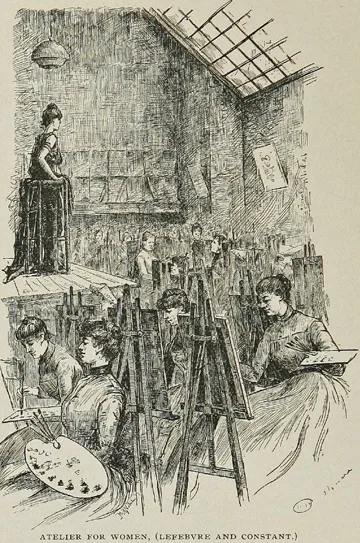
Julian then decided to welcome the growing number of women artists in Paris into his studio, where, initially, artists evaluated each other’s work in an atmosphere of emulation and camaraderie. Eventually, he invited “masters” to critique the artists as they worked. William-Adolphe Bouguereau, Gustave Boulanger, Tony Robert-Fleury, Jules Joseph Lefebvre, Henri Chapu (for sculpture), and Jean-Joseph Benjamin-Constant were among the regulars. The Académie Julian became so popular that he opened another studio on Faubourg Saint-Denis for men, while the Passage became a studio exclusively for women. He also opened another studio for women at 5 rue de Berry (8th arr.). Each studio benefited from the same masters who would make their rounds. In 1895, Julian married Amélie Beaury Saurel, a well-respected portraitist born in Spain, and named her director of the Passage studio.
According to Riccardo Nobili: "The atelier for women is truly a fortress of the Amazons. No soul of the other sex is allowed to pass the portal, save Monsieur Julian, the masters, the models and the dealers in colors. Even the fathers and brothers who accompany the ladies to the door, are compelled to leave them" (Cosmopolitan, 1890, 751). In the Passage and Berry studios, the models were always women.
Debans described the layout of the women's studio: the posing table was set in the middle, with students seated all around. Each Monday, places were available on a first-come-first-served basis and each woman kept her place for the rest of the week (196). Nobili described the manner of selecting models: "The candidate disrobes and mounts the pedestal, taking many different positions. The 'massier' (a student at the head of the school), takes a vote of the pupils amid a noise and confusion that is indescribable. If the majority approve, the model is employed" (748), and usually remained for eight hours. Each hour, the artists would work for 45 minutes and then take 15-minute break.
Twice a week, the masters would evaluate each student’s work. “The days on which they appear are great days. All these ladies, completely filled with emotion, follow them from easel to easel, drink, so to speak, their reflections and advice, and sometimes push self-defiance to the point of stenographing their words” (Debans 197-198). When the master had finished his rounds, he would be surrounded by women holding canvases they hoped to exhibit at the Salon (Debans 199). In her Memoirs of an Artist, published in 1940, American painter Anna Elisabeth Klumpke recalled her experiences at the school during her year of study, 1883-1884:
"Monsieur Tony Robert-Fleury was the director of the class. He came early in the morning - never later than half past eight on Friday and Saturday. There were no formal introductions. He inquired where one had studied. His corrections to each student were very brief, especially if the work seemed to him of little interest. His corrections were given in a loud voice as if for the benefit of all as well as the individual to whose work they applied. He went from easel to easel seeming to take in at a glance the measurable ability of each worker and our awe of him... was manifested by the intense silence as he went his rounds..." (16).
Among the masters, Bouguereau was preferred because he mixed critique with encouraging words, and he regularly invited several students into his own atelier on rue Notre-Dame-des-Champs. Robert-Fleury was the least severe; he spoke simply and kindly. Lefebvre, on the other, hand was the coldest of the three, but everyone believed he spoke the truth about their work; they also appreciated his ability to remember the names and works of each student (200).
Over time, Julian opened two other branches at 28 Boulevard St-Jacques (6th arr.) and 31 Rue du Dragon (6th arr.). He also inaugurated monthly competitions among the different studios, with medals and a small prize of 100 Fr (Debans, 201). His masters and students often served as jurors at the various Salons. Controversies arose around the impartiality of these jurors, who were said to favor artists from this school: "professors and some students supported each other in the elections to the Salon jury and in the distribution of prizes" (Greer 1994, 52).
Over the years, the Académie Julian attracted an extraordinary array of students and teachers, both French and foreigners, who would enjoy successful careers. Pierre Bonnard and Edouard Vuillard were students, as were Boris Anrep, Jean Arp, Cecilia Beaux, Thomas Hart Benton, Maurice Denis, Jean Dubuffet, Marcel Duchamp, Anthony Gross, Childe Hassam, Fernand Léger, Jacques Lipchitz, Henri Matisse, John Singer Sargent, James Wilson Morrice, Robert Rauschenberg, Diego Rivera, Jacques Villon, Grant Wood, and so many others. An alphabetical list of artists, both student and masters, can be found here.
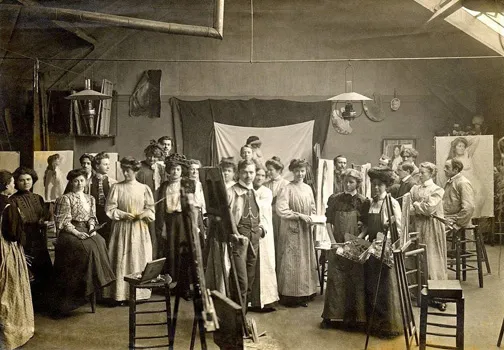
Female Students at the Académie Vitti, ca 1905 Wikimedia Commons
Located at 49 boulevard du Montparnasse, this academy was among the first to accept female students. It was founded in 1889 by Cesare Vitti, his wife Maria Caira (who spoke English), and her sisters. They had left Italy to become professional models and painters in Paris. The family returned to Italy at the outbreak of World War I and the school closed its doors in 1914. In 2013, Vitti's grandson inaugurated a museum in Atina commemorating the school's activities and affiliated artists. Paul Gauguin, Luc Olivier Merson, Frederick MacMonnies, and Kees Van Dongen, among many others, taught at there.
The Académie also served as a social hub for students in the Latin Quarter. Marguerite Thompson Zorach detailed the vibrant atmosphere at its Sunday services:
"Sunday nights you go to church in the famous Vitti studio. The entrance is through a narrow, gloomy passage marked by an electric sign"garage" in red letters. When you are beginning to wonder what sort of place you have gotten into and how you are ever going to find your way out, a group of students who have come in behind, open a mysterious door to the left and you follow them through queer winding passages where a smelly little lamp coaxes you up one more flight of narrow stairs into the sawdust strewn entrance to the Vitti, itself, as are most of the great studios of Paris, it is a great barn-like place, an atelier in the true meaning of the word. The walls are gray with daubs paint and crowds of Adams and Eves, masterpieces left behind by the generous students, but with a few exceptions carefully turned to the lest they distract the mind of the congregation. These Sunday meetings at the Vitti are very popular. Rain or shine, all the English-speaking student world is there, perched upon all sizes of drawing stools from the tiny ones used for the front row in the portrait class to the tall ones for the latecomers in the evening croquis (sketch class). It is certainly a unique service, given from the model stand; sometimes when the speaker becomes excited, you wonder what would happen if he stepped beyond his little circle into space. On one side of him stands a plaster cast of one of Sir Joshua Reynolds' little angel heads; on the other, the monstrous head of a horse, his teeth bared viciously and his upper lip missing; below, rows of palettes and paint aprons remind one of the ambitious students who struggle here all week. Marie Antoinette, the pretty little black-eyed daughter of the janitor distributes the books and you sing the old familiar hymns you have known since you sat in the infant class of the Sunday school in America . But that is not all, there is also a program furnished by some two of the celebrities of Paris. It may be the leading violinist of the Grand Opéra or one of the promising young students who has just "arrived” in her particular line. Everyone is most kind in giving his services and his best efforts are always rewarded by a burst of applause usually swelling into a persistent encore. You quite forget for a that it is a religious service, but are brought back when the minister ascends the model stand for his address. After the closing prayer, you hurry home, but too late, the door is locked and you have to hammer violently until the concierge pulls the cord to let you in" (Burk 93).
Artist Haunts, Studios, Models
Many watering holes in Montparnasse became intellectual hubs for artists, models, and literati. They were regulars at one or several eateries, often trading their work for meals. Famous among these hotspots were the Closerie des Lilas, Le Dome, and La Rotonde, whose walls today harken back to that Belle époque. By 1919, some of the cafés were staging their own exhibitions, and "there was quite a colony of artists whose life centered around the Café de la Rotonde, then the only drinking place of importance in the neighborhood" (Morrill Cody, date 13). As Georges Viaud, historian of La Coupole, exclaimed: "if their tables could speak, they would tell the role of (these places) in the history of art of the twentieth century."
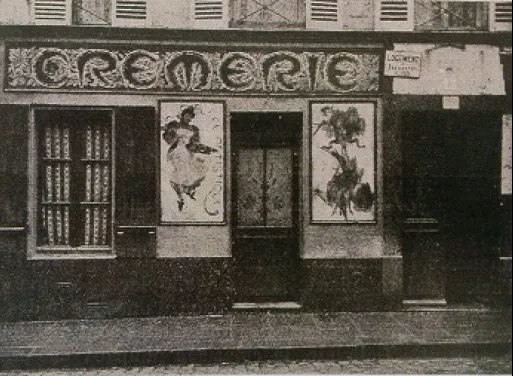
In the 1890s and early 1900s, an impressive group of artists gathered at the crèmerie known as Chez Charlotte, a small restaurant and hostel on rue de la Grande Chaumière. It was a regular beehive of creative encounters, where artistic relations and networks were formed. Regulars at Chez Charlotte included: Mucha, Gauguin, Strindberg, Paquo Diurio, Wladyslaw Slewinski, and Munch.
"La minuscule crémerie était un lieu hors du commun. Elle comprenait une salle pouvant recevoir tout au plus dix convives et une cuisine, souvent encombrée d’hôtes, qui donnait accès à une petite cour où se trouvaient les toilettes. Madame Charlotte habitait avec son fils dans un petit appartement au-dessus du restaurant et louait les autres chambres, le plus souvent à des artistes impécunieux auxquels elle servait également les repas. Aussi la crémerie était-elle tapissée d’œuvres offertes à celle qui se faisait appeler « la mère des artistes » en règlement de dettes, ou qu’elle avait achetées pour venir en aide à ses pensionnaires" (Gutman-Hanhivaara, 2008).
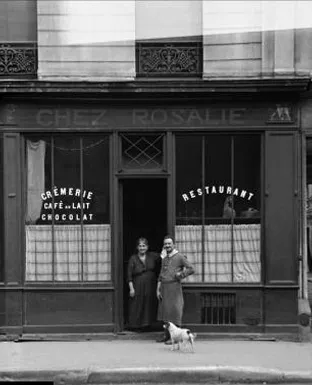
Chez Rosalie was established in 1906 at 3 rue Campagne-Première by Bouguereau's former model, Rosalia Tobia, born in Ciociaria, Italy. She invested in a small crèmerie, transforming it into a restaurant that would welcome artists, especially those in need, through 1926. Many exchanged a painting or drawing for nourishment in this tiny, convivial place with four tables and excellent Italian food and wine. Among the regulars were Modigliani (who painted her portrait), Utrillo (who painted a fresco with Modigliani on the restaurant wall), Edvard Diriks, and the poets Fort and Salmon.
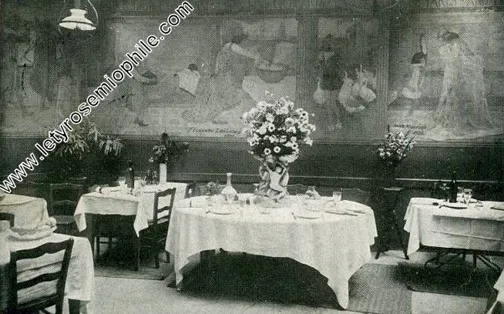
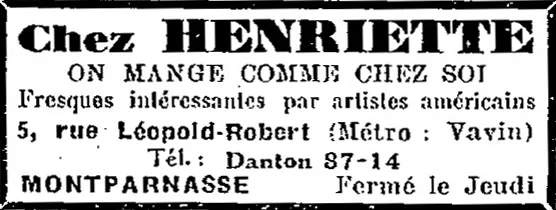
Chez Henriette's interior was decorated by two artist residents at the Girl's Club in 1899. The best description of this favorite gathering place for art students at the turn of the century (5 rue Léopold Robert), is provided by Katharine de Forest's 1900 article on student life in Paris:
"There is no more typical spot in Paris than [...] Henriette’s. It is an ordinary creamery at first glance, and a particularly tiny one at that. Half a dozen people would perhaps stand with difficulty before the little counter on which are displayed with French daintiness the eggs, fresh pats of butter, and fromage à la crème which, mixed with vivid color in tomatoes and strawberries, the Parisian knows how to make so extraordinarily decorative. The walls are covered with Cheret posters, among which glare out here and there with astonishing incongruity the English words of some American bill […]
At one end of the little room is a door. It leads to a rambling passage hung with sketches in color and pen and ink, with a suggestive rack of numbered pigeon-holes, each containing a napkin in a ring, and then at the end the full splendor of the Restaurant Henriette suddenly bursts upon you.
The place is light, airy, French. Upon each of the little tables there are flowers. But what makes the place celebrated is the really beautiful frescoes on the walls, done by two American girls, Miss Florence Lundborg of San Francisco, and Miss Alice Mumford of Philadephia. They represent the ancient but ever fascinating history of the Queen of Tarts, and nothing of the kind could be more distinguished and charming in both conception and execution than this procession of scenes over which hangs the quaint old rhyme. Go to Henriette’s, in the rue Leopold Robert, almost directly opposite the street in which is the Girls’ Club, and you will at once see the best of American Latin Quarter bohemia" (630-631).
In the same article de Forest also lists the daily menu:
"As for food, here is the scale of prices on a daily menu picked up this week at the famous Henriette’s: cutlet, 50 centimes (10 cents); beefsteak, 50 centimes; rabbit, 50; mackerel, 50; Fried potatoes, 20; salad (price not given, probably 20); fromage à la crème (cream cheese), 25; rice pudding, 25; strawberries, 25; prunes, 25; coffee, 25" (630).
In 2020, it is the site of an Italian restaurant, "Il Barone," and the fresques are no longer visible though the layout of the place is the same and the photo above is proudly displayed for incoming guests.

An astonishing array of painters, sculptors, and writers lived or had ateliers in Montparnasse: Cézanne (5 rue de Chevreuse), Gauguin (8 rue de la Grande Chaumière, 1893-1894), Mucha (13 rue de la Grande Chaumière, circa 1887-1893, then 8 rue de la Grande Chaumière until 1896), Sargent (73 rue Notre-Dame-des-Champs), Gertrude Stein (27 rue de Fleurus), Strindberg (12 rue de la Grande Chaumière). Gauguin and Mucha once shared a studio at 8 rue de la Grande Chaumière (1893-1895) where:
"Mucha rigged the studio so that when the door opened beautiful music played. An interviewer in 1900 called the studio, 'simply marvelous.' It was full of exotic objects and bohemian writers, artists, and musicians who came to work and play. An infamous photograph of Gauguin playing the Harmonium with no trousers on, captures the playful and free-spirited mood of their studio"
According to the Calepins du cadastre (AD75, D1P4), more than twenty artists’ studios were located on rue Notre-Dame-des-Champs between 1876 and 1900. If one considers just the studios with large glass windows, there was: no. 73 (Laurens); no. 75 (Bouguereau;) no. 86 (four studios, including Whistler's). Numbers 105, 111, 115, 117, 118 and 119 on the street also housed artists.
Like the Rue de la Grande Chaumière, rue Campagne-Première was filled with artist studios and residences: James Whistler (1858), the animal sculptor Pompon, designer Naudin, photographer, Atget, and painters Modigliani, Foujita, Aragon, and Triolet. In the 1920s, the Hotel Istria (29 rue Campagne-Première) welcomed such painters as Picabia, Duchamp, and Kisling, the American photographer Man Ray, legendary model Kiki, composer Eric Satie, and poets Rilke, Tzara, and Maïakovski.
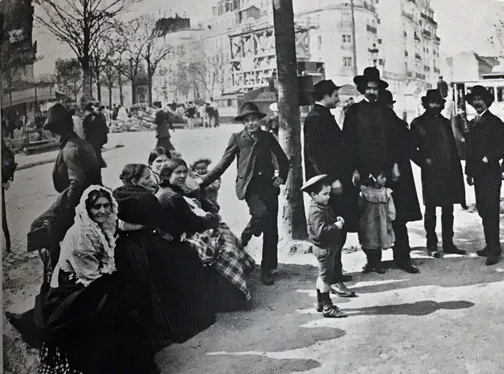
The models market on the corner of rue de la Grande Chaumière and the Bd. du Montparnasse, anonymous (Renault, 2018, 97).
One of the characteristic sights of the neighborhood was the Marché aux modèles, held every Monday at the Vavin crossroads, on the corner of the rue de la Grande Chaumière. Here, a motley crew of mainly Italian men, women, and children showcased themselves (Fuss-Amoré 208). According to Crombie (1998), "The supply of candidates offering themselves for public scrutiny and hire was in fact so plentiful as to line both sidewalks, thronging all the doorways" (47). The sculptor Janet Scudder recalled how easy it was to find a model in Montparnasse in the late 1890s:
"All I had to do, when I wanted a model, was to sit at the window and look over those who came by the dozens. They were in great part Italian, though there was practically every nation under the sun represented. I have always been glad that I got to know some of them so well, for many of them contradicted all the absurd ideas that the public in general have about models being fantastic creatures without any morals or education" (Modeling My Life 168).
Scudder even described the crowds of children who encircled her when walked toward the Académie where she was studying:
"I used to stop often in the street before Collarossi's [sic] Academy and found myself surrounded by fifty or more little children, ranging from one year up, who immediately set up a howl to be employed as models. They had been trained from the moment they could stand on their feet for a profession that helped out the family fortunes. I often gave them pennies and looked at them longingly; in spite of their poverty and their fantastic rags, they had all the gaiety and fun and joy of living that I was growing more and more keen about reproducing. These little tots knew they appealed to me and when they found out where I lived came in hordes to my door and had great fun with the bell [...] (Modeling My Life 170).
During her brief stay on rue de la Grande Chaumière in 1910, the young American sculptress Malvina Hoffman was also greatly struck by the long lines of models 'of all colours and nationalities' (Crombie 47).
Grace Hill Turnbull, resident at the Girls' Art Club, recalled an Italian model who posed for her at the Club in February 1914:
"I am very happy in my studio here: and Italian models are easily obtainable. The model I have at present has three children to support and a drunken husband [...]. The infant she brings to pose, however, is as unburdened with care as any other young animal: when its mother calls it and says "Ne veux-tu pas travailler maintenant?" it shakes its head decisively and say "Pas." In other words it won't. It prefers to prowl into every nook and corner of the studio, investigate every roll of canvas, pull every string, upset every flower pot, open every door, tear every paper [...] and, finally, after manifesting every form of activity possible to a being of fourteen months, sinks panting to rest on its mother's breast [...] a dirty little bundle of still life [...]" (Chips 38-39).
When the holiday season arrived each year in December and January, American artists made sure to share the festivities with their models. The Pall Mall Magazine reported in January 1912:
"The artists themselves look after the models who pose for them, and help with the best of good will in organising Christmas-trees for the strange mixture of nationalities which makes a little world in itself, and earns its daily bread by being sketched and painted in every possible and impossible pose and costume. Whole families of Italians live this way, and sometimes hear of the profession having been followed for three and four generations, until it has grown into a family heritage. To them, a New Year's fete is a material benefit, and they go away from it loaded with good cheer and a few useful presents to help them through the winter" (79).
Much to the relief of the shop-owners, whose windows and stalls were hidden by the veritable horde of models, World War I brought an end to this market as the Italians were either sent back home or to the front.
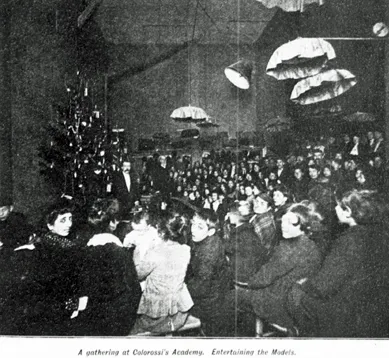
New Year's celebration for Italian models at Colarossi (Pall Mall Magazine, January 1912, volume 49, no. 225, 79)
Sources
Butlin, Susan. The Practice of Her Profession: Florence Carlyle, Canadian Painter in the Age of Impressionism. McGill-Queen's Press - MQUP, 2009, 309 pp.
Burk, Efram L., ed. Clever Fresno Girl: The Travel Writings of Marguerite Thompson Zorach (1908 - 1915). University of Delaware Press, 2008, pp. 89-94.
Cody, Morril
Debans, Camille, Les plaisirs et les curiosités de Paris: Guide humoristique et pratique, 1889.
De Forest, Katharine. "Art Student Life in Paris. Harper's Bazaar, July 7, 1900; 33, 27; ProQuest. p. 628
Gregory, Angela and Nancy L. Penrose. A Dream and a Chisel: Louisiana Sculptor Angela Gregory in Paris, 1925-1928. University of South Carolina Press, 2019, 240 pp.
La semaine à Paris
http://www.letyrosemiophile.com/departements/VilledeParis.htm - website identifying the creamery, Chez Henriette.
Reynolds, Sian. Paris-Edinburgh : Cultural Connections in the Belle Epoque. Routledge, 2007.
Rowland, Geraldine. "The Study of Art in Paris: illustrated by H. W. Faulkner." Harper's Bazaar, September, 1902 36, 9, pp. 756-761. American Periodicals.
Weisberg, Gabriel P. and Jane R. Becker. Overcoming All Obstacles: the Women of the Académie Julian. Dahesh Museum and Rutgers University Press, 1999.