The End of An Era
During WWI, St. Luke's was transformed into a ward for convalescing soldiers. On June 1, 1919, the bishop in charge Rt. Rev. J.N. McCormick reopened St. Luke's, and the chapel went right back to ministering to the spiritual needs of the American community in Montparnasse, just as it had done for the two decades before the war.
Archival records reveal that the Chapel's board attempted to convince Mrs. Reid to build a second temporary structure as a clubhouse in the back garden but she refused, in part because she had spent a considerable amount of money restoring said garden after the war. Instead, the Chapel's board opened a clubhouse named The American Students' Club (later, the U.S. Students and Artists' Club) at nearby 107 Boulevard Raspail on Easter Monday, April 17, 1922. In 1926, the Board tried in earnest to purchase the property at 4 rue de Chevreuse in order to build a finer chapel and establish a larger clubhouse but Mrs. Reid had already made plans to transfer the property officially to the American University Women's Club board.
Even as St. Luke's was expanding its services to other locations in Montparnasse, the little Tin Church remained a beloved part of life at the University Women's Club. Hope Mirlees, resident at the Club from 1922-1925, wrote at length about the Chapel in her memoirs:
"A little tin chapel was another of the ornaments of the garden – a humble vassal of the great American Episcopalian Church at the Etoile. On the principle of suave mari, it was very pleasant to sit of a Sunday morning in the arm-chairs of our comfortable study and listen to the strains of the Te Deum and of the Church’s One Foundation, and, particularly, to the scrapings and shufflings of the congregation as they performed the exhausting gymnastics entailed by the ritual of the Anglican Church. We were fond of that little chapel. It was certainly far from decorative, but it seemed as friendly as the Judas tree, and as much a part of the garden; though, from its vocal powers it had, perhaps, more in common with the innumerable cats who regularly held their concerts there every night of the week. But strange rumours have reached us that the horn of the little chapel is to be exalted, and, from being but a humble denizen of the garden, it is to become the owner not only of the garden, but of the house, the hall, the endless bath-rooms – even, I suppose, of the complete works of Charlotte M. Yonge. It is like one of Pharaoh’s dreams – the tiny animal that swells and swells till it swallows the whole herd" (Hope Mirrlees, Collected Poems, 2011, 93).
By 1933, the financial situation at the University Women's Club became less stable in part because of the 1931 death of Mrs. Reid. Her daughter-in-law, Helen Rogers Reid asked that "St. Luke's Chapel pay taxes on their portion of the rue de Chevreuse/rue de la Grande Chaumière property, a request that had never been made before" (Allen 603). Apparently, the Chapel's finance committee found this request to be reasonable and paid 1,529.60 fr. in May 1934.
SEE LETTER FROM BEEKMAN ASKING TO STAY A BIT LONGER (1933 - Women's Club).
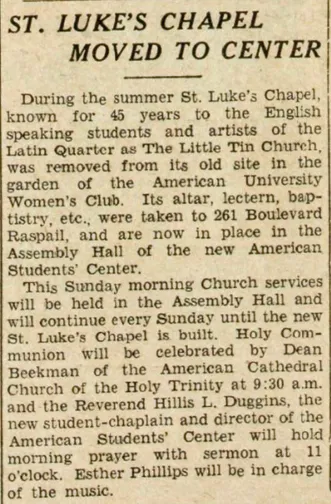
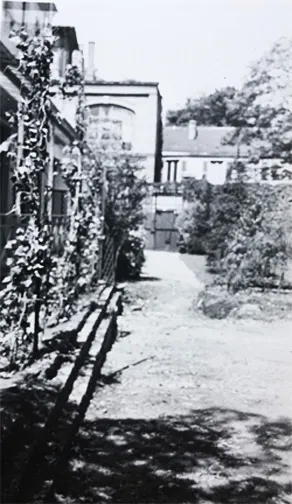
A few months later, the Little Tin Church was dismantled in October 1934. The baptistry, altar, and lectern along with other items had already been moved in the summer to 261 bd. Raspail, in the Assembly hall of the newly-built American Student Center (Chicago Tribune, October 6, 1934). The removal of the chapel's effects signaled to the community in no uncertain terms that St. Luke's was no longer welcome at 4 rue de Chevreuse, mostly because the corrugated iron structure was considered an eyesore in an otherwise Edenic garden setting. The Chapel's exodus was planned several months in advance, as evidenced in the correspondence between Dean Gildersleeve and Rev. Frederick W. Beekman:
“On Sunday, the 22, will be held the last service in the 'little tin chapel' and we were planning to remove the building and its appurtenances during the week following. Of course, we shall take care of the expenses. Canon Belshaw, who is much au courant with the details involved and who is to be in charge of the moving will be in contact with Miss Leet within the next day or two [...] While I am writing I want you to know of the deep appreciation of the Vestry, including myself, for the uniform courtesy accorded us at all times by Miss Leet and the officers of Reid Hall since the last named have been the proprietors. We send you all out [typo for our] best wishes for the continued success of your valuable center. Of course, Mrs. Reid’s memory will always be dear to us, as it was to our predecessors at the church and particularly to Dr. Morgan who, with Mrs. Reid entered into a real partnership for student work” (July 20, 1934 letter from Frederick W. Beekman of American Pro-Cathedral Church of the Holy Trinity to Gildersleeve, archives).