1947 - 1964
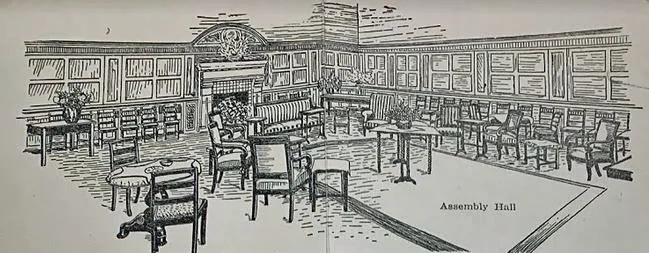
Reid Hall was returned to its American leadership on August 21, 1947 and resumed operations on September 1. Dorothy Flagg Leet was once again at the helm, this time as president. She was assisted by Sarah Dorothy Porter from 1950 to 1964. Virginia Gildersleeve, who retired from her deanship at Barnard in 1947, continued to serve as president of Reid Hall's Board of Directors, corresponding regularly with Leet and other Board members.
Reid Hall's founding mission remained unchanged:
- to enhance Franco-American cultural relations
- to bring together young Americans and their French counterparts
- to foster cross-cultural interactions
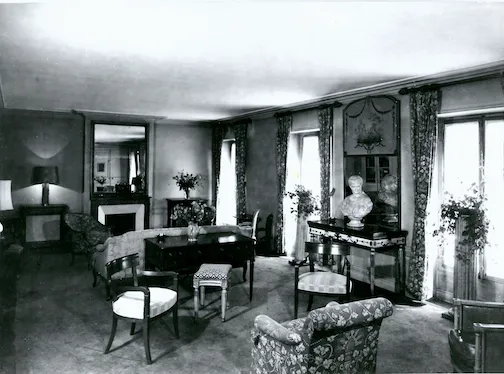
To that end, the Hall functioned as a residential facility for university women from all over the world, an educational center for a variety of American academic programs, the host of countless cultural and academic events, and the meeting place for the International Federation of University Women (IFUW). It was also the Paris headquarters of the American University Union, the American Association of University Women, and the French Federation of University Women.
Reid Hall Board members financially supported many initiatives, including funding scholarships, providing subsidies for redecorating salons and bedrooms, offering theatre tickets for cultural enrichment, and receiving students at their homes in New York and Paris for tea. Gifts from the Board and other benefactors were also used to upgrade the property and to sponsor cultural events. The Caroline Slade Memorial Fund was established in 1951 to endow a lecture series and refurbish the garden (plaque photo). The various academic programs on-site also contributed to social and cultural events.
RESIDENCE
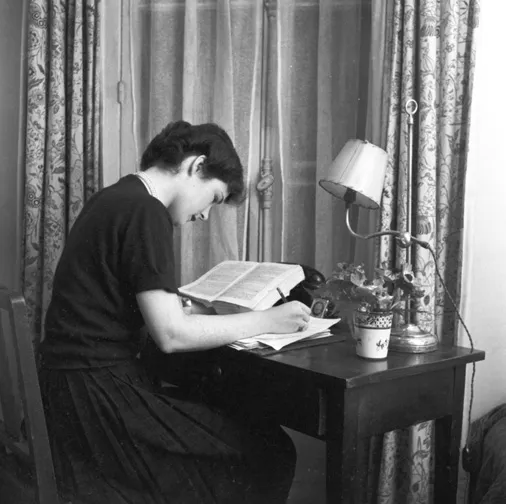
Reid Hall could accommodate 57 residents in this period. When it reopened in 1947, Leet touted the benefits of living at 4 rue de Chevreuse:
We try to protect them from the unpleasant and difficult side of life in a country that suffered through the war, by giving them sufficient food and adequate heat […] Tons of food, such as powdered milk and eggs, jam and canned butter, are now en route from America, Ms. Leet says, so that meals can be served with as little drain as possible on French food supplies. Carpeting and curtain materials are on their way too for refurbishing the building (New York Herald Tribune, July 15, 1947, page).
By 1948, Reid Hall had welcomed 49 students. The New York Herald Tribune published a story about life in postwar Paris, listing the commodities each student had brought with her: powdered eggs and milk, flour, cocoa, coffee, chocolate, cereals, macaroni, and vitamin-rich fruit crystals. With no power at the Hall on Fridays or before noon on Saturdays, Leet and her staff organized candlelight lectures or cinema excursions; hot water was only available two days per week and coal was also scarce. But the article also quoted Leet describing how the students were discovering "the richness of France-in a spiritual and intellectual sense” (January 25, 1948, page).
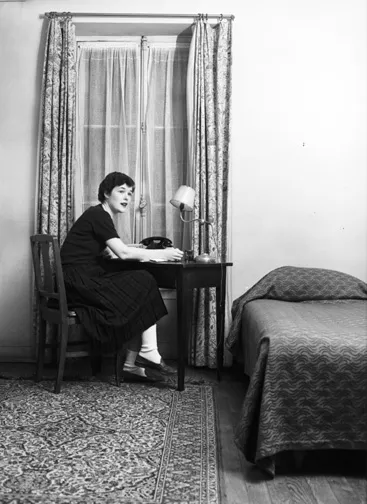
Reid Hall continued to serve as a residential facility well into the 1960s. Every year as many as 800 guests from all over the globe who needed temporary or long-term accommodations in Paris were welcomed at 4 rue de Chevreuse. In the early 1950s, new policies meant that male scholars and students could stay there but women remained the majority. In 1962, Dorothy Leet reported that over 15,000 university women had stayed at Reid Hall in the forty years since its 1922 opening as the University Women’s Club.
From 1947- 1963, a program designed to attract French university women and international scholars to Reid Hall offered two full residential scholarships (a room and three meals a day) as well as 8-10 food scholarships that covered all meals per year. Recipients were selected by the French Federation of University Women. According to Leet:
Through the generous contributions of some of our members, Dean Corwin, Miss Fogg, and others, we have been able to help undernourished French students, and to send others on needed vacations. This has been much appreciated by the French university women and the University of Paris (RH report, 1949-1950, Barnard Archives).
As academic programs continued to develop, another scholarship fund afforded budding French scholars the opportunity to study or teach at American colleges. In 1962, one recipient of the scholarship, Marianne Lagarde, went on to study at Columbia University. Her mother, a judge on the French Supreme Court, had won a Reid Hall residential scholarship in the 1930s which enabled her to study law.
Reid Hall became a haven for international students as well. Every year, a summer residential scholarship was awarded to a young British scholar. In the late 1950s, a yearlong scholarship for Hungarian university women was also offered.
In 1953, the Board of Directors established a dedicated fund to support students living at Reid Hall who were pursuing their musical education in Paris. Women from such colleges as Barnard, Bryn Mawr, Mount Holyoke, Oberlin, Radcliffe, Smith, Vassar, and Wellesley were awarded $1,000-$1,500 for one year’s study. In 1960-1961, an annual scholarship for art students (one per year) was also established.

AMERICAN EDUCATIONAL CENTER IN FRANCE
While the majority of students at Reid Hall were enrolled in university courses in Paris and were not necessarily affiliated with particular American institutions, several formal undergraduate and graduate study abroad programs did send cohorts of students to Paris for year-long or short-term summer opportunities. Their students and directors resided at Reid Hall or used the property for seminars and meetings. In an effort to grow the intensive summer programs, residential scholarships were granted to students and faculty (3 for Bryn Mawr in 1949; 1950, 1951, Yale 3 and UCLA 1; 2 for Yale in 1952). Three or four summer meal scholarships were also given to French women, ensuring that French would be spoken at mealtimes in the Reid Hall dining room.
Smith College began with 35 students in 1947 and the University of Delaware, which had maintained offices at Reid Hall from 1934-1936, asked to return in the late summer/early fall of 1947. In 1948 and 1949, Sweet Briar College sent 75 students to Paris, many of whom stayed at Reid Hall. Middlebury College created a graduate study group in 1948, and The University of Maryland graduate study program, comprising 20 men and women, met at Reid Hall for their seminars but resided elsewhere in Paris (NYHT, 1948). Hamilton began its own study program in 1957.
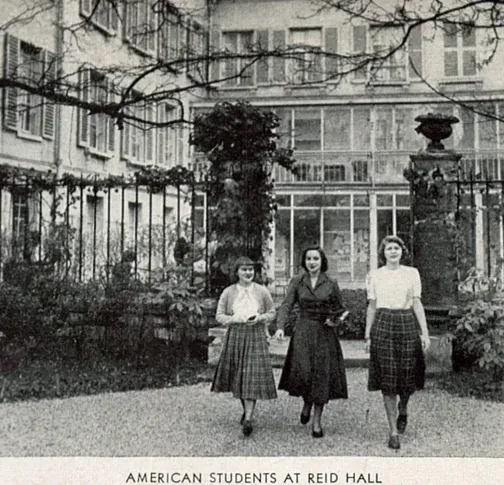
With the continued growth of study abroad programs at American universities, Reid Hall began to welcome more and more student residents and/or on-site program participants, either for the academic year or during summer sessions. As president of Reid Hall, Dorothy Leet also worked to develop its own academic offerings, including the Yale-Reid Hall Summer program (begun in 1950) and the highly successful Third Year in Paris (begun in 1951).
As the 1950s progressed, several American institutions continued to use Reid Hall as their headquarters, also utilizing its classrooms and conference rooms. Others relocated some of their students from the Hall to the apartments of Parisian host families. Some programs also suspended operations. In 1961-1962, Leet reported that 150 students were studying at Reid Hall. Smith, Hamilton, and Middlebury continued their operations at Reid Hall well into the 20th century, and were joined by other study programs for whom Reid Hall became an academic home away from home.
CULTURAL AND INTELLECTUAL HUB
Promoting French-American relations and educational exchange remained at the heart of Reid Hall’s activities. Reports by Dorothy Leet and Virginia Gildersleeve, meeting minutes, correspondence, and newspaper articles reveal that Reid Hall was a center for French-American interaction. Leet, who had been knighted by the French Legion of Honor, was made Officer in 1949 in recognition of her activities in "furthering international relations, through intellectual cooperation" (New York Herald Tribune, July 1950). She received her medal from Louis Joxe, Conseil d’État. Three hundred people attended the ceremony, including the new American ambassador to France, K.E. Brusse.
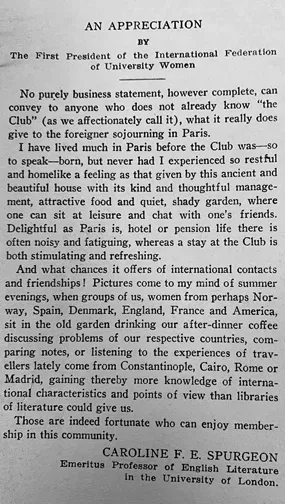
Leet was especially eager to foster connections between university women, believing that world peace could only be maintained through cross-cultural relations and understanding. She invited women scholars in a variety of disciplines from Latin America, Asia, Israel and the Middle East, and Africa to stay or speak at Reid Hall. She encouraged American women students to interact with the Hall’s international residents, in order to expose them to different cultures and ways of thought. There were organized concerts, exhibitions, conferences, and other events through which Americans could meet their French and international counterparts or come into contact with French academics and cultural organizations. The intellectual culture of Reid Hall remained very strong and was enhanced by other events sponsored by the various on-site study programs.
Clubs such as “Les 4 Vents” organized by the group “L’Accueil Familial des Jeunes Étrangers” enabled foreign students to interact with French families and offered courses at the Sorbonne in French civilization. The goal was to nudge Americans out of their bubble by placing them in au pair situations that would allow them to fully immerse in the French way of life.
A particularly celebrated annual event was the thé-dansant, a soirée meant to introduce the women of Reid Hall to students from various Parisian institutions, notably Polytechnique, Sciences Po, ESSEC, HEC. Valery Giscard d'Estaing, who would later serve as France’s youngest president between 1974 and 1981, attended an officers' ball at Reid Hall in the 1950s. He still recalled that festive occasion when he returned to Reid Hall in 2016 to discuss French politics and his presidency.
Reid Hall was also famed for its lectures, monthly teas with guest speakers, luncheons, and receptions in honor of members of the Board, notable visitors, or important French and American officials. André Maurois, Jean-Louis Barrault, Pierre Daninos, to name but a few French intellectuals, all spoke at Reid Hall.
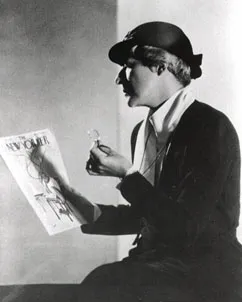
In the spring of 1951 Miss Flanner ushered Reid Hall into the second half of the twentieth century with a speech that found an echo in the heart of every Francophile, American as well as French. Its resounding title was France Yesterday, Today, Tomorrow and Forever. (Davenport 32).
The Miss Flanner to whom Davenport refers was Janet Flanner, a celebrated columnist for The New Yorker. The column, "Letters from Paris," first published in September 1925 under the pen name of 'Genêt,' was considered a must-read even for Parisians for many decades. Flanner spoke again at Reid Hall in 1953, 1955, and 1957, sharing her perspectives on "France Today."
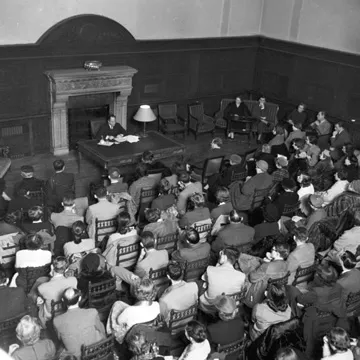
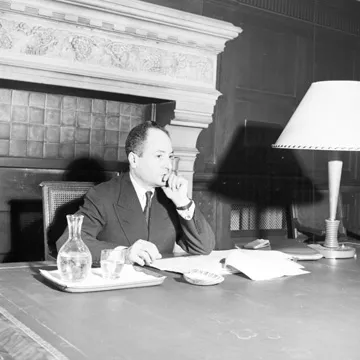
Other notable speakers were also regulars at Reid Hall’s teas; their presence was made possible, beginning in 1951, with funds from the Caroline McCormick Slade Memorial Fund (Slade was a former Trustee of Bryn Mawr College and member of the Reid Hall Board of Directors):
- Raymond Aron, philosopher, journalist and professor at the École nationale d’administration (ENA) and the Sorbonne, spoke about politics in France (1951, 1953, 1954, 1955, 1956, 1957, 1958, 1959, 1961).
- French composer Nadia Boulanger had already been at Reid Hall in 1927 and 1937; after WWII, she was invited to speak about music and perform piano demonstrations, sometimes accompanying students who had won the music scholarships (1950, 1951, 1952, 1954, 1955, 1956, 1957, 1958, 1959, 1960, 1961, 1962, 1963 concert in memory of President John F. Kennedy).
- Abbé Henri Breuil, noted prehistorian and collaborator of former Reid Hall resident Mary Boyle, spoke on parietal art in France (1955, 1956)
- French writer and humorist Pierre Daninos spoke about his book, Les Carnets du Major Thompson (1954), an event co-organized by the Fulbright Commission (1956).
- Abbé Ernest Dimnet, Catholic priest, writer, teacher, and Montparnasse neighbor, who already had been a guest speaker in the 1930s, attended teas and other functions at Reid Hall until his death in 1954.
- Etienne Gilson, historian, philosopher, at the Collège de France, and “Académicien,” (1947, 1949, 1950).
- René Huyghes, philosopher at Collège de France and “Académicien,” spoke on French painters (1952, 1953, 1954, 1955, 1958, 1959, 1960, 1962, 1963).
- French actress Claude Nollier of the Comédie française (1954, 1955, 1956, 1957, 1959, 1960, 1961, 1962, 1963, 1964).
- American broadcast journalist David Schoenbrun (1952, 1956, 1960, 1961).
- Political writer and “Académicien” André Siegfried spoke about his visits to the U.S. (1947, 1948, 1949, 1952, 1953, 1954, 1956).
The French chapter of the International Federation of Women (AFFDU) was especially active in welcoming women to Paris for international congresses, and they frequently held meetings in the Reid Hall salons or gave lectures to residents and students.
Reid Hall’s annual Thanksgiving dinner was also an opportunity to invite esteemed speakers and host special guests. Former First Lady Eleanor Roosevelt attended in 1951, while she was in Paris as American delegate to the United Nations. Another year, the guest of honor was Dr. Mildred McAfee Horton, former President of Wellesley College, who served as a member of the U.S. delegation to the UNESCO assembly in Paris that year.
A Christmas dinner was also held every year on December 25th without any speakers, just musical entertainment and/or dancing. Toward the late 1950s, this celebration was preceded in the week by a festive Christmas Egg-Nog.
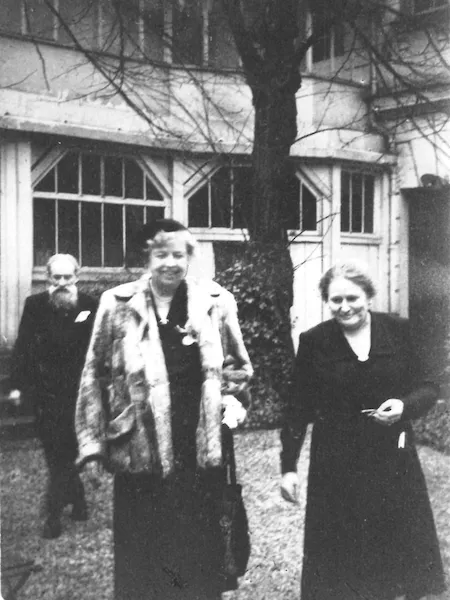
In June 1952, Reid Hall marked two special anniversaries: 30 years as a Paris residential center for students and 60 years since its official founding as the Girls’ Art Club, the first iteration of this beloved Franco-American center. According to Leet's report to the Board, "Ambassadors Dunn and Joxe spoke with warm appreciation of the work accomplished in international understanding. Ogden Rogers Reid cut the birthday cake, and it was a special pleasure to have with us our board members [...] as well as numerous French and American friends [...]" (October 30, 1952, BC Archives). The 40th anniversary event held in 1962 attracted many distinguished guests, including the American ambassador, members of the Ministry of Foreign Affairs, the French director of cultural relations, the rector of the University of Paris, the director of the Institut d’études politiques,representatives from the U.S. Educational Commission for France, professors, and, of course, Reid Hall’s residents.
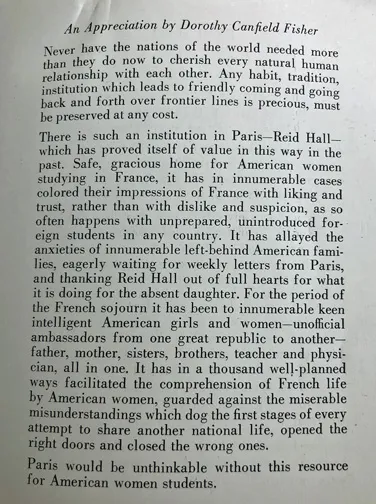
In keeping with the turn-of-the century traditions of the Girls’ Art Club , Leet also organized art exhibitions featuring work by students. In 1950-1951, the art students in the various study groups at Reid Hall installed a painting and sculpture show, with prizes awarded by French and American art critics. In 1952, there were 13 exhibitors: Shirley Kaplan; Jane Wolverton; Carole Cleworth; Gertrude Bookbinder (student of the sculptor Ossip Zadkine); Anna Blakemore (student of painter André Lhote); Margaret Gatch (Smith College); Lucy Keith (Smith); Anita Slowcome (Smith); Carolyn Hill; Ellen Howard; Josephine Matsen (Smith); Barae Lamb (Smith); and Prof. Beatrice Hyslop showed color photos. The exhibition was reviewed in Actualité artistique et internationale (March 27, 1952) and several young women were singled out as showing great promise: Kaplan, Wolverton, Blakemore, and Bookbinder. On May 31, 1953, exhibitors included: Margaret Abe; Margot Avery; Barbara Cledon; Barbara Hicks; Grace L. Hoffman; Nell MacCracken; June Nakamura; Lorna Muir Himmo; Jeanne Sigg; Caroline Hill. Shirley Kaplan, who studied at Académie de la Grande Chaumière and remained in Paris for four years, seems to be the only student who later pursued a career as an artist.
INTERNATIONAL MEETING PLACE
Groups of university women attending international congresses in Paris used Reid Hall as a meeting place and for special sessions – among these groups was the Association of Librarians, Association on Questions of Nutrition and Health. One of the most interesting international events was the 12th Congress of the International Federation of University Women, held in Paris in August 1956. A dinner was hosted on August 2 by Reid Hall's Board of Directors for 100 officers and delegates. A cocktail party at the closing of the Congress attracted 1000 guests in Reid Hall's gardens and salons.
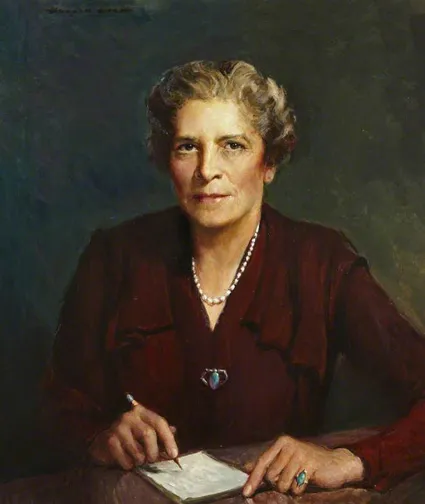
Virginia Gildersleeve's portrait was unveiled at the dinner, then hung in the Reid Hall library for many years. Today, the portrait by Harold Matthew Brett is part of Reid Hall's art collection; an exact copy can be found in Columbia University's Art Properties collection in New York.
Sources
- Dougherty, David. M. The Value of a Year of Study in France for Undergraduates." The French Review, vol. 23, no. 4, Feb., 1950, pp. 304-307. JSTOR.
- Press clippings from the Herald Tribune and other newspapers. Scrapbook, RH archives.
- Reports by Dorothy F. Leet and Virginia Gildersleeve. Barnard archives.