Virginia de Fremery (1867–1964)
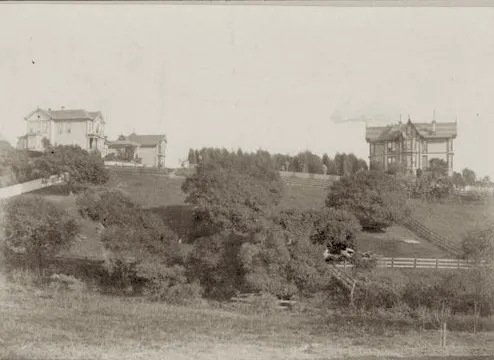
Jessie Virginia de Fremery was an American organist and church musician, born March 4, 1867, in Oakland, California, the daughter of Willem Cornelius Bastian (W. C. B.) de Fremery and Ellen de Fremery. She belonged to the prominent Dutch-American de Fremery family that played an important role in the commercial and social development of nineteenth-century Oakland. Her father was the younger brother of the wealthy merchant and Dutch consul James de Fremery (1826–1899) and was also his business partner in the firm James de Fremery & Co. The two brothers thus headed closely connected but distinct branches of the Oakland family. James and his family occupied the well-known estate “The Grove,” later incorporated into deFremery Park, while W. C. B. established his family at Prospect Heights.
Early Life
Virginia grew up at Prospect Heights, an imposing residence commissioned by her father in 1877, when she was ten years old. Designed by architect Mr. Sherwin, the house stood on the heights on the east side of what was then New Broadway, near Prospect Avenue, and was later known as 77 Fairmount Avenue, Oakland. A contemporary account in the Oakland Tribune of May 14, 1877, described the projected twenty-room residence in considerable detail, noting its unusually careful provisions for light, ventilation, and sanitation, its large parlors and dining room, Spanish-mahogany staircase, stained-glass window, Roman mosaic and encaustic tile floors, and electric bells. The newspaper predicted that it would be “one of the most complete residences ever erected in Oakland.” The house remained the de Fremery family residence for decades and was still Virginia’s documented address well into the twentieth century.
Known principally as Virginia, and occasionally as Virginie de Fremery, she pursued music seriously and was already an established church musician before her extended European sojourn. The Oakland Enquirer of April 20, 1901, identified her as the organist of the First Presbyterian Church of Oakland. In 1901 she was living in Paris and sharing rooms with California artist Gertrude Partington, a former resident of the American Girls’ Art Club. She is therefore very probably the woman identified as “Miss de Fermery” in the surviving family transcription of Alice Searle’s letters. Searle included her among “some of the nicest girls,” together with Margaret Patterson and Catherine Critcher, whom she introduced to her cousin Mimi Filley at one of the formal afternoon teas at the Girls’ Art Club—the kind of gathering that Mimi, intrigued by Searle’s artistic milieu, regarded as a “Bohemian tea.”
Paris Years
During her European residence, de Fremery pursued advanced organ study in Paris with Charles-Marie Widor, the celebrated organist of Saint-Sulpice and professor of composition at the Paris Conservatoire. Having relinquished the Conservatoire organ class to Alexandre Guilmant in 1896, Widor nevertheless continued to accept private organ pupils. He was at the center of an international network of serious organ students, including Americans, who came to Paris specifically for private study with him. De Fremery was therefore by no means the only established American musician drawn to Widor at this time.
One particularly close contemporary parallel was Arthur Dunham of Chicago, formerly of Bloomington, Illinois. Dunham sailed for Europe on May 4, 1901, expressly to undertake several months of specialized study with Widor devoted to the composer’s eight organ symphonies. The contemporary newspaper account described this explicitly as “special work.” Dunham, like de Fremery, was already a professional musician: he was organist at Chicago’s Sinai congregation and active with the Apollo and Mendelssohn clubs. He returned from Paris in the autumn of 1901; the Pantagraph of Bloomington reported on October 21 that he had “just returned from Paris” and announced an organ recital by him at Holy Trinity Church two days later. A later contemporary musical journal likewise identified Dunham as a pupil of both Clarence Eddy and Widor.
Another American organist, Eric DeLamarter, studied in Paris with both Widor and Guilmant in 1901–02, placing him within essentially the same musical environment. DeLamarter, who had graduated from Albion College in 1900 and had already pursued organ studies in the United States, subsequently became an important figure in Chicago musical life. Whether de Fremery knew Dunham or DeLamarter remains unknown, but the chronological overlap, particularly with Dunham in 1901, raises the intriguing possibility that these American musicians encountered one another within the relatively specialized circle of advanced organists studying in Paris.
Widor’s private pupils also included Albert Schweitzer, who had begun studying organ with him several years earlier and maintained a long intellectual and musical relationship with his former teacher. In 1902, Widor encouraged Schweitzer to undertake the study of Bach that eventually became J. S. Bach, le musicien-poète. Schweitzer’s relationship with Widor is significant in this context not because he can be shown to have studied alongside de Fremery, but because it illustrates the level and character of the advanced private instruction for which musicians sought Widor out. Already organist of Oakland’s First Presbyterian Church before her European sojourn, de Fremery likewise appears to have approached her studies with Widor as an experienced professional musician seeking advanced training rather than elementary instruction.
Return to the U.S.
De Fremery remained in Europe until sometime in 1903 but had returned to Oakland by April of that year. The Oakland Tribune announced that she would give an organ recital at the First Presbyterian Church on April 21, 1903, providing a firm indication that she had resumed her musical activities in Oakland by that date. She went on to pursue a long career as an organist and church musician in the city, with later appointments at the First Congregational Church of Oakland and the First Unitarian Church of Oakland. In 1915, for example, she was at the organ at First Congregational Church for a performance of Widor’s Mass in F-sharp—a particularly interesting continuation of her association with her former teacher’s music.
De Fremery was also active in the American Guild of Organists, serving as dean of its Northern California Chapter by 1919. Her influence extended to a younger generation of California musicians: a 1945 account recalled that organist Maurice Michaels had taken his first organ lesson from de Fremery, then organist of the First Congregational Church, and explicitly identified her as a pupil of Charles-Marie Widor. Michaels credited her with inspiring his devotion to the instrument. Her long professional career thus connected the cultivated musical world of turn-of-the-century Oakland with the advanced musical training available to American musicians in Paris.
According to the San Rafael Daily Independent (June 25, 1964), Virginia de Fremery, who never married, died in June 1964 at the age of 97, survived by her brother and three sisters. was an American organist and church musician, born March 4, 1867, in Oakland, California, the daughter of Willem Cornelius Bastian (W. C. B.) de Fremery and Ellen de Fremery. She belonged to the prominent Dutch-American de Fremery family that played an important role in the commercial and social development of nineteenth-century Oakland. Her father was the younger brother of the wealthy merchant and Dutch consul James de Fremery (1826–1899) and was also his business partner in the firm James de Fremery & Co. The two brothers thus headed closely connected but distinct branches of the Oakland family. James and his family occupied the well-known estate “The Grove,” later incorporated into deFremery Park, while W. C. B. established his family at Prospect Heights.
Virginia grew up at Prospect Heights, an imposing residence commissioned by her father in 1877, when she was ten years old. Designed by architect Mr. Sherwin, the house stood on the heights on the east side of what was then New Broadway, near Prospect Avenue, and was later known as 77 Fairmount Avenue, Oakland. A contemporary account in the Oakland Tribune of May 14, 1877, described the projected twenty-room residence in considerable detail, noting its unusually careful provisions for light, ventilation, and sanitation, its large parlors and dining room, Spanish-mahogany staircase, stained-glass window, Roman mosaic and encaustic tile floors, and electric bells. The newspaper predicted that it would be “one of the most complete residences ever erected in Oakland.” The house remained the de Fremery family residence for decades and was still Virginia’s documented address well into the twentieth century.
Known principally as Virginia, and occasionally as Virginie de Fremery, she pursued music seriously and was already an established church musician before her extended European sojourn. The Oakland Enquirer of April 20, 1901, identified her as the organist of the First Presbyterian Church of Oakland. In 1901 she was living in Paris and sharing rooms with California artist Gertrude Partington, a former resident of the American Girls’ Art Club. She is therefore very probably the woman identified as “Miss de Fermery” in the surviving family transcription of Alice Searle’s letters. Searle included her among “some of the nicest girls,” together with Margaret Patterson and Catherine Critcher, whom she introduced to her cousin Mimi Filley at one of the formal afternoon teas at the Girls’ Art Club—the kind of gathering that Mimi, intrigued by Searle’s artistic milieu, regarded as a “Bohemian tea.”
During her European residence, de Fremery pursued advanced organ study in Paris with Charles-Marie Widor, the celebrated organist of Saint-Sulpice and professor of composition at the Paris Conservatoire. Having relinquished the Conservatoire organ class to Alexandre Guilmant in 1896, Widor nevertheless continued to accept private organ pupils. He was at the center of an international network of serious organ students, including Americans, who came to Paris specifically for private study with him. De Fremery was therefore by no means the only established American musician drawn to Widor at this time.
One particularly close contemporary parallel was Arthur Dunham of Chicago, formerly of Bloomington, Illinois. Dunham sailed for Europe on May 4, 1901, expressly to undertake several months of specialized study with Widor devoted to the composer’s eight organ symphonies. The contemporary newspaper account described this explicitly as “special work.” Dunham, like de Fremery, was already a professional musician: he was organist at Chicago’s Sinai congregation and active with the Apollo and Mendelssohn clubs. He returned from Paris in the autumn of 1901; the Pantagraph of Bloomington reported on October 21 that he had “just returned from Paris” and announced an organ recital by him at Holy Trinity Church two days later. A later contemporary musical journal likewise identified Dunham as a pupil of both Clarence Eddy and Widor.
Another American organist, Eric DeLamarter, studied in Paris with both Widor and Guilmant in 1901–02, placing him within essentially the same musical environment. DeLamarter, who had graduated from Albion College in 1900 and had already pursued organ studies in the United States, subsequently became an important figure in Chicago musical life. Whether de Fremery knew Dunham or DeLamarter remains unknown, but the chronological overlap, particularly with Dunham in 1901, raises the intriguing possibility that these American musicians encountered one another within the relatively specialized circle of advanced organists studying in Paris.
Widor’s private pupils also included Albert Schweitzer, who had begun studying organ with him several years earlier and maintained a long intellectual and musical relationship with his former teacher. In 1902, Widor encouraged Schweitzer to undertake the study of Bach that eventually became J. S. Bach, le musicien-poète. Schweitzer’s relationship with Widor is significant in this context not because he can be shown to have studied alongside de Fremery, but because it illustrates the level and character of the advanced private instruction for which musicians sought Widor out. Already organist of Oakland’s First Presbyterian Church before her European sojourn, de Fremery likewise appears to have approached her studies with Widor as an experienced professional musician seeking advanced training rather than elementary instruction.
De Fremery remained in Europe until sometime in 1903 but had returned to Oakland by April of that year. The Oakland Tribune announced that she would give an organ recital at the First Presbyterian Church on April 21, 1903, providing a firm indication that she had resumed her musical activities in Oakland by that date. She went on to pursue a long career as an organist and church musician in the city, with later appointments at the First Congregational Church of Oakland and the First Unitarian Church of Oakland. In 1915, for example, she was at the organ at First Congregational Church for a performance of Widor’s Mass in F-sharp—a particularly interesting continuation of her association with her former teacher’s music.
De Fremery was also active in the American Guild of Organists, serving as dean of its Northern California Chapter by 1919. Her influence extended to a younger generation of California musicians: a 1945 account recalled that organist Maurice Michaels had taken his first organ lesson from de Fremery, then organist of the First Congregational Church, and explicitly identified her as a pupil of Charles-Marie Widor. Michaels credited her with inspiring his devotion to the instrument. Her long professional career thus connected the cultivated musical world of turn-of-the-century Oakland with the advanced musical training available to American musicians in Paris.
According to the San Rafael Daily Independent (June 25, 1964), Virginia de Fremery, who never married, died in June 1964 at the age of 97, survived by her brother and three sisters.