Social Life at the American Girls' Art Club
"It is the nucleus of student life in the quarter, and from the very existence of this center of American life in a strange land, the lonely newcomer feels a sense of comfort and protection" (Elizabeth Taylor, The Churchman, October 20, 1894).
Socializing was a key component of life at 4 rue de Chevreuse. One of the later residents, painter Anne Goldthwaite, recalled the general atmosphere of the Club in 1909:
"Under the direction of Jean Moffatt ... 'we paid little board and lived in the midst of luxury and romance. Nonresidents who wanted to be included in the club's social events concealed any irregularities in their lives so that they might be invited. Thanksgiving was an important occasion at the club, and American students in Paris vied for an invitation.' Goldthwaite also described how Miss Moffatt ordered everything in the grand manner, and one year chairs of crimson satin were hired for the holiday dinner. Although the director's 'morals were the strictest,' wrote Goldthwaite, 'she disguised the fact with so much splendor of living that everybody desired an entrée to the Club, and if their lives were irregular, they tried to conceal their waywardness that they might be invited to Thanksgiving dinner'" (as quoted in Dennison 2005, 34).
There were even formal occasions, like a Bal Masqué in 1898, listed in Quartier Latin, along with other entertainments put on by the Club, as "a feature in the social life of the Quarter" (vol. 4, 742).
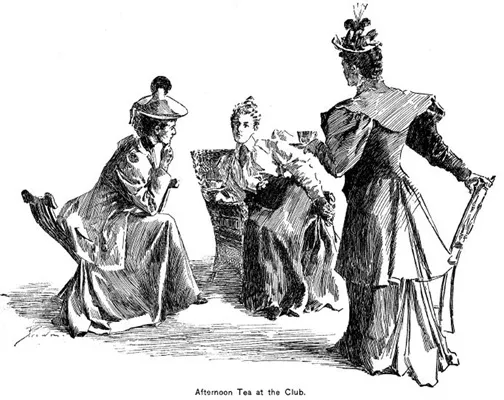
Another highlight was daily tea at 5pm in the gardens or the large reception room, known for its tasteful red furnishings, piano, and silver urn. Nina Estabrook wrote for The Washington Post on May 13, 1900 that the daily teas were subsidized through "the courtesy of Mrs. Lukemeyer, a charming American woman who lives in Paris" (26). Residents of the Club were allowed to invite guests, and even young men on Sundays. Everyone enjoyed tea, sandwiches, cake, and relaxation.
Image Carousel with 3 slides
A carousel is a rotating set of images. Use the previous and next buttons to change the displayed slide
-
Slide 1: Afternoon tea at the Club, (Scribner's Magazine, 1894), article by Emily Meredith Aywlard, 604
-
Slide 2: Afternoon tea at the Club, 1907 (Baltimore Sun, September 8, 15)
-
Slide 3: Afternoon tea at the Club, 1910 (Baltimore Sun, March 20, 17)
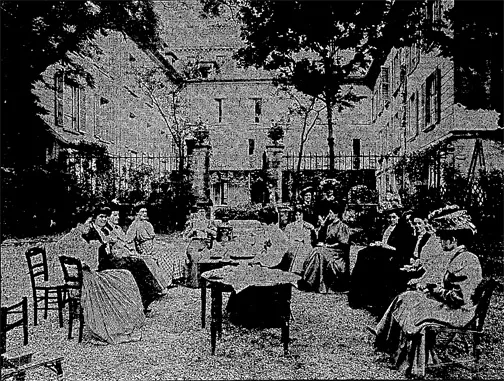
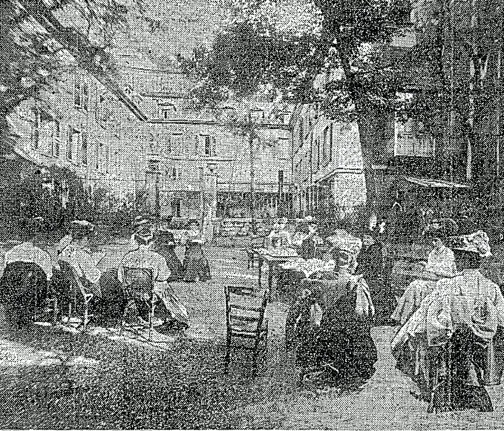
Good Housekeeping (vol. 45) reports in 1907: "With the tea (either plain, with cream, or à la Russe) is served bread and butter - graham bread cut in thin slices with delicious fresh, unsalted butter, and generally cake and square sweet biscuits. One of the American girls has set a custom which, it is amusing to see, is now followed by everyone who comes to the club for tea. Taking a slice of the brown bread and butter, she forms it into a sandwich with one of the sweet biscuits. The soft bread and the dry, crumbly sweet biscuit would hardly seem to combine well, but they are really quite delicious and the combination has been named 'the Yankee sandwich.'" (page)
In the same Washington Post (May 1900) article in which she describes the afternoon tea tradition, Estabrook also shares how the Club acquired its grand piano:
"The new grand piano which adorns the hall was presented by subscriptions raised by Consul General "Jack" Gowdy. The first time Gen. Gowdy went over to visit the club he learned there was great need of a piano. Without saying a word at the club, he began systematically to buttonhole every rich American man who came into his office for money for that purpose. Mr. Andrew Carnegie set the ball rolling with $100. And presto! the girls had a splendid grand piano almost without even knowing how it happened."
In February 1903, Josephine Breekons writes another Washington Post article about the frieze once decorating the walls in the Club’s dining room:
“The dining-room has a very interesting frieze around it, and one with a history. On a certain day the matron had invited the American students of architecture from the Ecole des Beaux Arts to dinner. Feeling keenly the honor, they brought with them an immense roll of canvas, which proved to be a procession of ducks, geese, strutting gobblers, and every fowl known to be edible, the parade being interrupted at intervals by exhibition pumpkins, grapes, and all manner of dining-room fruit. The canvas survives to this day as a monument to the young men’s gratitude.” (page)

Beyond its role as a center for the American student community, the Girls' Art Club also functioned as a clearing house of information about everyday life in Paris. French lessons were offered in the evenings for a nominal fee of 1 franc. Josephine Breekons’ article for The Washington Post noted that the residents were required to learn French: "Each year the girls are placed at a table in the dining room with competent French teachers, and not one word of English is permitted. They usually end by speaking well before returning to their own country" (Special Correspondence of The Washington Post, Feb. 8, 1903, page). Miss Moffat and her assistants were responsible for regularly updating and transmitting all of this information: addresses of stores, the names of reliable art teachers and their costs, lists of cultural events, travel tips and itineraries, etc.
"The reading room adjoins the red room. The long center table is covered with magazines and papers. Here a homesick girl is cheering herself with Life; a studious one is reading Le Figaro; the Herald is being consulted for concert and theatre programs and the departure of mail steamers. A girl is curled up in a big rocking chair by the fire, lost to the world in the last number of "Trilby". The writing table by the window is occupied by students with home letters. Bookcases at the far end of the room hold the library, which grows steadily, if slowly by contributions from different sources. Some girls are looking over the bulletin board, which contains notices of church services, and summer sketching classes, addresses of doctors, dentists, French teachers, pensions, and announcements of the sale of student furniture" (Elizabeth Taylor, The Churchman, October 20, 1894).
Unfortunately, life at the Club was not always happiness and sunshine. Aside from the dreaded possibility of artistic failure or financial misfortune, the girls who called 4 rue de Chevreuse "home" were not immune from illness and, occasionally, death. Jessie Allen, a promising young painter from San Francisco, was among the unfortunate few whose Parisian sojourn ended tragically just as she was gaining critical recognition for her work.
And in the chaos surrounding the outbreak of WWI, it appears that the Club, so long a haven for American women, hastily exiled its young residents as disaster loomed. On August 31, 1914, just a month into the war, The New York Tribune reported on the harrowing journey Miss Ethel Traphagen had endured first in Switzerland and then in France while trying to find temporary shelter as she arranged passage back to America on the Espagne liner. Traphagen, an art teacher at Cooper Union originally from Brooklyn, New York, had been in Lucerne when war erupted, and traveled by train to Paris, subsisting only on bread and water during the forty-eight hour trip. According to The Tribune, she had applied for accommodation at the Girls' Art Club, "in charge of an English woman named Shields" but was refused entry upon her arrival at the front gate. Apparently, Mrs. Shields also "ordered out" the 30 American residents who were already staying at the Club but admitted a "wealthy American woman" (9). Of course it is impossible to know exactly how all of these events transpired, or if Mrs. Shields truly did evict the residents and board up the Club to all but her own friends. One can imagine the sheer terror of those first weeks of war and the uncertainty over what would befall 4 rue de Chevreuse.
Sources
Special Cable to the New York Times, "American Charity Made Ineffective," New York Times, August 14, 1914, p. 4.