Residence for Students and Scholars
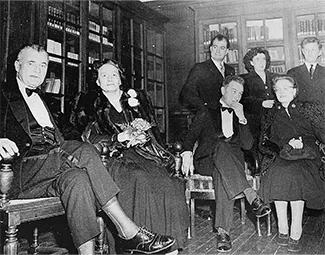
While Reid Hall welcomed American student residents as early as September 1, 1947, its official reopening was only celebrated on February 12, 1948. Guests of honor included: the American Ambassador to France, Jefferson Caffery; Louis Joxe, Conseiller d'État and Director General of Cultural Relations of the French Ministry of Foreign Affairs; Jean Sarrailh, Rector of the University of Paris; and Madeleine Guilloton, Director of the Smith College Junior Year Group. Caffery addressed an audience of French and American students, educators, and friends of Reid Hall who had gathered on this symbolic day, marking the birth of Abraham Lincoln, sixteenth President of the United States.
Refurbishing the Property
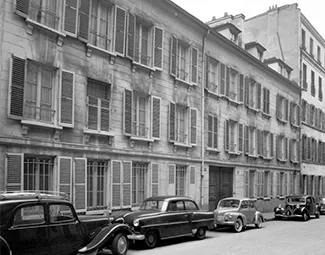
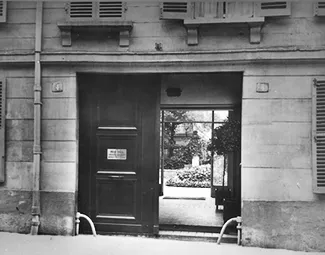
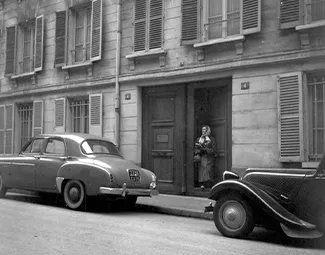
When the property was returned to its American leadership on August 21, 1947, it had suffered little serious damage, but the Sévrienne's residency had generated considerable wear and tear:
Heat, except for the conquerors and their collaborators, was an unavailable luxury. [...] Teachers and students huddled together at the stone hearth of the Grande Salle, feeding the flames with the improvised firewood of broken tables and chairs (Davenport 31).
Dorothy Leet immediately proceeded with upgrading the property, furnishing it, and securing necessary operational supplies. The first residents were to arrive on-site ten days later.
Tons of food, such as powdered milk and eggs, jam and canned butter, are now en route from America, [...] so that meals can be served with as little drain as possible on French food supplies. Carpeting and curtain materials are on their way too for refurbishing the building (Leet cited in the New York Herald Tribune, July 15, 1947, 19).
In her "Report to Members and Other Friends of Reid Hall" (June 7, 1948), Virginia Gildersleeve described the immensity of the undertaking that lasted more than a full year:
The inside of the building – bed rooms for seventy students and for eighteen personnel, the big assembly hall, five salons, the library, the large dining room and kitchens – was renovated, walls washed down or painted. The plumbing, electricity, heating system, telephone and room bell systems were thoroughly overhauled. The Embassy shared coal with us so that the house was comfortably heated after November 1st. There was hot water two days a week, which has now been increased to four (1).
The fifteen tons of food and household supplies, paint, curtains, rugs, tables, linen, etc., etc., purchased by the Board in America and shipped through the courtesy of the French Supply Mission, reached Reid Hall through the winter and were invaluable in keeping the students well and warm. Milk, butter, flour, cocoa, coffee, tea, macaroni, fruit juice and many other articles have been so scarce in France this winter that our supplies have helped nourish French students as well as our own. [...] (1).
There is still much work to be done on the property. And we are just beginning the extensive work on the outside of the buildings and the gardens (2).
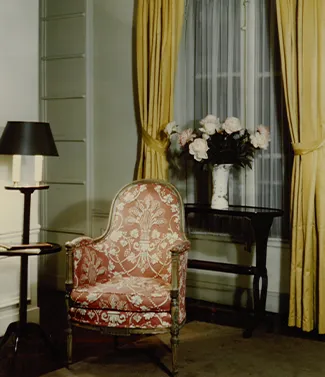
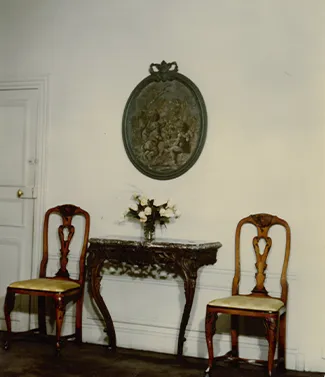
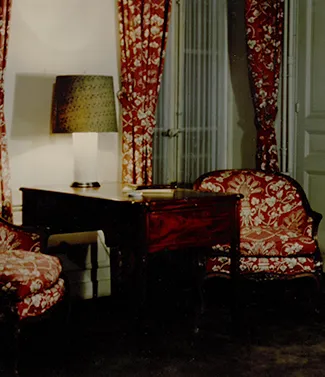
Following a nationwide contest among members of the Institute of Decorators, Reid Hall was gifted new furniture. An October 1947 article in the New York Herald Tribune names the contributors to said gift:
Through the efforts of the committee, donations of suitable furnishings have already been received from Brunovan Inc., Brunschwig & Fils, Elizabeth Draper, Freeman Furniture, Theo Hoffstatter & Co., Josephine Howell, Mildred Irby, Joseph Lombardo, Don Ruseau, Ailsa Shaw-Thompson, Douglas Sommerville, Diane Tate, and Marian Hall. A nation-wide appeal for cash donations to the fund is underway (page).
In 1948, one of the Reid Hall Board members, Mrs. James E. Briggs, gifted Reid Hall a concert piano (probably, the Mason & Hamlin that is still on-site and that was completely overhauled in 2010). In her 1948 report to members, Gildersleeve also mentions the gift of a statue by Janet Scudder, which has disappeared from the property.
On March 24, 1949, two newly decorated salons were formally opened and presented by the American Institute of Decorators in the presence of Ambassador Jefferson Caffery. A plaque commemorating their gift can be found in the Reid Hall archive. Other pieces of furniture were provided later.
In the 1949 – 1950 academic year, painting of the interior spaces was gradually completed. Generous gifts from Mrs. Elon Hooker, Miss Dorothy Ainsworth, and others helped re-decorate bedrooms with curtains and bed covers.
In 1951, the Board held a memorial to Mrs. Louis Slade: "[...] whose constant interest and enthusiasm helped to rebuild this Centre. Since Slade enjoyed particularly the garden, this would seem to be the most suitable memorial" (RH report, 1950 – 1951, Barnard Archives).
Under the auspices of the Caroline Slade Memorial Fund, in 1952, "[...] the lovely garden which runs toward the rue de la Grande Chaumière has been planted as a small formal French garden, with low box borders and plants flowering throughout the year" (RH report 1951 – 1952, Barnard Archives). In addition, the student salon was redecorated thanks to a gift from Mrs. Winthrop Ames, Treasurer-Emeritus of Reid Hall.
The glass gallery was repaired in 1958, along with the installation of a new telephone switchboard as well as a new hot water boiler.
The following year, the entire exterior of each building was painted, and an American member from Dublin gave a generous gift to maintain the garden.
Finally, in 1961, the house was refurbished with new rugs, curtains, chairs, and bed covers, and the salons, bedrooms, baths, and corridors were painted.
Residence
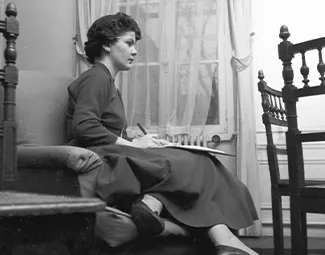
Resident in her bedroom, 1950s. Photograph retrieved from U.S. National Archives & DVIDs.
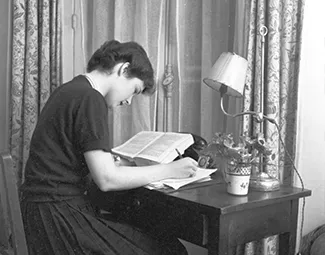
Resident in her bedroom, 1950s. Photograph retrieved from U.S. National Archives & DVIDs.
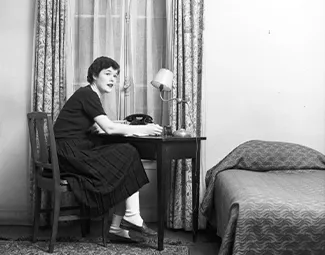
Resident in her bedroom, 1950s. Photograph retrieved from U.S. National Archives & DVIDs.
In the late 1940s and early 1950s Reid Hall could accommodate up to 60 residents. When it reopened in 1947, Leet touted the benefits of living at 4 rue de Chevreuse:
We try to protect them from the unpleasant and difficult side of life in a country that suffered through the war, by giving them sufficient food and adequate heat […] (Leet, cited in the New York Herald Tribune, January 25, 1948).
By 1948, Reid Hall had welcomed 49 students. The New York Herald Tribune published a story about life in postwar Paris, listing the commodities each student had brought with her: powdered eggs and milk, flour, cocoa, coffee, chocolate, cereals, macaroni, and vitamin-rich fruit crystals. With no power at the Hall on Fridays or before noon on Saturdays, Leet and her staff organized candlelight lectures or cinema excursions; hot water was only available two days per week and coal was also scarce. But the article also quoted Leet describing how the students were discovering "[...] the richness of France [...] in a spiritual and intellectual sense” (January 25, 1948, n.p.).
Reid Hall continued to serve as a residential facility well into the 1960s. Every year as many as 800 international guests who needed temporary or long-term accommodations in Paris were welcomed at 4 rue de Chevreuse. In the early 1950s, new policies allowed for male scholars and students to lodge at the Hall, however, women remained the majority. In 1962, Dorothy Leet reported that over 15,000 university women had stayed at Reid Hall in the forty years since its 1922 opening as the University Women’s Club.
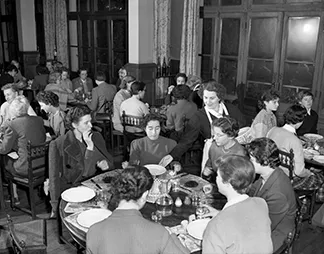
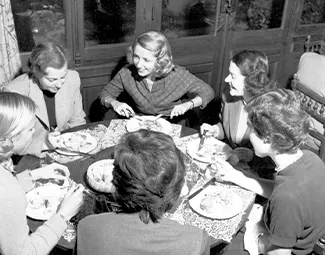
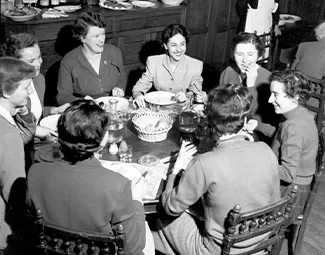
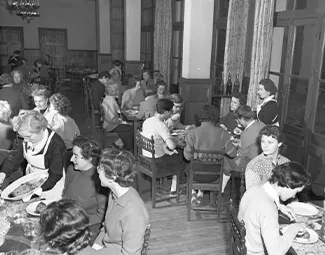
All residents had access to a wood-paneled dining room, created between 1929 and 1930, located on the ground floor of the building overlooking Reid Hall's back garden. The meal plan provided residents with three meals per day, and non-residents could also benefit from dining privileges at Reid Hall. The dining facility and food were praised by all for their elegance and taste. French visitors were especially welcome to the dining room as this would encourage interactions in the French language. To institutionalize this initiative, the French Federation of University women offered eight (later ten) food scholarships covering all meals per year. Additionally, they provided two (later three) annual room and board scholarships.
Residents benefited from access to several salons where they could study or meet with visitors. Reid Hall’s wood-paneled library was also quite popular with students and scholars. Its rich collection of works on art, culture, history, and politics were complemented by a host of magazines and newspapers in both French and English.
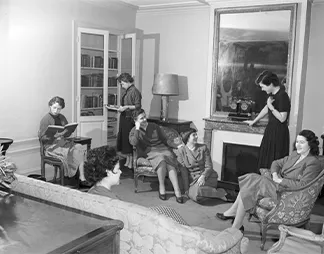
Women in conversation in one of Reid Hall's salons, 1950s. Photograph retrieved from U.S. National Archives & DVIDs.
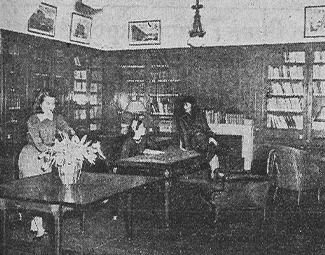
Reid Hall's Library, 1947. The students are: Sarah Frantz, Princeton; Alida M. Butler, St. Paul, Minnesota; Frances Huntoon, Providence, R.I. Photograph retrieved from the New York Herald Tribune, February 15, 1948, n.p. RH archives, scrapbook.
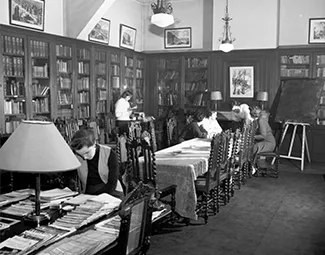
Library, 1950s. Photograph retrieved from U.S. National Archives & DVIDs.
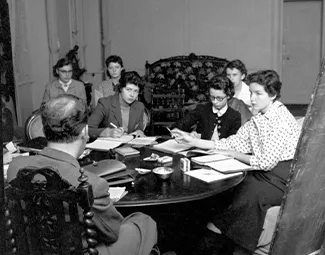
Students discussing with professor in a salon, 1950s. Photograph retrieved from U.S. National Archives & DVIDs.
In order to attract residents to Reid Hall, members of the Board of Directors and friends of Reid Hall contributed funds for scholarships. In the early years of the center, Leet proudly announced the generous contributions of several members through whose funds “[…] we have been able to help undernourished French students, and to send others on needed vacations. This has been much appreciated by the French university women and the University of Paris” (Report for 1949 – 1950, Barnard College archives). Scholarships for 10 French residents were funded by the AFDU. As early as 1949, another scholarship fund afforded budding French scholars the opportunity to study or teach at American colleges. In 1962, the recipient of this scholarship, Marianne Lagarde, went on to study at Columbia University. Her mother, a judge on the French Supreme Court, had won a Reid Hall residential scholarship in the 1930s which enabled her to study law (Leet letter to members, November 1, 1962):
Our members offered hospitality to her in many charming and interesting ways, so that she returned to France with a very full knowledge of American life. She speaks of her year as the most worthwhile experience of a young lifetime (Leet, letter to members, November 1, 1963).
Every year, a summer residential scholarship was awarded to a young British scholar. In the late 1950s, a year-long scholarship for Hungarian university women was also offered, and scholarships were also allocated to study-abroad students.
In 1953, the Board of Directors established a fund to support students pursuing their musical education in Paris. Women from such colleges as Barnard, Bryn Mawr, Mount Holyoke, Oberlin, Radcliffe, Smith, Vassar, and Wellesley were awarded $1,000 – $1,500 for one year’s study. In 1960 – 1961, an annual scholarship for art students (one per year) was also established. Its first recipient was Marianna van Rossen Hoogendyk.