Remarkable Women
The Portrait of Elisabeth Mills Reid (see image card) was drawn by John Singer Sargent who was confirmed at Holy Trinity in 1874 in the same class as Elisabeth Mills Reid. He had his studio around the corner at n° 73bis, rue Notre-Dame des Champs.
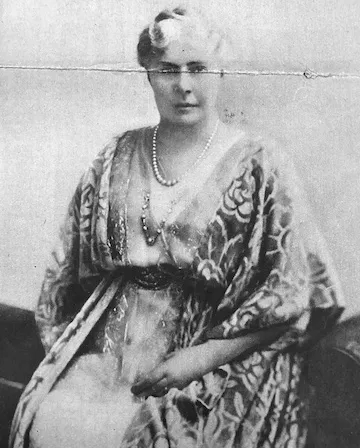
Elisabeth Mills Reid
"Of all the very wealthy persons I have known Mrs. Reid seemed to me the most sound and just, least open to flattery, and most interested in the human touch, in the welfare of individuals. When her husband was American Ambassador to France she wanted to provide better care and a happier social life for American girls studying art and music in Paris, and so she established and supported the American Girls’ Club in the charming old building on the rue de Chevreuse which we still occupy. This enterprise furthered also the Franco-American relationship to which she and her husband were at that time especially dedicated." Virginia Gildersleeve, 1950
Elisabeth Mills Reid founded nursing schools, hospitals, sanatoriums and was known for her philanthropic endeavors and her many benefactions.
Personal Background
Born in New York City in 1858, she was the only daughter of Darius Ogden Mills and Jean Templeton Cunningham. They also had a son, Ogden Mills, financier and patron of the arts. D.O. Mills was a self-made man from simple farming folks in Westchester NY. He moved to San Francisco after several failed attempts at different odd jobs. In California, he benefited from the gold boom of 1849 and made his fortune by trading gold and investing in railroads. He helped found the Bank of California, which he headed for some 30 years, but he returned to New York in 1880 where he invested in real estate and funded the building of several hotels for poor men, including Mills' House n°1, now known as "The Atrium," a place with 1,554 tiny cheap rooms, very strict rules of residency, and affordable meals. He also bought a mansion on fifth avenue, across from St. Patrick’s Cathedral. He had a lifelong interest in philanthropy, something he inspired in his daughter. When he died in 1910, he gave bequeathed to his children close to fifty million dollars.
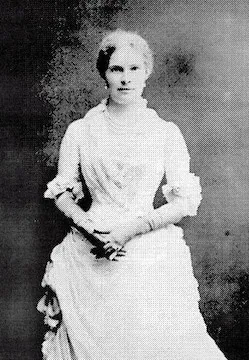
As a young woman, Elisabeth was sent to Mlle Valette's school in Paris and joined the American Cathedral of the Holy Trinity where she was confirmed in 1874 in the same class as John Singer Sargent, who was living in Paris, on the rue Notre-Dame des Champs. She remained a faithful member of the church and also endowed a pew in 1924, in which she sat whenever she attended the services in Paris.
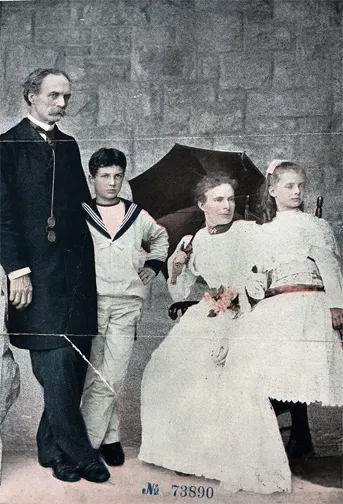
Elisabeth Mills married Whitelaw Reid, twenty years her senior, in 1881. He succeeded Horace Greeley as owner and editor of The New York Tribune. From 1880-1892, he was "ministre plénipotentiaire" to France. He then became ambassador to the court of St. James from 1905 to 1912, when he died unexpectedly.
They had two children. Born in 1882, her son, Ogden, followed in his father's footsteps as editor of the New York Herald Tribune and President of the New York Herald, Paris. On March 14, 1911 Ogden Reid marries Helen Rogers, his mother's social secretary (1903-1911), Barnard graduate (1903). They have three children: Elizabeth, Whitelaw, Ogden. In 1924, Ogden Reid purchases the New York Herald and merges it with the Tribune: the paper became the New York Herald-Tribune. He dies in New York in 1947. Born in 1884, her daughter, Jean, was married to the son of the Earl of Dudley, Hon. John Hubert Ward. She died in 1962.
Elisabeth died from double pneumonia at the age of 73, at Villa Rosemary in St. Jean-Cap-Ferrat, the home of her daughter on the morning of April 29, 1931. The memorial rites held in her honor at the American Cathedral in Paris on May 7, attracted an impressive list of government officials, socialites, heads of American organizations in Paris, students, and family members (Herald Tribune, May 8, 1931). She is buried in the US...
- "Mrs. Reid’s death is an incalculable loss and the news of her passing comes to me, as it undoubtedly comes to her many friends, as a great blow […] Mrs. Reid was so brilliantly active, so devotedly helpful in the many foundations and charities which her enterprise and inspiration had made possible that, in spite of her advanced years, her friends were unprepared for the end. She was an unfaltering friend of France. Her deep sympathy for the French nation and appreciation of French culture dated back over half a century, and when her distinguished husband was minister in Paris in 1889-1892 she played an active part in making his mission a success. Reid Hall, where so many American students find hospitality, is but one monument of her unselfish devotion to and encouragement of practical Franco-American cooperation and friendship" 'Ambassador Walter E. Edge, Herald Tribune, Wednesday, April 29).
Leased the property from J.J. Keller in 1993 (except for the plot on which the chapel had been erected in 1892) with an "option to buy" in 1911, which she did. In addition, she bought the plot on which the chapel stood, and later bought the passage from the neighboring property to the well in the first courtyard. She not only lent the property for use by the Girl's Club, the Women's University Club, and the Study Abroad groups, but also paid for significant upgrades on the existing buildings and actually commissioned an architect of note to build a third building to be used as a residence hall, a fourth as an exhibition and meeting space, and a fifth as a small student clinic. For her work, she was named Chevalier of the Legion of Honor (1922). The property was named Reid Hall in her honor in 1928
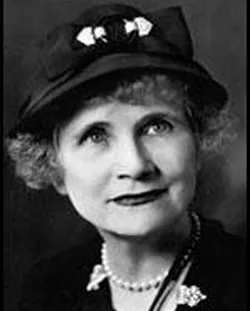
Helen Rogers Reid
"Mrs. Ogden Reid, now President of the New York Herald-Tribune, was a graduate of Barnard College of Columbia University, deeply interested in international affairs and naturally associated with the small group of American university women who saw a vision of what this Paris centre might accomplish. To her also Reid Hall owes a great debt." Virginia Gildersleeve, 1950
"There was little in Mrs. Reid's appearance to suggest the influence she wielded, nor the force of her character. She stood only an inch over 5 feet; and she looked as fragile as piece of expensive china. Her hair, at first brown, then gray and later white, was a fine soft fuzz that curled close to her head. Her large green eyes, however, were alert and probing. According to advertising salesmen who dealt with her, they could be quite unnerving" (New York Times, July 28, 1970).
According to the biographical dictionary of Notable American Women, she entered Barnard College as its first midwestern student in 1899 and received her BA in 1903. She obtained the position of social secretary of Elisabeth Whitelaw Reid and worked with her for eight years between New York and London, until she married Elisabeth's only son, Ogden Reid, in 1911. From 1918 onward, she took great interest in the Herald, which she basically overhauled from both a financial and editorial point of view. An ardent supporter of women's rights, she also hired numerous women staff members, including Irita van Doren. In 1924, she was instrumental in merging the Herald and theTribune and in developing the Herald Tribune into one of the nation's best-selling newspapers. When her husband died of pneumonia in 1947, she succeeded him as President. She died in 1970 of arteriosclerosis at the age of 87. Her obituary in the New York times identifies her as "an unflamboyant but powerful force in the newspaper world and in the city's civic and social life." She became a Trustee of Barnard College in 1914 until 1956 and helped raise funds for a dormitory built in 1963 and named for her. She was a trustee of the Metropolitan Museum of Arta. Active in the New York Newspaper women's Club, she was president of the Reid Foundation, established by her husband in 1946 to give fellow ships to journalists for study and travel abroad.
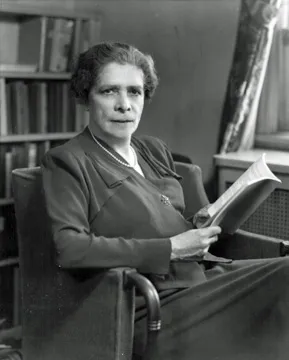
Virginia Crocheron Gildersleeve (1877 - 1965)
Dean of Barnard College for thirty-six years (1911-1947), Gildersleeve was a significant player in Reid Hall's long history, and yet biographical accounts often gloss over the important work she accomplished in Paris. She was president of Reid Hall's Board and was responsible for convincing Elisabeth Mills Reid to establish the University Women's Club as a five-year experiment that would then continue till the outbreak of World War II. She visited Reid Hall on a regular basis and maintained close contact with the resident director, Miss Leet. She helped found the International Federation of University Women whose French chapter, the Association française des femmes diplômées des universités (AFFDU), which from its inception in 1922 still continues its activities at Reid Hall today.
In all ways, Gildersleeve paved the way for young women in education, administration, leadership, civic responsibility. Her activities and creations are telling examples of her profound commitment to women and international: Dean of Barnard College; founding member of the International Federation of University Women, Chair of the advisory council of WAVES, Chair the American Council on Education, founding member of Seven college conference of Women's Colleges, she was appointed to the United Nations Charter Committee; member of the US educational mission to Japan. She opened doors for women in the medical school, law, engineering
Undergraduate studies at Barnard 1895, six years after the college was inaugurated. She completed her studies in 1908 with an MA in medieval history and PhD in English and Comparative literature from Columbia University. Prior to her deanship, she taught English both at Barnard and Columbia.
The correspondance and reports in Barnard's archives bear witness to her indefatigable interest in the affairs of Reid Hall, even during WWII when the site had been evacuated of its American residents and staff. When the Red Cross left the property in 1922, the collaborated with a group of key academic administrators from prominent women's colleges and suggested that 4 rue de Chevreuse become the site of a University Women's Club that would further international understanding among French and American University women.International Federaton of University Women. The club would also house the French chapter of the Her "five-year experiment" continued till the outbreak of the Second World War. When it was clear that the
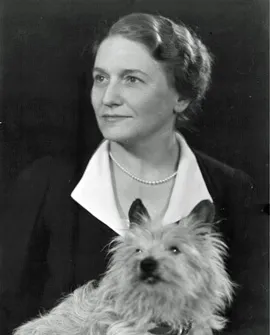
Dorothy Leet
"She came to us in her youth in 1924 as Secretary of Reid Hall. Soon she was Acting Director and then Director, so that for twelve years before World War II she guided the destiny of our Centre. A graduate of Barnard College, with a good background of travel in Europe and America, she had had but little active experience in international affairs before coming to Reid Hall ; but she quickly learned the intricate web of life in Paris and the relationships between nations, institutions, government departments, groups of all kinds, and piloted our ship with remarkable wisdom, vision and tact. To the resident students she was a kind and helpful friend. One of them said of the early days that 'Miss Leet was a radiant spirit whom all the students adored.' Her courage, her persistence, her imaginative ability in administration, the charm and distinction of her presence, have made her an ideal leader in this project in international understanding. We were delighted recently to see the French government recognize her great service by elevating her to the rank of Officier in the Legion d’honneur, for Reid Hall is very largely her creation." Virginia Gildersleeve, 1950
She was awarded the Legion of Honor in 1934 in recognition of her distinguished work in developing Franco-American relations and building up Reid Hall as an international center.
Miss Leet left Reid Hall on April 1, 1938 to take on the position of Secretary of the Foreign Policy Association in New York. She named Miss Sarah D. Porter, Wellesley college graduate and her assistant from 1928-1938, as Director of Reid Hall. Miss Porter was not interested in keeping the position after October 1938. Search for the position: "This is one of the most interesting positions in the whole field of international relations. It involves being the head of a household containing about fifty students and graduates of various nationalities, carrying on all the necessary relations with the French authorities, and representing American University women in the educational and social world of Paris." (Gildersleeve, February 8, 1938 Announcement)
Soon after they stopped their administrative efforts at Reid Hall on August 31, 1964, Miss Leet and Miss Porter took a short trip to Portugal. they then took a trip around the world and returned to New York in the later part of December 1964.
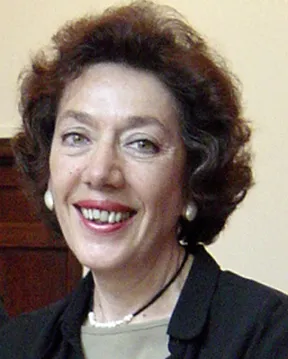
Danielle Haase-Dubosc
Danielle came to Reid Hall in 1972, after obtaining her PhD from Columbia University’s department of Comparative literature; she retired from her administrative duties in 2010. Her directorship is flanked by two significant periods of transition in the activities at 4 rue de Chevreuse: the first in 1964, when the Reid Family bequeathed the facility to Columbia University, unbeknownst to its leaders on site; the second in 2010, when Columbia University integrated Reid Hall into its network of Global Centers. But while Danielle’s beginnings were fraught with administrative turmoil, budgetary issues, and thoughts of selling the property, when she retired, the budget was in fine shape, numerous academic programs were settled at the Center, and the future could be built on the solid foundations she had created.
By 1975, Danielle was named resident Director and helped in establishing the Centre de Recherche Internationale of the Institut des Sciences Politiques in the building in the rear garden. She also headed, from 1972, Columbia’s undergraduate program whose offerings were gradually expanded to include not only French language and literature but also art history, music, architecture, history, and social science. She was the first in study abroad to establish international exchange agreements with the French universities that welcomed Columbia students into their classrooms. The initial agreement with Paris VII (in the early 70’s) was followed by others with Paris I, Paris IV, and Sciences Po. Under her leadership, Columbia’s undergraduate program grew from 31 students in 1972-1973 to 143 in 1984-85, when Brunhilde Biebuyck came on board as Assistant Director of Studies.
Enrollments soared over the next decades, with an average of 200 students yearly, including a summer program begun in 1983. Besides growing the Columbia program, Danielle also invited other undergraduate study abroad programs to become members of Reid Hall: Smith, Hamilton, Southern Methodist University, Hollins, Delaware, Sarah Lawrence, Vassar-Wesleyan developed their own curricula and shared the space in all collegiality. By the time she retired in 2010, more than 800 American undergraduates were studying at Reid Hall on a yearly basis. In recognition of her significant contribution to undergraduate education and Columbia University, she was named Associate Provost in 1987.
But Danielle was not only committed to undergraduate education. She wanted to accomplish the mission laid out by the Reid family when they entrusted the Hall to Columbia: that is, to develop undergraduate, graduate, and research programs. She was convinced that study abroad should not be limited to a parenthetical “junior year” but that one should be able to return as a Masters student, a PhD candidate, or a junior and senior scholar, benefiting at each level from networks and resources that Reid Hall had established.
In 1987, with the help of seed money from the Florence Gould Foundation, she created a Graduate Research Institute for PhD students working on their theses in France. This very successful program attracted an average of thirty budding researchers who benefited from seminars in French language, research methods, and theoretical skills; they were also introduced to the various documentation centers, archives, and academic institutions in France. It closed its doors in 1995, when funds were no longer available. In 1993, she inaugurated the Masters in French Cultural Studies, the first full-standing masters of its kind offered by an American university in a foreign country. It attracted an average of 15 students per year and today has evolved into the Master in History and Literature.
With the bequest of a fund by Sterling Currier, Danielle also initiated a program of French-American conferences and artistic activities that crossed not only cultural borders but also disciplines. In 2000, in collaboration with Provost Jonathan Cole, she launched the Columbia Institute for Scholars, which attracted fellows from Columbia and other parts of the world who, at Reid Hall, engaged not only in individual research but also collective activities. The Institute closed its doors in 2010, but the idea has been rekindled with the creation of the Columbia Institute for Ideas and Imagination that opened in 2018.
Throughout her long career, Danielle was very keen on enhancing Reid Hall’s position in French-American cultural and academic exchanges and in fostering educational and cultural activities that were deeply rooted in French-American reciprocity. From her perspective, “the imposition” of an American model (or any other national model) had to be avoided so the concept of intellectual community could prevail. The different programs she established at Reid Hall attracted students and scholars with outstanding academic and personal profiles. French scholars of renown taught in these Columbia programs, where junior scholars also found their place, so much so that the Reid Hall became kind of obligatory “passage” in their French academic career. Reid Hall became a kind of “magical” site for many that defined life goals or refined career paths and opened the way to innovative discourse and research. More than a set of buildings, it was an environment through which students and scholars succeeded in crossing borders both physically and intellectually. As such, it is anchored in people’s memory as a distinctive place where they experienced very real transformations.
Before the creation of the Columbia Global Centers in 2009, Danielle had already outlined the future of higher education and of global engagements, highlighting the importance of enhancing the global outreach of Columbia faculty and positioning Reid Hall as the hub for Columbia’s involvements in Europe. In short, she laid the groundwork for many of the directions in which Reid Hall is now heading.