Reid Hall Gifted to Columbia University
By 1963, it was evident that Reid Hall could not withstand the financial burden of being a residence for university women. A new model had to be envisioned, based on Reid Hall's role as an international academic center.
Before Columbia was selected as the University that would manage Reid Hall, board members discussed the possibility of giving it to a governmental organization but many were opposed to this idea and Mrs. Ogden Reid felt that the "property would be of considerable value to an American institution of higher learning, foundation or learned society." (Letter to Miss Corwin, Nov. 22, 1963). Columbia University was elected as most suited to carrying out Reid Hall's mission as a center for study, cultural programs, and research.
"In October, it was learned that Mrs. Ogden Reid was willing to give the Reid Hall property to Columbia Univeresity and that they were most interested in taking it over. Miss Corwin drew the distinction between the University Women’s Realty Corp., owner of the land, and in which Mrs. Reid owned all the shares, and Reid Hall Inc., the operator of services and programs for which Reid Hall is known. The board of Directors of Reid Hall, Inc. were highly encouraged by Columbia University’s interest. It seemed to them a natural evolution of the concept of Reid Hall as a center for international education. Miss Corwin described the many talks she, Mrs. Reid and Miss Leet had with President Kirk and other Columbia officials. They were pleased that Columbia was prepared to continue Reid Hall’s association with the Colleges who have offices in Reid Hall, and that they also recognized our responsibilities to French university women […] Mrs. Reid said that it was the wish of her sons and daughters-in-law that Reid Hall should always continue to be connected with international education and that when President Kirk had been so interested it seemed the best possible answer to everyone’s hopes. Mrs. Reid then quoted from a letter from President Kirk expressing both his interest and pleasure and that of Columbia Board of Trustees. She concluded saying she could not imagine what could better ensure the successful future of Reid Hall” (Report, Annual Meeting of Reid Hall Inc., January 15, 1964).
In his letter to Helen Rogers Reid, Grayson Kirk, President of Columbia University (January 7, 1964) states that Trustees of Columbia university accept the gift of Mrs. Ogden Reid
- “We are confident that at Reid Hall, Columbia University has a bright future and that this transfer of ownership will open up this splendid property to a new era of usefulness and enhanced service not only to the University but to the whole of American higher education."
In december 1965 - Edith sterling Currier
The transition period from what Reid Hall was to what it would become was a quite difficult. At Columbia itself, initial discussions focussed on the eventual sale of the property, but it was decided to maintain the premises and make the property a viable center for students and faculty.
In 1964, numerous efforts were made to repurpose rooms and redecorate them. In his 1965 report (RH archives) to the Reid Hall Board, Stanley Stalman, Secretary of the Board, clearly identifies this transformation, which he says will take several years, as one that "emphasizes scholarship rather than residence." (p.1). Numerous plans were drawn up included a vast renovation scheme by the architect, Matveev, that never saw the light. But by 1965, numerous
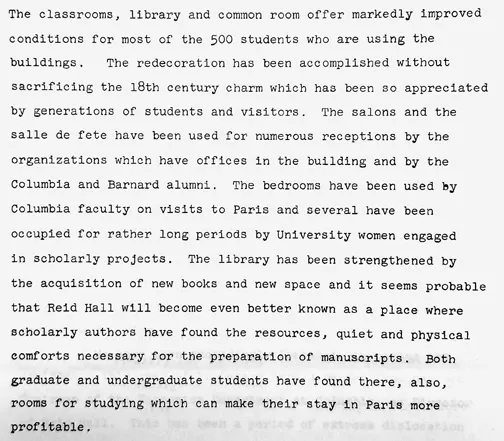
Columbia University sent several members of the faculty to Reid Hall to assess the potential of the place and pave the way for the future.
The first professor to head Reid Hall was Harold Barger, Chair of the Department of Economics. Because a Resident Manager could not be found, Gwyneth Barger, Harold's spouse, assumed many administrative responsibilities on a part-time basis. As Stalman's report indicated, the period was one of "extreme dislocation and even discomfort," especially since the facility was still in operation. Nevertheless, financial issues were clarified, space was reorganized, and student programs were consolidated.
Bert Leefmans, French Department, was appointed as the second Director of Reid Hall, from 1965-1966. He was especially instrumental in "exploring opportunities for educational exchange." (Salman report)
From 1968 to 1974, William W. Davenport was director of Reid Hall. Theodore De Bary, Provost of the University had this to say about him: “Well, unfortunately, Reid Hall had been put under the directorship of a charming, but inefficient, graduate of the college who was also a younger brother of a very wealthy alumnus, a very influential alumnus. This many was very cultured. He was a writer. He didn’t have any academic degrees. He had no experience of academic administration, but he was put in charge of this place. He really didn’t know how to go about making it function properly, or serve the needs of undergraduate students, or any other potential student population. He spent a great deal of money on public relations and cultivating people in Paris, entertaining and things like that--running up big deficits. By the time I came in as provost, Reid Hall had a debt of $600,000.
Programs at Reid Hall 1964
- Smith College
- Middlebury College
- Hamilton College
- Hollins College
- Sweetbriar College
- Tulane University
- Sarah Lawrence (from September 10 to October 28, before going to Rouen)
- Columbia School of Architecture summer program
-
University of Paris had several offices for their scholars (Heller...)
-
In 1965, plans to hold a summer program for undergraduates from the College and Barnard.
10 rooms for African Institute and Plans and Documentations section of Economics Dept.
Between 1964 and 1972, the residences were gradually phased out because students wanted an immersive experience in families; the “Third Year in Paris” program was terminated, and the restaurant, which had already proved to be difficult to maintain, was also ended.
Endowments
Grace Hill Fund (1946)
Provisions of the will of Grace A. Hill relating to the legacy to Reid Hall, reads as follows:
"I direct that the rest of my property be divided equally between Radcliffe College, Cambridge, Massachusetts, and Reid Hall, 4 rue de Chevreuse, Paris France; the income to be used for scholarships as may seem best to the institutions concerned. In case Reid Hall, the American Women's University Centre, be discontinued in its present form, this share is to be added to the Radcliffe College Scholarship Fund. Total amount to Reid Hall $16,198.93."
In her report to the Reid Hall Board, Dorothy F. Leet states that the fund was bequeathed to Reid Hall by Grace Hill, a Radcliffe graduate, amounted to over $30,000 (1947, RH archives).
The Grace Hill fund continues in 2020 to offer scholarships to students.
Edith Sterling Currier Fund
A $1 MILLION BEQUEST
A $1 MILLION BEQUEST to Reid Hall, Columbia's Paris outpost, will fund adult education programs "to further understanding within the FrancoAmerican community." The gift, establishing the Sterling Currier Fund, was provided in the will of the late Edith Sterling Currier, who died in 1972. In late August, President McGill named a nine—member advisory committee headed by history professor Robert Paxton to plan general policy and outline a detailed program "on a high scholarly and cultural level." Although the advisory committee has not yet formulated recommendations to the president, Paxton said that a faculty and graduate student exchange program and a lecture series are among possible plans.
University Record, Volume 1, Number 5, 30 September 1975