The Neighborhood (1922 - 1939)
In May 1927, Florence Pfalzgraf wrote an article in the Boston Evening Transcript entitled:
Month in, Month Out, There Are Some 25,000 Americans in the City, Mostly in Montparnasse - at the Dome, the Dingo Bar, or Studying
"There is a new name for the old, old Latin Quarter in Paris. Frenchmen call it the American quarter now and up and down its boulevards from Mich to Raspail, one sees American students, American Artists and American idlers. If you sit long enough at the Dome or the Rotonde they say you will see every American you have ever known. On summer evenings the college crowd "over" for vacation gathers at one or another of these renowned cafés for a glass of café au lait or something a little stronger. Older Americans come to visit haunts of their student days or merely out of a desire to see the old resorts of Victor Hugo and Anatole France. Montparnasse, the most American of the quarter, buzzes with American slang, American songs and American French. Around the corner from the Dome there is the Dingo Bar, where Charlie, a genial Texan, mixes cocktails and serves chili con carne for fifteen francs a plate and where almost any evening you can hear "My Old Kentucky Home" or "Who?" banged out on an old jazz-strewn piano surrounded by half a dozen Paris-Americans and perhaps one or two interested French flappers (...)"

The "Lost Generation"
One can just imagine the exciting atmosphere around Reid Hall in the 1920s when the so-called "Lost Generation" of American writers, artists and intellectuals made their homes in Montparnasse. Ernest Hemingway describes many of the neighborhood’s hotspots in A Moveable Feast, the account of his early years in Paris as a young journalist and writer. Hemingway and his first wife, Hadley Richardson, lived in a rented flat above a sawmill at 113 rue Notre-Dame-des-Champs (long since demolished). When their son John, known affectionately as Bumby, was born in 1923, the Hemingways had him christened at St. Luke’s Chapel, the ‘Little Tin Church.’ Hemingway describes landmarks like Ezra Pound’s apartment at 70 bis rue Notre-Dame-des-Champs, Chez Les Vikings, a cabaret and café once located in adjoining buildings at 29 and 31 rue Vavin, and his favorite place to write (and drink), La Closerie des Lilas, still open in 2020 at 171 boulevard du Montparnasse.
Another local celebrity was the so-called Queen of Montparnasse, Kiki (real name Alice Prin), whose scandalous autobiography shed light on the debauchery of the quarter in this period. Kiki’s Memoirs, translated into English in 1930 by Samuel Putnam, were published by At the Sign of the Black Manikin Press, run out of a rare book shop of the same name on the rue Delambre by Edward Titus, husband of Helena Rubenstein. To Kiki,
"Montparnasse is a village that is as round as a circus. You get into it you don’t know how, but getting out again is not so easy! There are people who have got off by accident at the Vavin subway station, and who have never left the district again, have stayed there all their lives.” (176)
Kiki was such an outsize presence in the neighborhood that the young women living at Reid Hall would certainly have known her, though she was likely too risqué for their tastes. But she certainly took notice of them:
"Montparnasse, so picturesque, so colorful! All the peoples of the earth have come here to pitch their tents; and yet, it’s all just like one big family. In the morning, you can see young fellows in wide trousers and fresh-cheeked young girls on their way to the art-schools, to Watteau’s, to Colarossi’s, the Grande Chaumière, etc. …Later the café-terraces begin to fill up, and pretty Americans eating oatmeal can be seen sitting side by side the French picons-citron. The crowd goes to look for a ray of sunlight at the cafés. The models meet one another there." (175)
Notable Artistic and Literary Haunts Near 4 rue de Chevreuse
Painters, sculptors, and writers were regulars at many of the cabarets and brasseries on the boulevard Montparnasse and its surrounding streets. In Philip Greene's words, the neighborhood was "A drinkable feast" (2018, page) and many Americans were an important part of the scenery. Prohibition in the United States, the favorable currency exchange, and the relatively cheap cost of living in Paris attracted numerous Americans for whom France represented freedom of expression at many different levels. Montparnasse thus abounded in American-style bars and restaurants, dance clubs and cabarets, all catering to the expatriates.
Peggy Guggenheim, who became one of the greatest modern art patronesses of the 20th century, was a young socialite when she moved to Paris around 1920 to live with her first husband, Dada sculptor Laurence Vail. The couple resided in Montparnasse and were friendly with all of the celebrities of the quarter: Man Ray, Kiki, Constantin Brancusi, Marcel Duchamp, and so on. Her autobiography, Out of This Century: Confessions of an Art Addict (published by Andre Deutsch in 1979), tells of her immersion in the bohemian nightlife surrounding 4 rue de Chevreuse: "We generally spent every night in cafes in Montparnasse. If I were to add up the hours I have whiled away at the Cafe du Dome, La Cupole, the Select, the Dingo and the Deux Magots (in the Saint-Germain quarter) and the Boeuf sur le Toit, I am sure it would amount to years" (51).

The Jockey Club
The first cabaret-club in Montparnasse was Le Jockey, which opened in November 1923 at 146 boulevard du Montparnasse, on the corner of the rue Campagne Première. Famous clients included Aragon, Cocteau, Fujita, Hemingway, Kiki, Man-Ray, Pound, and Tzara. It was crudely decorated to resemble a western saloon, with posters and cartoons painted with shoe polish. In the spring of 1923, Le Jockey became the center of controversy when a group of American tourists harassed and ejected Kojo Touvalou Houénou, a prince of the royal family of Dahomey who had served as doctor in the French army during WWI and then stayed in Paris to earn a law degree and make connections with French intellectual elites. Several months later, he was also kicked out of a dancing club in Montmartre (Chatuant 2010, page). These incidents led President Poincaré to admonish American visitors for their racist attitudes and played a role in Touvalou's future political activities. In 1932, Le Jockey crossed the boulevard and established itself at number 127, on the corner of the rue de Chevreuse. In 2020, it is the site of a restaurant.
Le Jockey's two iterations were emblematic of the bohemian "montparnos" (neighborhood regulars). Jeffrey H. Jackson describes the original Jockey as:
"[...] a small, dark, smokey, crowded nightspot [...] where customers had to squeeze past each other to find a few inches at the bar. Despite its lack of comfort, it was nevertheless one of the most fashionable destinations in Montparnasse. Named for the occupation of one of its proprietors, the Jockey featured 'bizarre posters and other weird decorations' on the walls and ceilings along with paintings of 'cowboys and Indians' by painter Hilaire Hiler, who occasionally played the piano. Sometimes, poetry and lectures accompanied the various musical entertainers, who passed the hat to collect tips" (2003, 68).
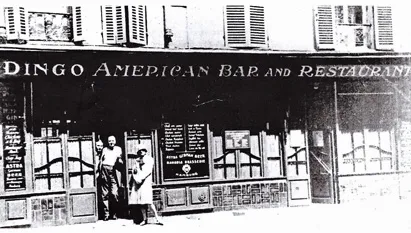
Dingo American Bar
Located at 10 rue Delambre (in 2020, home of the restaurant Auberge de Venise), the Dingo American Bar opened its doors in 1923. Regulars included Isadora Duncan, who lived across the street, Kiki, Lady Duff Twysden, Nancy Cunard. In 1925, Hemingway first met F. Scott Fitzgerald at the Dingo. In This Must be the Place (1934, 1937), edited by Morril Cody with an introduction by Hemingway, the Dingo's barman, Jimmy Charters, reminisces about his encounters with the many expatriates who ate, drank, and conversed within the walls of the different clubs and restaurants in which he worked: the Dingo, the Falstaff, the Trois et As, the Jockey, and le Parnasse. The book is illustrated by Hilaire Harzberg Hiler (1898 - 1966), who encouraged Charters to publish his memoirs. This legendary barman originally from Liverpool, was known for his special concoctions, one of which was said to have special effects on women, who after two drinks would inevitably undress in public. In 2020 his memoirs ring sexist, homophobic, and racist, but his writing captures the ethos of expatriates in Montparnasse.

La Jungle
In the early 1920s, The Jungle (127 bd. du Montparnasse, on the corner of the rue de Chevreuse) was one of the many haunts where Kiki sang. It was decorated by Hiler, who painted murals and played jazz in several of the favorite expatriate nightclubs of Montparnasse. According to Jeffrey H. Jackson, The Jungle was one of the Jockey’s main competitors, famous for its black dancers (2003, 69). Paul Cohen-Portheim describes The Jungle as “tremendously hot, highly coloured, and African” (1930, 44).
One of the performers at The Jungle was the jazz singer and dancer Zaidee Jackson, who came to Europe in 1927 and immediately gained in popularity in London, Paris, and other cities in Europe. The newspaper, L'Intransigeant (June 23, 1931, 5) announced her début at La Jungle on June 30.

The Great Brasseries
Between the end of the 19th and the beginning of the 20th centuries, several large brasseries were established on the Bd. du Montparnasse. Teeming with artists of every medium and nationality, many of these brasseries began exhibiting paintings as well as organizing concerts and dances. Those mentioned below are still open in 2020 and boast of the bohemian days of yesteryear in their brochures, place settings, advertisements, and decorations.
The Dome: Established in 1897 at 108 bd. du Montparnasse.
According to an article in the Baltimore Sun (June date 1924): "Before the war American girls were as scarce as hens' teeth at the Dome and never came unescorted. Now they file in and order their own drinks and smoke cigarettes, while some sport nice clean pipes." The same article mentions that during WWI, the Dome "filled up with American soldiers." It was frequented, among others, by Lenin and Trotsky, Hemingway, Henry Miller, Samuel Beckett, Man Ray, Blaise Cendrars, and André Breton.
The Closerie des Lilas: Established in 1903 at 171 bd. du Montparnasse.
In the 1920s, the Closerie showcased itself as "Le Café de la Société Artistique et Littéraire, française et étrangère (The Café of French and Foreign Artistic and Literary Society). It redecorated its interior with an American bar in 1922. Apollinaire and Alfred Jarry met there and it was later patronized by the likes of James Joyce, John Dos Passos, F. Scott Fitzgerald, Paul Fort, Ernest Hemingway, André Breton, Michel Leiris, and Robert Desnos.

The Rotonde: Established in 1911 at 105 bd. du Montparnasse.
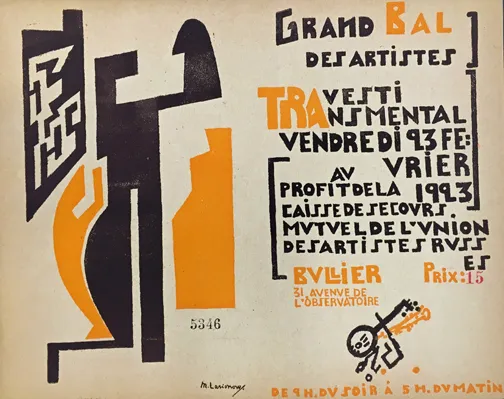
One of the regulars was the police captain Léon Zamaron. Known as an art enthusiast and advocate for the cause of artists, Zamaron created an association, "Aide Amicale aux Artistes," (AAAA) and assisted foreign artists with obtaining visas, resident permits, etc. (Yagil, 2015 page). He obtained numerous paintings from such artists as Soutine, Modigliani, Utrillo, Chagall, Foujita, Valadon, Vlaminck, and Zadkine.
In 1923, the AAAA organized in tandem with the Union of Russian artists, an event that echoed throughout the neighborhood, Le Grand Bal des Artistes Travesti-Transmental.
The Select: Established in 1923 or 1925 at 99 bd. du Montparnasse.
Known as the American bar, it was the first to remain open all night. According to Crombie (2005) page, it attracted mainly Anglo-Saxon writers rather than visual artists.
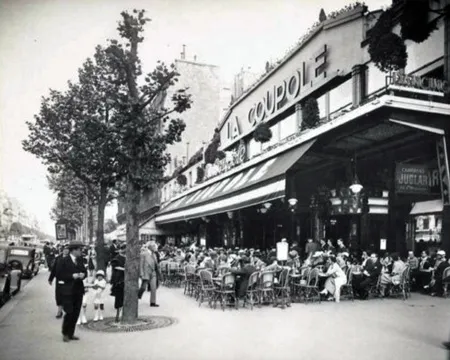
La Coupole: Established in December 1927 at 102 bd. du Montparnasse.
The owners, Ernest Fraux and René Lafon, converted an old wood and coal warehouse measuring 1000m² into an art deco haven, with frescoes painted by Fernand Léger, Moïse Kisling, Marie Vassilieff, Henri Matisse, and many others. Legend has it that 2500 guests reveled throughout the night during its opening. La Coupole, still open in 2020, rapidly attracted numerous artists, including Picasso, Fujita, Giacometti, Zadkine, Derain, Léger, Soutine, Man Ray, Brassai, and Kisling. Georges Viaud, former head-waiter turned historian, rightly remarks: “If the tables could talk, they would tell the story of La Coupole’s role in the history of 20th-century art.”
The University Women's Club and Montparnasse
Whether the women at 4 rue de Chevreuse actively participated in Montparnasse nightlife is unknown, but they certainly bathed in its bohemian context. Abbé Ernest Dimnet, longtime friend and neighbor of Reid Hall, who published the very popular self-help book, The Art of Thinking (1928), wrote an article about the culture of Montparnasse for The New York Herald Tribune on April 18, 1935. He describes the advantage which Reid Hall women have in being near the 'bohemian' hangouts but still safely ensconced in their Club's salutary environment: "As a matter of fact, American women are happier in so-called Bohemian Paris than their more unbridled brothers, because decency is necessary to every declaration of independence, and if you spend all your freedom in licentious rioting there is nothing left to be spent. I suspect that the college girls in Reid Hall secure the maximum enjoyment from being so near the Dome and the Rotonde while all the time preening their wings in their coy rue de Chevreuse" (page).
An interesting article from The Baltimore Sun talks about the substantial population of young women who chose not to live at the Club, opting for a more independent lifestyle. The article, "Girls in Paris Find Freedom," describes "hundreds of girls" living" 'independently' in their mansard garrets." The article's author, Sterling Heiling, interviewed one such young woman, asking if she didn't find the prospect of going broke in Paris "sordid." The girl, unnamed, replied: "'Such risks are stimulating to the artiste [...]. A Paris garret does not scare me,' she bridled. 'Students and attics go together. It is the everyday commonplace that throws cold water on the artiste'" (July 11, 1926, SF21). One wonders if those young women truly moved in Kiki's circles or if their choice of lodging and carefree attitude were mere affectation.
Artists: Matisse at 132 bd. du Montparnasse, 1927
Link to appendix listing ALL artists' studios/homes?