Josephine Miles Lewis (1865 – 1959)
Text based on initial draft submitted by Jacqueline Yu, B.A. in Art History and East Asian Languages and Culture, Columbia University in the City of New York, 2024. Columbia Global Virtual Intern, 2023 – 2024. Edited and expanded by Brunhilde Biebuyck.
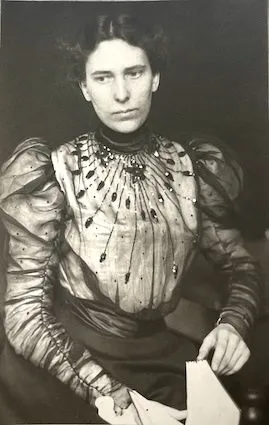
Josephine Miles Lewis was born on March 10th, 1865 to Henry G. Lewis and Julia Coley Lewis. Henry was president of the New Haven Wheel Co. and served as mayor of the company’s eponymous city from 1870 to 1877 (Letter from Ridgeway Hall to Judith Schiff, 29 August 1980). Her mother was an artist of some repute for her watercolors. As her father was both wealthy and politically powerful, Josephine was afforded many privileges that other women at the time were not. She attended private schools in her youth and began her studies at her father’s alma mater, Yale, through the recently established School of Fine Art in 1883, earning a technical certificate in 1887 (The Scituate Historical Society). After completing two additional years of advanced studies, a written thesis, and an original piece of work, Josephine was awarded in June 1891 the first bachelor’s degree for a student in the School of Fine Art as well as the second undergraduate degree for a woman at Yale. Josephine's achievement received widespread acclaim in the U.S. press, where it was recognized as a milestone not only for her personally but also for the Yale School of Fine Arts. In a September 17, 1891 article titled “The Yale Art School,” published in the now-defunct magazine The Independent, Susan Hayes Ward praised her accomplishment, emphasizing both its historical significance and the rigor of Lewis’s training:
For the first time since the founding of the Yale School of Fine Arts, a degree, that of Bachelor of Fine Arts, has been conferred by the University upon one of its pupils, Miss Josephine M. Lewis, who received the honor, had completed the prescribed courses of study, the three years’ technical course, and, after that, a course of advanced studies, continuing her connection with the technical department, and passing examinations in the history and criticism of art. In the Exhibition of Students’ Work, which is still on view at the Art School, a special display is made of Miss Lewis’s studies and sketches, which go far to prove her worthy of the degree (7).
Josephine's exhibition career seems to have begun in 1886 with the display of her work at the Yale School of Fine Art’s commencement exhibition, where she received the Ethel Childe Walker Prize—an award recognizing exceptional artistic development by an undergraduate art student. In February 1889, alongside other students from the Yale School of Fine Arts, she exhibited Waiting for the Procession (#81) in the 22nd Annual Exhibition of the American Water Color Society at the National Academy of Design, marking the beginning of a long association with the Academy. The following month, she presented two works at the Annual Exhibition of Local Artists and Amateurs at the Cutler Art Gallery in New Haven: Before the Rain, a landscape (#31), and Contentment, a study of a little girl with a doll. A year later, she returned to the National Academy of Design to exhibit Beach at Westhampton (#162) and Coming From School (#260) in the 23rd Annual Exhibition of the American Water Color Society (February–March 1890). That same year, she and her Yale colleague M.S. Miles Johnson were jointly awarded the “honor of especial excellence” for their compositions shown in the school’s year-end exhibition, which included 1,000 entries.
Henry G. Lewis, Josephine’s father, died on December 25, 1891, and was followed just days later by his spouse, who passed away on January 4, 1892. Their deaths left behind two daughters, Matilda and Josephine.
On July 27, 1892, the sisters sailed for Europe aboard the Majestic and settled in Paris, where they lived at 33 rue de Lubeck in the 16th arrondissement. According to some secondary sources, they traveled to Paris with their friend, miniaturist Alice Beckington, whom they would later see again in Giverny and with whom they eventually co-founded an artistic community in Scituate, Massachusetts.
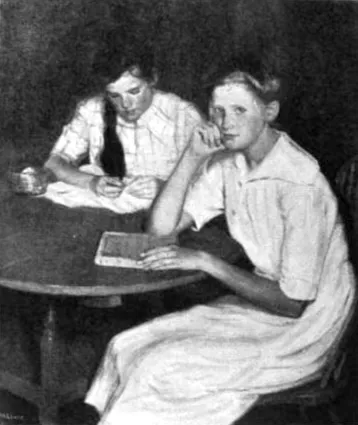
Josephine Miles Lewis continued her artistic training in Paris, Giverny, and possibly Holland. Newspaper sources and art historians suggest that Lewis may have studied under Symbolist painter Edmond Aman-Jean at the Académie Julian. Aman-Jean was not formally affiliated with the Académie, and Josephine may have worked with him privately. She is also said to have studied with Frederick MacMonnies, likely through private instruction in Paris, or possibly at the Académie Vitti or the Whistler Academy.
In Paris, Josephine showed Margery (#2263) at the 1893 Salon des Artistes français, and a “study” in the 1894 American Woman’s Art Association exhibition at the Girls’ Art Club. Secondary sources suggest that she exhibited at the Salon des Beaux-Arts in 1896 or 1897; however, her name does not appear in the official catalogues for either year.
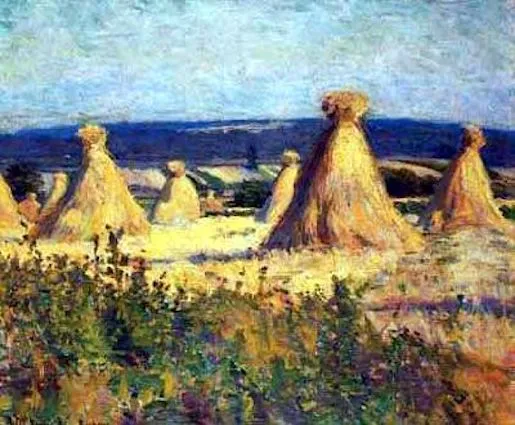
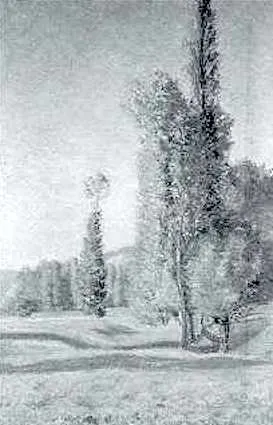
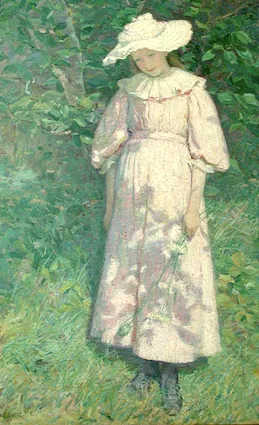
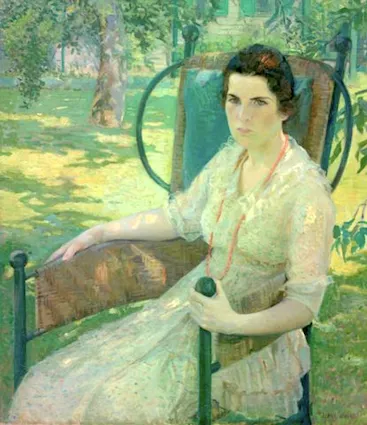
Lewis's connection with Frederick MacMonnies extended to Giverny, where she seemed to be present as early as 1892 and would return on a regular basis through 1897. Registration records published by art historian William Gerdts confirm her stay at the Hôtel Baudy—which provided low-cost accommodations for artists—on the following dates (225-227):
- March 5(?) – 20, 1894
- April 23 – July 2, 1894
- October 3 to November 10, 1894: According to Gerdts, she returned with her sister Matilda, Janet D. Pulsifer, and G. Hutchinson following a trip to Holland (118). From November 7-30, painter Paul Cézanne, who had been invited by Monet, spent a month at the same hotel (Gerdts 226). Matilda later recorded her impressions of him in a letter to their family—a typescript copy of which is held in the Yale University Art Gallery: When I first saw him, I thought he looked like a cut throat with large red eyeballs, standing out from his head in the most ferocious manner, a fierce, looking pointed beard, quite gray, and an excited way of talking that positively made the dishes rattle. I found later on that I had misjudged his appearance, for far from being fierce or a cutthroat, he was the gentle nature possible, “comme un enfant” as he would say. His manner at first rather startled me; he scrapes his soup plate, then lifts it and pours the remaining drops into the spoon; he even takes his chop in his fingers and pulls the meat from the bone. He eats with his knife and accompanies every gesture, every movement of his head with that implement, which he grasps firmly when he commence the meal and never puts down until he leaves the table; yet, in spite of the total disregard of the dictionary of manners, he shows a politeness towards us, which no other man would have shown. He will not allow Louise to serve him before us in the usual order of succession at the table; he is even deferential to that stupid maid, and he pulls off the old tam-o’shanter, which he wears to protect his bald head, when he enters the room (cited in Gerdts, 118).
- April 8, 1895: Josephine is identified as being in an atelier (“en loge”) at Giverny. Her painting Girl in Sunshine, seems to have been painted at this time (Gerdts, 117).
- June 4 – June 13, 1896: together with her sister
- April 13 – April 20, 1897: together with her sister
During her time in Giverny, Josephine was mentored by Frederick MacMonnies, who, along with his wife—the artist Mary Fairchild MacMonnies Low—had spent intermittent periods in the village before purchasing and restoring an abandoned priory, affectionately nicknamed “the MacMonastery.” Its garden was said to rival that of Monet (Gerdts 133) and was the scene of many of Mary's paitings. By all accounts, their home became a center for American artists, particularly MacMonnies’ Parisian students. Among his close friends in the Giverny art circle was designer and muralist James Wall Finn, who was married to Florence Lee Quinn, a second cousin of the Lewis sisters. In May 1955, Finn's spouse donated Josephine's painting In the Orchard (also identified as Portrait of a Woman) to the Yale art Gallery, together with the typescript of Matilda's description of Cézanne (Gerdts 235).
Unfortunately, little else is known about Lewis’s time in Europe, as she destroyed her diary—which contained reflections on her years abroad—shortly before her death (Letter from Ridgeway Hall to Judith Schiff, 29 August 1980).
Lewis returned to the United States in 1897 and established a studio in New York, dividing her time between the city and Scituate, Massachusetts, where she preferred to summer. According to the Scituate Historical Society, she moved into the newly constructed Carnegie Hall studios. Built between 1894 and 1897, they were the product of an ambitious collaboration between the Art Students League and philanthropist Andrew Carnegie, who envisioned a space where artists could live and work. The project was brought to life by renowned architect Henry J. Hardenbergh, whose design combined elegant residential features with practical studio spaces tailored to the needs of performing artists and painters. The painting that Josephine showed at the 22nd annual exhibition of the Society of American Artists in the spring of 1900 was her view of fifty seventh street from the Carnegie Tower (A’Becket, 324). She still lived there in 1936 (Peyser, 148) and seems to have moved out in 1943.
In this period, she exhibited sparsely and did not receive another award until 1916.
- 1900: Girl in a Hammock (#78) was shown in the 1900 First Annual New Gallery Exhibition organized by the Boston Art Students’ Association.
- 1906, Portrait of a Child (#635) was represented in the 101st Annual Exhibition of the Pennsylvania Academy of the Fine Arts.
- April 1907, her watercolor Herring Brook (#432) was represented at the Fourth Annual Philadelphia Water Color Club Exhibition at the The Pennsylvania Academy of the Fine Arts.
- 1907, Early Spring, Mass Coast (#99), owned by Mrs. George B. Phelps, in an exhibition of the National Academy of Design.
Although her career appeared to stall, Lewis was a founding member of the New Haven Paint & Clay Club, established in 1900—one of the oldest exhibiting art associations in Connecticut and the Northeast. This apparent stagnation may have had little personal impact. She reportedly declined commissions and did not rely on her art for income, likely supporting herself through an inheritance from her father (Letter from Ridgway M. Hall to Jules D. Prown, 17 March 1980).
Beginning in 1910, she focused exclusively on painting portraits of women and children (The Scituate Historical Society). She continued to exhibit her work in group shows, including with the National Academy of Design, the National Association of Women Painters, the Allied Artists of America, and the New Haven Paint and Clay Club (“Biographical Material”).
- January 1914: The portrait of a child was represented at the Vanderbilt Gallery in New York.
- December 1915: Interpretations of childhood were represented at the Mac Dowell Club exhibition in New York.
- January – March 1916: The Jungle Book (#284, oil); A New England Gentlewoman (#316, oil); Portrait of A Young Girl (#377, oil) in the 111th Annual Exhibition of the Pennsylvania Academy of the Fine Arts. It was purchased in 1922 by William Munroe of Muskegon, Mich. It was shown in February 1922 at the Hackley Art Gallery.
- March – April 1916: she was represented in the Ninety-first annual exhibition of the National Academy of Design, earning the Julia Shaw Memorial Prize, awarded to the “most meritorious art produced by an American woman” for her painting A Rainy Day (Schiff).
- January – March 1917: A Rainy Day (#56) in the 112th Annual Exhibition of the Pennsylvania Academy of the Fine Arts.
- May 1917: represented in the Exhibition of the National Association of Women Painters and Sculptors, at the Brooks Memorial Gallery, under the auspices of the Memphis Art Association.
- July 1917: Frederica, shown in the loan exhibition of the National Association of Women Painters and Sculptors, at the Brooks Memorial Gallery.
- March 1918: showed an unknown portrait at the Annual Exhibition of the National Academy of Design.
- April 1918: Showed A Rainy Day at 27th Annual Exhibition of the National Association of Women Painters and Sculptors.
- March – April 1923: Christine (#4) in the 98th Annual Exhibition of the National Academy of `Design.
She also won first prize, honorable mention, and the Elizabeth K. Luquiens Prize in the 1923, 1933, and 1939 annual exhibits of the New Haven Paint and Clay Club respectively (“Biographical Material”).
- February – March 1931: Unknown work at the Exhibition of Allied Artists at the Fine Arts building in New York City.
- 1933: the Springville High School Art Association granted Lewis a special award of honor for her painting “Henry” (Letter from Springville High School Art Association to Josephine M. Lewis, 1933).
Beyond her accolades, Lewis served as the treasurer of the National Association of Women Painters and Sculptors as well as the Artists of Carnegie Hall and maintained a busy, seasonal travel schedule between New Haven, New York, and Scituate, Massachusetts (“News of Art,” New York Times, 17 April 1937; “Heads Carnegie Hall Artists,” New York Times, 7 June 1938; The Scituate Historical Society).
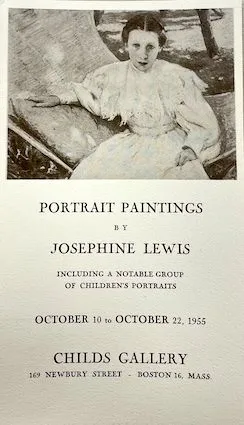
Lewis moved permanently to Scituate in 1943 (New York Times, 1959, 35). She continued to paint portraits of local children and, in October 1955 at the age of 90, she was honored with a solo exhibition of her portraits at the Childs Gallery in Boston. This was to be her last exhibition (The Scituate Historical Society).
Josephine Lewis died four years later on May 11, 1959. Her paintings are now held in the collections of the Mattatuck Museum, the Yale University Art Gallery, the New Haven Paint and Clay Club, the William A. Farnsworth Library and Museum, and the Lyman Allyn Museum (“Biographical Material”).
In the 1980s, Lewis’ first-cousin once removed, Ridgway M. Hall, pursued rigorous research into her life, aiming to assemble a retrospective and a catalogue (Letter from Ridgway M. Hall to Jules D. Prown). Although this project never came to fruition, his notes and archival materials on Lewis’ life were donated to the Archives of American Art where they now immortalize Lewis’ accomplishments and serve as an invaluable resource for future researchers (Letter from Ridgway Hall to Marius B. Peladeau, 5 February 1981).
Sources
- A’Becket, John J. “The Spring Exhibition,” Harper's Bazaar 1900-04-14: Vol 33 Iss 15, pp. 324-325. Internet Archive.
- American Art News, Vol. 15, no. 30, p. 5, 1917. Internet Archive.
- American Art News, Vol. 15, no. 35, p. 6, 1917. Internet Archive.
- Belanger, Pamela J. Maine in America, Farnsworth Art Museum, 200, p. 100. Internet Archive.
- The C Major Chord (Olivia Carter Hall). Boston Museum of Fine Arts.
- Cary, Elisabeth L. “Question Ages Old: Socrates Introduces New Work Placed on View Here by Two Women’s Groups.” New York Times, 15 April 1928, pg. 126. ProQuest Historical Newspapers.
- Catalogue of the 23rd Annual Exhibition of the American Water Color Society at the Academy of Design, 1890, pp. 11, 15. Internet Archive.
- Catalogue of the Annual Exhibition of the National Academy of Design, 1907, p. 37. Internet Archive.
- Catalogue of the Fourth Annual Philadelphia Water Color Club Exhibition, 1907. p. 38. Internet Archive.
- Catalogue of the 98th Annual Exhibition of the National Academy of Design, 1923 p. 10. Internet Archive.
- Dratch, Gladys I. Childs Gallery, Boston, exhibition chronology and publications, 1937- 1980 : listing of exhibitions, catalogues, checklists and sales publications with protocol, Boston Public Library; Childs Gallery, 1982.
- Fahlman, Betsy. “Women Art Students at Yalen, 1869 to 1913: Never True Sons of the University” Women’s Art Journal, vol. 12, no. 1, 1991, pp. 15-23. JStor.
- “Figure Subjects and Miniatures at Academy: Art at Home and Abroad.” New York Times, 31 March 1918, pg. 81. ProQuest Historical Newspapers.
- “French Engravings and Various Exhibitions: Art at Home and Abroad.” New York Times, 14 April 1918, pg. SM8. ProQuest Historical Newspapers.
- “Girl in the Sunshine,”Art Gallery, Yale.
- Gerdts, William H. Monet's Giverny : an impressionist colony, 1993, Internet Archive.
- Harper's Weekly, April 8, 1916, p. 358. Internet Archive.
- “In the Orchard,” Art Gallery, Yale.
- Hall, Ridgway. Biographical Material. Ridgway Hall Research Material on Josephine Miles Lewis, circa 1880-1981. AAA.Hallridge, Box 1, Folder 2. Archives of American Art, Smithsonian Institution, Washington, D.C.
- Hall, Ridgway. Letter to Judith Schiff. 29 August 1980. Ridgway Hall Research Material on Josephine Miles Lewis, circa 1880-1981. AAA.Hallridge, Box 1, Folder 3. Archives of American Art, Smithsonian Institution, Washington, D.C.
- Hall, Ridgway. Letter to Jules D. Prown. 17 March 1980. Ridgway Hall Research Material on Josephine Miles Lewis, circa 1880-1981. AAA.Hallridge, Box 1, Folder 3. Archives of American Art, Smithsonian Institution, Washington, D.C.
- Hall, Ridgway. Letter to Marius B. Peladeau. 5 February 1981. Ridgway Hall Research Material on Josephine Miles Lewis, circa 1880-1981. AAA.Hallridge, Box 1, Folder 3. Archives of American Art, Smithsonian Institution, Washington, D.C.
- Illustrated Catalogue of the Twenty-Third Annual Exhibition of the American Water Color Society, Held at the Galleries of the National Academy of Design, 1890, pp. 11, 15. Internet Archive.
- Jewell, Edward Alden. “Annual Exhibition by Allied Artists.” New York Times, 7 April 1934, pg. 18. ProQuest Historical Newspapers.
- “Josephine M. Lewis, 95.” New York Times, 12 May 1959, pg. 35. ProQuest Historical Newspapers.
- “Josephine Miles Lewis.” The Scituate Historical Society.
- “New Carnegie Hall Group to Open Its Gallery, Guided by Edwin Howland Blashfield.” New York Times, 23 September 1932, pg. 17. ProQuest Historical Newspapers.
- “News of Art.” New York Times, 17 April 1937, pg. 14. ProQuest Historical Newspapers.
- Peyser, Ethel, The House That Music Built: Carnegie Hall, Robert Mc Bride & Co., 1936
- Schiff, Judith. “The first female students at Yale.” Yale Alumni Magazine, September/October 2009.
- Springville High School Art Association letter to Josephine M. Lewis. 1933. Ridgway Hall Research Material on Josephine Miles Lewis, circa 1880-1981. AAA.Hallridge, Box 1, Folder 3. Archives of American Art, Smithsonian Institution, Washington, D.C.
- The Christian Science Monitor, vol 10, no. 130, 1918-04-29, p. N15. Internet Archive.
- The New York Times, January 04, 1914, p.15. Internet Archive.
- The New York Times, March 31, 1918, p. 14. Internet Archive.
- Ward, Susan Hayes. “The Yale Art School.” The Independent, 17 September 1891, vol. 43, pg. 7. ProQuest Historical Newspapers.
- “Work of American Portrait Painters at the Present Academy Exhibition – Some of the Recent Prize Winners.” New York Times, 18 December 1910, pg. SM15. ProQuest Historical Newspapers.
- “Works of Balthus Put on Exhibition.” New York Times, 18 March 1939, pg. 21. ProQuest Historical Newspapers.