Helen Waddell, 1889 – 1965
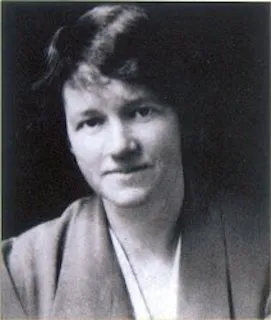
Helen Waddell was a lecturer, playwright, translator, and research scholar of Irish descent. Born in Tokyo in 1889, she spent the first 11 years of her life in Japan. She attended Oxford at the age of 31 and became a literary sensation in the late 1920s and 1930s.
Largely overlooked in the historical record, Helen Waddell's contributions to the literary world have recently gained recognition in academic circles. She is now acknowledged as a pioneering figure in historical fiction and an accomplished scholar of medieval history and literature.
The goal of this profile is to simply highlight her time as a resident at the American University Women’s Club, located at 4 rue de Chevreuse. Unfortunately, little information about her activities at the Club has survived, apart from a brief mention in Constance Mabel Winchell’s oral history interview about her own residency. By the time Winchell arrived in Paris in January 1924, Waddell had already returned to England. Winchell was assigned to the room that Waddell had occupied in 1923:
For the first month or two my room was the room occupied ordinarily by Helen Waddell. Helen Waddell was an Englishwoman, a scholar and a writer. She’s written a number of books, including The Wandering Scholars and Peter Abelard. I didn’t know anything about her then, but her room had a whole wall lined with books. The first couple of months I was there, then, I spent evenings reading her library – a very good one! (Winchell transcript 60-61).
It remains unclear whether Waddell ever returned to the Club or reclaimed her books.
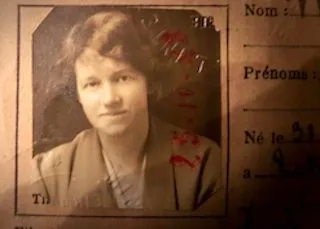
Waddell was a Susette Taylor Fellow whose two-year residency in Paris was supported by a scholarship of £200 per year from Lady Margaret Hall College, Oxford. She spent much of her fellowship at the Bibliothèque nationale researching an upcoming book and found herself “increasingly drawn to the 12th-century scholar and philosopher Peter Abelard” (Mosse, n.p.). This research led to several publications by Waddell on medieval imagination, including translations of poems and tales. The 1927 book The Wandering Scholars brought to light the history of 12th and 13th-century itinerant European clergy, known as goliards, whose lyrics included satirical critiques of the church, parodies of their fellow clergymen, and odes to drinking and lustful love. In 1929, she published its companion volume, Medieval Latin Lyrics, which included translations of several poems and songs by these goliards. Her fascination with Abelard led to the 1933 publication of her only novel, Peter Abelard, which explores the love and spiritual quest of Héloise and Abelard. According to Hugh Oram of The Irish Times, the novel was an immediate success:
[...] with 15 printings in its first year. It also made her a lot of money and she defied her many friends, one of whom warned her that a writer should never buy a house. Helen did just that, at Primrose Hill Road, close to Hampstead in north London. With the publication of Peter Abelard, Helen Waddell, who already knew most of the then current literary “greats” was propelled into mega-stardom, just like any top selling chick-lit author today, except Helen’ s work was grounded in intense academic research (n.p.).
In 1934, she published Beasts and Saints, a collection of stories drawn from medieval Latin chronicles of the saints, translated into English "without sophistication from the original Latin" (Preface, xi). These stories depict the "mutual charities between saints and beasts, from the end of the fourth to the end of the twelfth century" (Preface, xi). In 1936, Waddell published The Desert Fathers, a work about hermit monks who formed monastic communities in the desert, living lives of extreme asceticism. Waddell had translated their stories and sayings from a 1628 Latin collection.
She also authored other books and plays, contributed articles to The Standard, Manchester Guardian, and The Nation, and she served as assistant editor of The Nineteenth Century magazine.
Waddell died in 1965 after spending more than a decade in seclusion due to Alzheimer's disease.