Florence Blood (1866-1925)
Research and Text by Jacqueline Yu, B.A. in Art History and East Asian Languages and Culture, Columbia University in the City of New York, 2024. Columbia Global Virtual Intern, 2023 – 2024.
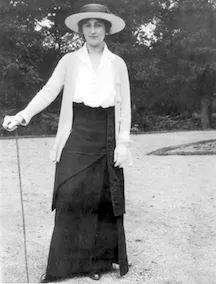
Florence Blood was likely born in 1866 in Wurttemberg, Germany. Her father, Henry Blood of Norwich, Vermont, was a wealthy businessman who frequently worked out of Europe. It was rumored that his constant sojourns had exhausted his wife, Caroline Laura Shelby of Nashville, Tennessee, and by the early 1870s, she chose to settle in Paris to raise their nine children. Thus, for the most part, Florence grew up in France.
As a young adult, she pursued painting, participating in the flourishing Parisian art scene of the 1880s. It was probably amidst the soirées, cafés, and clubs that she met fellow art student and famed beauty, the Romanian princess Catherine Jeanne Ghyka (née Kesko), who would become her life-long companion. Blood achieved moderate success in her early career, exhibiting four works at the 1895 Salon des Beaux Arts: a charcoal “Portrait de Mme G” and three pastels, “Portrait de Mme G,” “Portrait de Mme T,” and “Portrait de Sa Majesté la reine Nathalie.” The subject of the latter pastel, Queen Nathalie of Serbia, was the sister of Princess Ghyka.
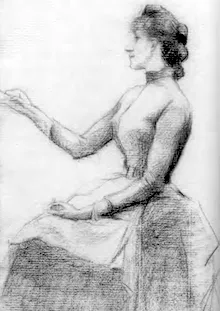
In late 1896, Ghyka and Blood moved out of France and into a verdant early seventeenth-century villa just outside of Florence, Italy. The Villa Gamberaia immediately became a subject of fascination for Ghyka. By 1900, the princess had designed and executed the addition of a water parterre to the garden. Sometime around 1902, she hired Martino Porcinai, the father of modernist landscape designer Pietro Porcinai, as her head gardener. It is unclear how involved Blood was in the renovation of the villa, although observers sometimes lumped the pair’s accomplishments together. Visitor Evelyn March Philipps, for example, referred to the two as “artists… who have initiative, who are not afraid to show that the world has gone forward, and that today can add beauty even to the most beautiful creations of yesterday” (Brown 18). Beyond their at-home advancements in landscape design, Ghyka and Blood joined a vibrant, scholarly, and sexually liberated community in the outskirts of Florence. They often hosted garden parties for international nobility, socialites, and literati.
In contrast to her companion’s reputation for reclusiveness, mystery, and oddity, Florence Blood was considered a prominent figure in the local expatriate community. Not only did she welcome guests and visitors at Villa Gamberaia, but she often visited Mary and Bernard Berenson at the nearby Villa I Tatti, and associated with American expatriates in Fiesole and Settignano. She upheld a long-standing correspondence with Gertrude Stein and even met Pablo Picasso through Stein in 1912 and 1913. Nicky Mariano, a friend of Blood’s niece Olga as well as the later lover of Bernard Berenson, described Florence as “a dainty small woman in a long velvet dress with a magnificent blue-grayish Angora cat on her lap… very gracious and welcoming” (Osmond 17). Rumors abounded that Blood was of an amorous sort, having attempted to seduce an unnamed American who designed the Florentine railway station, Hutchins Hapgood, as well as Bernard Berenson and others.
Beyond fulfilling social obligations, Blood also handled all of the administrative tasks for the estate. According to her nephew, Basil Sanderson, who sometimes vacationed at the Villa Gamberaia, Princess Ghyka “dominated” the garden while Blood coordinated staff, wages, food, and bills. They lived in separate suites and would meet at prescribed times of the day: seven in the morning for a long walk through the poderi (farms), mealtimes, and again in the evening. When they were not together, Blood would siesta, venture into the city to shop for supplies, and paint.
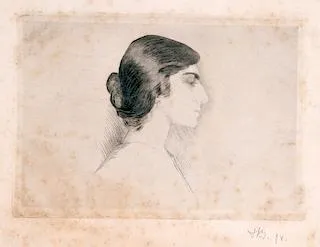
Florence Blood continued to pursue her artistic interests after moving to the Villa. She was known to paint in the style of Cézanne and was praised for her excellent reproductions of his work. In 1906, Blood showed another painting at the Salon des Beaux Arts. The following year, she exhibited four pieces at the American Woman’s Art Association (AWAA) annual exhibition at 4 rue de Chevreuse. Her work entitled “The Garden” (likely that of the Gamberaia) was lauded by The New York Herald (“American Women Artists Hold Annual Exhibition” 6). It is possible that during this 1907 sojourn as well as other personal travels to Paris, Blood stayed at the Girls’ Art Club. Or she may have stayed at the home of someone in her extensive network of friends in the city.
At the outbreak of WWI in 1914, Blood and Ghyka left Villa Gamberaia and headed to the southwestern French city of Biarritz where Ghyka’s sister, Queen Nathalie, had settled after being rebuffed by her husband. For the next three years, Blood and Ghyka ran a war hospital out of the Queen’s Villa Sachino, where they treated hundreds of wounded soldiers. In a letter to Gertrude Stein, Florence wrote:
We have forty-five beds, a resident doctor, four sisters, a chaplain & innumerable servants. I boss them too! & never have I had the feeling of doing a job as well. Every faculty I have is used to its utmost, & all I do is absolutely within my line… This whole experience has been most interesting & I consider it a great privilege to have had work to do in these awful days… (Matarrasso 36).
Although Blood found much joy in her new work, she was emotionally and physically exhausted by 1917, when she and Ghyka returned to Villa Gamberaia. Possibly afflicted with a serious, debilitating illness or drained by the stress of the conflict, the couple became reclusive “invalids” and neither regained prominence in society. Florence Blood died on October 20th, 1925 at the Villa di Doccia and was subsequently buried in the cemetery of Settignano. In an obituary published on November 3rd, 1925, Frances C. Platt writes “No soldier died more valiantly for the world’s peace and safety than did she.”
Sources
- “American Women Artists Hold Annual Exhibition.” The New York Herald [European Edition], 18 February 1907, p. 6. International Herald Tribune Historical Archive, 1887-2013, link.gale.com/apps/doc/IXRNVN860926624/IHTO?u=columbiau&sid=bookmark-IHTO.
- Brown, Jessica. Expatriate Gardens in Tuscany: Planting Ideas of Nationality. 2017. University of Virginia, Master’s Thesis. https://libraetd.lib.virginia.edu/downloads/xg94hp99r?filename=1_Brown_Jessica_2017_MARH.pdf.
- Campbell, Katie. Paradise of exiles: the Anglo-Florentine garden. 2007. University of Bristol, PhD dissertation. https://hdl.handle.net/1983/e49a8660-b551-4250-a503-a263a3cb62c4.
- Matarrasso, Pauline. A Voyage Closed and Done. Norwich, Great Britain, Michael Russell Publishing Ltd., 2005.
- "Obituary." The New York Herald [European Edition], 30 Oct. 1925, p. 4. International Herald Tribune Historical Archive, 1887-2013, link.gale.com/apps/doc/FWGJQK193063867/IHTO?u=columbiau&sid=bookmark-IHTO
- “Ont quitté Paris.” Excelsior: journal illustré quotidien: informations, littérature, sciences, arts, sports, théâtre, élégances, 13 April 1913. Gallica.
- Osmond, Patricia J. Revisiting the Gamberaia: an anthology of essays. Florence: Centro Di, 2nd ed., 2014.
- “Passengers on the Ocean Liners.” Chicago Daily Tribune, 11 May 1895, p. 2. ProQuest Historical Newspapers: Chicago Tribune. http://ezproxy.cul.columbia.edu/login?url=https://www.proquest.com/historical-newspapers/change-police-justice-system/docview/175028811/se-2?accountid=10226.
- Platt, Frances C. “Tribute to Miss Blood.” The New York Herald [European Edition], 3 November 1925, p. 4. International Herald Tribune Historical Archive, 1887-2013, link.gale.com/apps/doc/DUJPLV172592717/IHTO?u=columbiau&sid=bookmark-IHTO.
- Rolle, Elisa. “Florence Blood.” Queer Places. http://www.elisarolle.com/queerplaces/fghij/Florence%20Blood.html. Accessed February 1, 2024.
- “Salon of Champ de Mars: Remarkable Paintings and Sculptures of the Annual Exhibit.” New York Times, 21 April 1895, p. 5. ProQuest Historical Newspapers: The New York Times with Index. http://ezproxy.cul.columbia.edu/login?url=https://www.proquest.com/historical-newspapers/salon-champ-de-mars/docview/95322041/se-2?accountid=10226.
- Schnadelbach, R. Terry. Hidden Lives/Secret Gardens: The Florentine/Villas Gamberaia, La Pietra and I Tatti. iUniverse, Inc., 2009.
- “THE BLOOD ESTATE: Important Chancery Sale by the Clerk and Master Yesterday,” Daily American [Nashville, Tennessee], 17 February 1893, p. 3. ProQuest Historical Newspapers: The Nashville Tennessean (1812-1922). http://ezproxy.cul.columbia.edu/login?url=https://www.proquest.com/historical-newspapers/blood-estate/docview/929379340/se-2?accountid=10226.
- Thomas, Kate. “Lesbian Arcadia: Desire and Design in the Fin-de-Siècle Garden.” Graduate School of Design Spring 2021 Public Program, 18 February 2021, Harvard University. Online Lecture. https://www.gsd.harvard.edu/event/kate-thomas-lesbian-arcadia-desire-and-design-in-the-fin-de-siecle-garden/.