ENS des Jeunes Filles de Sèvres
The Sévriennes at Reid Hall
After much discussion and lengthy negotiations with the French Ministry of Education, Reid Hall was rented to the École normale supérieure des jeunes filles de Sèvres. This arrangement was initially proposed to Dorothy Leet by Mme Octave Monod, President of the French committee of the International Federation of University Women. The Board in New York had not wanted Reid Hall to remain vacant and the presence of a French school under protection of French ministry of education would guarantee the maintenance of the property while, most importantly, preventing German requisition and occupation. On September 4, 1941, Mr. Soulas dispatched a radiogram to Helen Rogers Reid at the Herald Tribune in New York confirming the impending occupation of the property by the Sévriènnes.
This was a remarkable opportunity for the French student to pursue their education. The 1937-39 graduating class had been sent home and their building in Sèvres had been occupied by the Germans, who transformed it into a military compound and basically ransacked the premises. The deal to move into 4 rue de Chevreuse was finalized by Mme Cotton, head of the Ecole de Sèvres (later replaced by Edmé Hatinguais-Marc, and then by Lucie Prenant in 1944): the "Sévriennes" were granted Reid Hall as their headquarters until August 1, 1946. The literary track was housed at rue de Chevreuse while the mathematics/philosophy/history track was housed at the Maison des étudiantes, 214 Boulevard Raspail. Students attended the Sorbonne and other institutions, but classes were also held at Reid Hall, whose dining facilities were open to all. The French Federation of University Women (AFDU) continued to hold its monthly meetings at the Hall throughout the war.
One Sévriènne recalled her stay at Reid Hall (translation from the French):
"The old house of the rue de Chevreuse was a haven for us. We immediately felt at home; quickly, we were happy to live there together, in a closed space where we felt protected from the aggressive presence of the Germans [...] Agreeably open onto the garden through its large windows, the dining room rustled with animated conversations [...] At 7:30pm, our concierge and zealous guardian, the fearsome Joseph, shut the heavy door giving onto the outside world on the rue de Chevreuse [...] our nights were sometimes interrupted by the howl of sirens. Aerial alerts! we had to leave our rooms running to the basement of a neighboring convent that served as shelter [...]" (P. Patois-Pinaud).
In the winters, the Sévriènnes especially endured the privations of war:
"Heat, except for the conquerors and their collaborators, was an unavailable luxury. ...Teachers and students huddled together at the stone hearth of the Grande Salle, feeding the flames with the improvised firewood of broken tables and chairs" (Davenport 31).
A Former Student Returns to Reid Hall
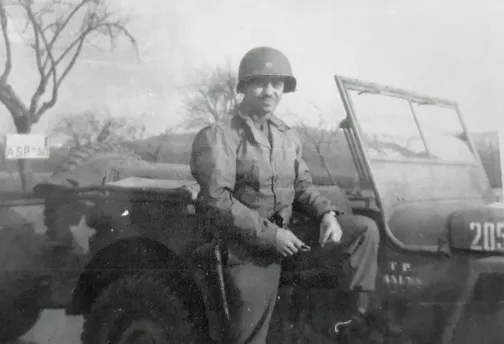
Scott Frederick Runkle, a U.S. Army Major who had landed on Omaha Beach on D-Day, was among the first Americans in uniform to enter Paris in August 1944. He brought his regiment to Reid Hall, which he had known as a Dartmouth student while studying at Sciences Po in 1936-37. His memories of that emotional return are gripping:
" [...] By the time we had sent our last report, and had drunk innumerable toasts at the Invalides, it was late in the evening and we were exhausted, having had little sleep for 48 hours. We could not leave our jeeps unattended and were too tired to mount guard over them. We had to find shelter for them so we could sleep. I immediately thought of Reid Hall, with its stout outer door and inner courtyard. It must have been about 11p.m. when we drew up at 4, rue de Chevreuse, which seemed very silent, contrasted with the noisy celebration on at the blvd. Montparnasse nearby. I knocked on the door. After some delay, an old man opened it cautiously, then ran back inside, shouting: "Les américains ! Les américains sont là !" We were still waiting outside, but the sound of people bustling inside grew, until a very large woman of middle age appeared, grabbing me in a mountainous embrace. She was, we learned, Mme. l'économe of l'Ecole Normale de Sèvres.The doors were opened wide so we could drive our jeeps inside. Then all the young women of the school descended on us, in a state of high emotion and curiosity. I, of course, had no idea that Reid Hall had been taken over during the Occupation by the Ecole de Sèvres. All we wanted to do was to sleep. All they wanted to do was talk. So we talked for some hours, about la France, les Etats-Unis, la guerre. One wanted to know if Cherbourg was badly damaged; I reassured her that it had suffered little in the fighting, but Caen and St. Lô... that was different. Les jeunes filles were excited but we became increasingly inarticulate with fatigue. Finally, we were given beds on which we fell gratefully, without even bothering to undress. We stayed at Reid Hall for several days until we were assigned regular quarters, but during that time we saw much of the young normaliennes, who were delightful. There was much picture-taking of the girls sitting in our jeeps in the courtyard, and... in those few days which were very unstructured, we would take them for rides in our jeeps. They found this particularly felicitous. No romances, sorry, but much camaraderie, until we were whisked off to our assignments, scarcely looking back, which was the way things happened in the army in wartime. La guerre, c'est laisser les choses derrière, même des moments délicieux comme celui de la "libération" de Reid Hall. It was only later that I reflected on the symbolism of those days, and that I, a former denizen of Reid Hall, had had the honor of playing a modest role of seeing it restored to its ancient freedoms" ("Some recollections of Reid Hall on August 25, 1944", Reid Hall archives).
The Liberation
Victor Soulas was stripped of his access to Reid Hall's financial accounts when he was arrested for collaboration with the Germans. He was temporarily released in early 1945 but further information about him is not extant. Renée Brasier at the Herald Tribune was given power of attorney in his stead. She appointed a solicitor to attend the opening of Soulas' safe at the Morgan bank in Paris, where his personal funds were frozen but where he also kept 43,000 francs belonging to Reid Hall and 112,000 francs belonging to the Paris Herald (January 5, 1945 minutes of the meeting of the Executive Committee of Reid Hall Inc.) .
In April 1945, even before V-E Day, Virginia Gildersleeve wrote to then Secretary of State Edward R. Stettinius, Jr., requesting permission to send Dorothy Leet back to Paris to survey the conditions at 4 rue de Chevreuse with an eye toward reopening the Club as an educational center. Gildersleeve notes in her letter, "The break in our cultural relations with France has been, of course, very serious, and anything that can be done to pick up the threads again should certainly be undertaken as soon as may be possible."
In spite of their determination, Gildersleeve and Leet would not be able to reopen the American educational center at Reid Hall until September 1947. The Sévriènnes negotiated a one-year extension for their lease since they had not yet found a new home for their school.
Sources
Davenport, William W. An old house in Paris: The story of Reid Hall, 4 rue de Chevreuse, Paris VI. France: Reid Hall, Inc., 1970. Reid Hall archives.
Gildersleeve, Virginia. Letter to Secretary of State Edward R. Stettinius, Jr. April 1945. Reid Hall archives.
Minutes of the Meeting of the Executive Committee of Reid Hall, Inc., January 5, 1945. Reid Hall archives.
Patois-Pinaud, P.
Runkle, Scott Frederick. "Some recollections of Reid Hall on August 25, 1944.” Reid Hall archives.
Soulas, Victor. Radiogram to Helen Rogers Reid, September 4, 1941. Reid Hall archives.