Catharine Carter Critcher (1868 – 1964)
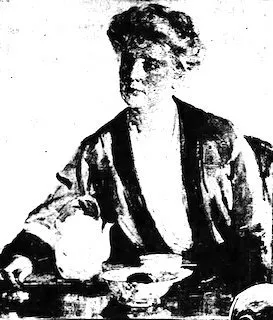
![Harris & Ewing, photographer. CRITCHER, C., MISS. [Between 1905 and 1945] Photograph. Retrieved from the Library of Congress](/sites/reidhall.globalcenters.columbia.edu/files/styles/cu_crop/public/content/Critcher/Critcher%20Painting%2C%20Library%20of%20Congress.jpg.webp?itok=IJG541SL "Harris & Ewing, photographer. CRITCHER, C., MISS. [Between 1905 and 1945] Photograph. Library of Congress. This very image appeared in the Washington Post, June 5, 1921, p. 59")
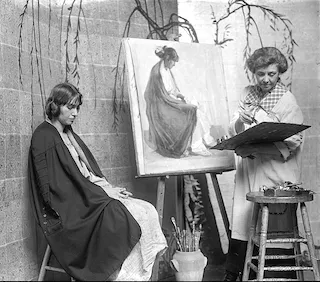
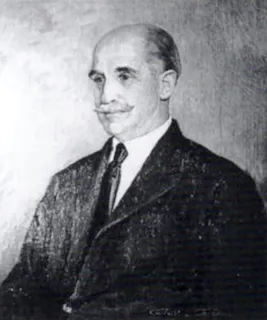
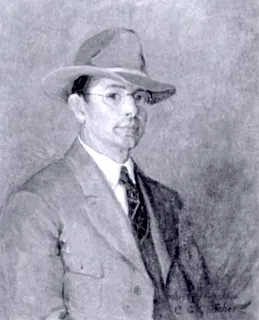
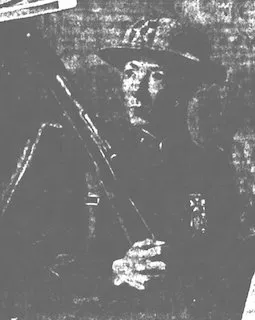
Catharine Critcher was born in Westmoreland County, Virginia, often called the "Athens of Virginia" because it was the birthplace of many eminent leaders, including George Washington and James Monroe. She was the youngest of five children of circuit court judge John Critcher—a multi-term member of Congress, who had studied for three years in Paris—and Elizabeth Thomasia Kennon Whiting Critcher. She spent her childhood at Audley, the family plantation in Oak Grove, Virginia. The family moved to Alexandria in 1884, where her father had established his own law firm. The family settled in a ten-room home.
As we shall see, Critcher’s reputation as a skilled portraitist was established early through numerous commissions depicting Virginia’s social and political elite, including prominent politicians, military men, religious figures, artists, and friends. Portraiture remained central to her artistic practice throughout her career. In nearly every exhibition in which she participated, critics praised her remarkable ability to capture both the likeness and the inner character of her sitters—often with a precision that approached photographic realism. Her portraits were widely admired for their technical excellence, emotional sensitivity, and meticulous attention to detail. One of her earliest portraits is a life-size depiction of her father (c. 1896), which she donated, together with her sister Mrs. Nannie C. Gatewood, to Westmoreland on May 3, 1910 on the "occasion at Montross of presenting and accepting the portraits, tablets and statues so generously given to Westmoreland county, and in public recognition of the gifts" (cited in T.R.B. Wright, 10).
While Critcher’s contributions to the art world in the United States—particularly her work in New Mexico—have been acknowledged in most publications, her activities in Europe have received far less attention. This article therefore focuses on her early years, as well as the time she spent in Paris and other parts of Europe, with particular emphasis on the exhibitions in which she presented her work.
The Early Years
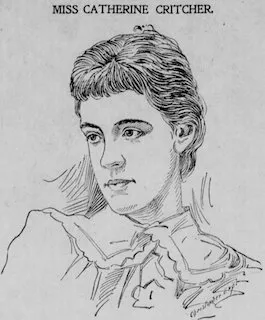
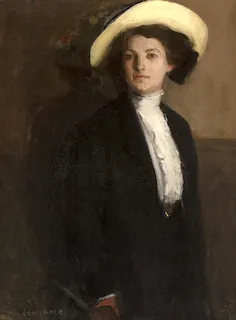
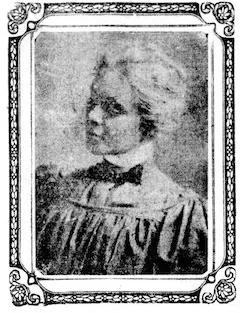
Critcher’s education included studies at the Arlington Institute in Virginia, followed by Cooper Union in New York City, where in 1890 she earned a bronze medal among a class of 80 students. On December 1, 1890, Critcher and Marietta Minnigerode—assistant to E. F. Andrews, founder and director of the Corcoran School—opened free art classes in two large rooms of the library in the Peabody public school building. They offered private instruction two nights a week and organized exhibitions of their students’ work. Admission was based on drawing submissions, and approximately fifteen students were accepted into the program. Approximately 15 students were admitted, based on drawing submissions. They were joined by Katherine Honk and Hallie Ramsey. The classes continued through at least 1897, with new instructors joining over time, while Critcher remained actively involved throughout.
Critcher continued her artistic training at the Corcoran School of Art in Washington, D.C., winning a gold medal for her work in 1892:
The committee to award the gold medal for the best drawing and greatest improvement in the Corcoran school of art were confronted upon entering the school by 72 drawings, the work of 12 competitors for the gold medal. There were, besides these, many other drawings by these competitors scattered among a collection of 625 drawings, the whole exhibition representing the work of some 110 students, comprising elementary, intermediate, antique, and life classes. The committee gave the gold medal to Miss Catherine Critcher [...]The industry and earnest work of the school may be better understood when one considers that the 625 drawings have been selected from some 2500 made since October 1, 1891 (“Notes and Novelties” 253).
In the summer of 1894, Critcher and Minnigerode spent July and August in Shinnecock, Long Island studying under William Merritt Chase. During this time, Critcher also completed a portrait bust of General Whiting of Mobile, Alabama, and helped establish a new sketch club dedicated to weekly sessions with costumed models. The Evening Star shared a description of one of those sessions:
Last Tuesday evening, the sketch club was entertained by Miss Catherine [sic] Critcher at her [father’s] home in Alexandria. Quite a large party of artists and students enjoyed her hospitality, and tested the patience of a self sacrificing youth, who posed in all the glories of the regulation cowboy outfit. The number of clever sketches were made, and everyone had an intensely enjoyable time (November 10, 1894, 13).
In November that year, she participated in a loan exhibition for the benefit of the Eastern Dispensary, a charitable organization that supplied immediate medical assistance to those who could not afford it.
In recognition of her talents, the Society of Washington Artists invited her to become a member in 1896; the letter nominating her was published in the Alexandria Gazette: "Dear Miss Critcher: I take pleasure in notifying you that at the meeting on March 10th, you were unanimously elected a member of the Society of Washington Artists. Very truly yours, W. B. Chilton, Secretary (March 17, 1896, 3). She was elected together with Bertha E. Perrie and Jane Brigdham Curtis and served on its executive committee from 1911 to 1931.
- February 1896: Showed Georgiana in the sixth annual exhibition of the Society of Washington Artists at the Cosmos Club.
- December 1896: Exhibited a charcoal head study in the first annual show of the Water Color Club at the Cosmos Club.
In 1897, Critcher studied at the Washington Art Students’ League, taking Louise Hull’s portrait class and participating in the life class taught by Edmund Clarence Messer, a founding member of the League in 1886 who remained on its faculty until it closed in 1902. Messer then became principal of the Corcoran School of Art, a role he held until 1918, and also served as president of the Society of Washington Artists and vice president of the Washington Water Color Club. At the time, Critcher maintained her own studio at the old Minor house in Alexandria (R. Wright 36).
- March 1897: Elected a member of the Watercolor Club in March 1897.
- April 1897: Showed a portrait of John S. Mosby in the seventh annual exhibition of the Society of Washington Artists, also held at the Cosmos Club. The portrait was then shown at the Women’s exposition of the Carolinas in Charlotte, North Carolina.
- May 1897: Represented in the Washington Art Students League’s exhibition showcasing student work from the academic year.
- June 1897: Received the prize for drawing at the end of the year at the Arlington Institute.
- December 1897: Represented in the Water Color Club’s second annual exhibition at the new gallery of the Society of Washington Artists on Connecticut Avenue.
In 1898, Critcher once again enrolled at the Washington Art Students’ League, attending Messer’s women’s life class and Hull’s class on antiques and portraits.
- April 1898: Exhibited in the annual show of the Students’ Art League.
- April 1899: Showed a portrait “head” in the ninth annual exhibition of the Society of Washington Artists at the space on Connecticut ave.
- It appears that Critcher did not participate in the Society of Washington Artists' tenth annual exhibition in April 1900, but she did exhibit in its eleventh, held in March 1901 at the Corcoran Art Gallery.
In addition to pursuing her own education and exhibiting her work, she also taught at the Alexandria Art School, housed in the Peabody building. In addition, according to the Richmond Times Dispatch, she was "[...] solicited to take charge of the Art Department of the Mary Ball Seminary, Staunton, Virginia with a splendid salary" (July 16, 1899, 11)—suggesting an early and sustained commitment to art education alongside her own developing practice.
Bridging Two Worlds: Between France and the United States
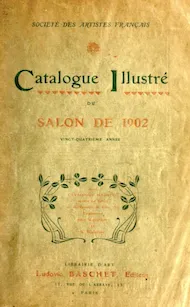

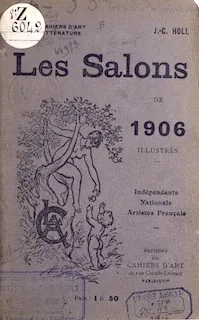

Although most sources claim that Critcher first traveled to Paris in 1904, she actually made her initial trip in September 1901, having received “the compliment of a round-trip ticket to Europe during the summer on the Cunard line of steamers” (Thomas Wright 87). It is worth noting that her father died on September 27, 1901 and her mother died several years later on February 26, 1904. Club resident Alice Searle described her arrival in Paris:
She is one of the most fascinating, lovely girls I ever met. More charm of manner and voice than of person. She is of a fine old, southern family, I hear, and when she had been here only a week (came over alone), she heard of her father’s death. Very sudden for when she left home he was perfectly well. It all happened before I came and the girls all say she has been so brave and good and Miss Acly has been most kind to her. She is so bright and jolly one would never have suspected, but I surmise she is now working hard in sheer desperation. Hers is an example of why a girl should not come over here alone and less well informed as to destination and surroundings. Her father arranged for her to go to a pension on the right bank of the Seine where special inducements were made to our students. but, coming over on the steamer, she heard that this woman who kept this place was a fraud and the whole thing a scheme to get art students to go there and then cheat them. Two other girls on the seamer were coming to the club so she came with them. Miss Acly confirmed the story about the so-called Institute, so that she had a narrow escape. I feel very sorry for her. She knows the Kingsolvings very well and the bishop’s wife was her chum at college. Mimi was delighted with her and wants me to bring her to tea some night (Letters from Paris, 65).
Critcher thus stayed at the Girls’ Art Club where she befriended several women with whom she shared outings and evening conversations. She Alice Searle, a certain Miss Church, and Mary Smyth Perkins met regularly after dinner in order to drink a cup of hot milk:
Our little party, as we call it, met in my room tonight, and the last guest of the four has just departed, carrying her milk-mug with her. It seems very like college sprees (Miss Church and Miss Perkins are here on scholarships). We all sit on the floor around the little stove, and when the milk boils, pour it into very artistic mugs and sip it with crackers, and on rare occasions, cakes, donated by one of the four. We call one another by our last names, in real college fashion, and I am getting quite accustomed to the Searle address. Miss Critcher says she sleeps much better for the hot toddy, while I am getting so stout my new jacket fits quicker than ever (Letters from Paris 69).
Critcher enrolled at the Académie Julian, where, according to Searle, she worked all day (Letters from Paris 65). At Julian's, she studied under Jean-Paul Laurens and possibly Charles Hoffbauer, an associate of the Académie with whom she would later collaborate. She earned the third honorable mention in an exhibition of the school featuring over 500 artists (Alexandria Gazette, March 10, 1902, 3). According to Searle, Critcher also attended Mme de Billemont-Chardon's miniature workshop.
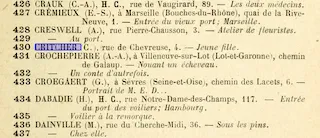
In May 1902, she exhibited Jeune Fille (no. 430) at the Salon des Artistes Français held at the Grand Palais. In the Orsay "Base Salon," her name appears as "Critcher (Cacharme)," with her birthplace listed as Virginia. Her Paris address is given as 4 rue de Chevreuse, and her instructor is noted as Jean-Paul Laurens.
Critcher returned to Washington in September 1902. She taught art classes at the Gunston Institute in Arlington, took a studio on F street, and began working on a genre painting titled American Interior, depicting a little girl in an old-fashioned rocking chair.
In 1903, Critcher continued teaching art classes at Gunston Hall in Arlington and completed a painting of Reverend Dr. Crawford, Dean of the faculty, Virginia Episcopal Theological Seminary.
- February 1903: Showed several works at the thirteenth annual exhibition of Washington artists at Corcoran Art Gallery. According to the Alexandria Gazette, among the works she exhibited were Emeline, the three-quarter-length portrait she had previously shown at the Paris Salon and which still bore its entry number on the frame. She also showed A North Hollander, painted during her travels in Holland (February 10, 1903, p. 3).
- May 1903: Exhibited fifteen oil paintings at the Veerhoff Gallery in Washington, D.C., including portraits of senator Charles J. Faulkner’s wife (painted in early May); Mr. Doyle of Philadelphia; a large Dutch genre scene, Dutch Smoker; a portrait of her father; Woman Reading; Emeline; A Girl in a Red Dress; Portrait of a Young Man Reading, and Old Man.
Tragically, in May 1904, a fire, caused by the explosion of an oil stove, destroyed the entire contents of Critcher’s studio on F Street, reducing to ashes five years worth of artworks, including her father’s portrait, Emeline, and most of the paintings she had completed in Europe.
In June 1904, she took three of her students—including Bertha Perrie, who would later oversee the art classes at Gunston in Critcher’s absence—on a study tour to Volendam and Laren in Holland, as well as Brittany. They remained abroad until October 1904 (Alexandria Gazette, June 1, 1904; Evening Star, April 23 and June 1, 1904).
By 1904, she had established a large art school in Paris. According to the Evening Star (August 26, 1905), she "fitted up a series of studios in the Latin Quarter with artistic accessories, engaged good models, and with rare wisdom, associated herself with two or three artists who had already attained reputations as painters and teachers." This endeavor became known as the Cours Critcher Painting School. Artists associated with her school included: Richard Emil Miller, originally from St. Louis, a member of the Giverny Colony of American Impressionists, Charles Constantin Joseph Hoffbauer, born in Paris but became an American citizen in 1941; Thomas R. Congdon, originally from New York. A 1909 review in the Evening Star praised her efforts:
For an American to attempt to teach art in Paris, the great teaching center of the world, might seem the height of presumptuous folly, but the need was real, and hence the venture was successful. The French schools demand a long apprenticeship and lay utmost stress upon academic accomplishment. The average American student going to Paris is unprepared for this kind of training and is unable to profit from a brief course of instruction, having most frequently comparatively little time at his or her command. It was to meet these conditions that Miss Critcher opened her school, organizing it in accordance with French custom and securing able instructors. Naturally, this occupied much of her time, but she continued her own studies, received numerous portrait commissions, and exhibited regularly at the Salon (April 17, 1909, 26).
- May 1905: Exhibited Portrait de M. (n° 501) in the Salon des artistes français at the Grand Palais. She listed her address as 86, rue Notre-Dame-des-Champs, where Whistler had his studio from 1892-1902, and Max Beckmann had his studio beginning in 1903.
Critcher returned to Alexandria in June 1905 but by September she was back in Paris, joined in November by her sister Lulie, who remained by her side until June 1908. Between 1906 and 1908, she participated in several exhibitions:
- February 1906: Served on the hanging committee for the American Woman’s Art Association’s annual exhibition at the Girls’ Art Club, where the jury included Richard Miller, Walter Gay, and Florence Esté.
- May 1906: Showed two paintings at the Salon des Artistes Français at the Grand Palais: Portrait de Miss H (No. 438) and Un vieillard (No. 439), while residing at 17 rue Campagne Première.
- October 1906: Sent her portrait of Miss H to the annual exhibition at the Art Institute of Chicago, which opened on October 16.
- February 1907:
- Head of an Old Woman in the annual exhibition of the American Women's Art Association at the Girls’ Art Club.
Submitted a portrait of Bladen T. Snyder, which she had painted in Paris in c. 1906, to the 102nd annual exhibition of the Pennsylvania Academy. The Evening Star reviewed the exhibit as follows:
One of the most noteworthy portrait studies in the Pennsylvania Academy's 102nd annual exhibition, which is now in progress in Philadelphia, is by Catherine Critcher, a member of the Society of Washington artists. It is, presumably, a likeness of Mr. Bladen T. Snyder of this city, but was painted in Paris a year or more ago. He wears a picturesque black felt hat and brown, velveteen suit, and is seated with his right arm on the back of his chair, which is placed sideways. The background is dark and the treatment simple, but the values have been well sustained, and the brushwork shows both maturity and knowledge. The picture has been shown in the Paris salon, and in the present exhibition is attracting favorable attention (February 2, 1907, 23).
- April 1907: Visited Rome in the company of a large group of American students.
- May 1907: Showed Ma Femme de Ménage (n° 444) in the Salon des artistes français at the Grand Palais, listing her address as 8bis rue Campagne-Première in the Montparnasse district, and identifying her teachers as Richard Miller and Ch. Hoffbauer.
- November 1907: Devant la Glace in the exhibition of the Lodge Art League at Holy Trinity Lodge on the rue Pierre Nicole a stone’s throw from the Montparnasse district.
- Early 1908: Elected president of the American Woman's Art Association in Paris (The Washington Herald, February 16, 1908).
- March 1908: Presided over the American Woman’s Art Association's fourteenth annual exhibition at the Girls' Art Club, where she showed two portraits, Margaret and Miss Van H.
- May 1908: Portrait de Miss Margaret Smith (No. 448) and Intimité (No. 449) in the Salon des Artistes Français at the Grand Palais. She still listed her address as 8bis rue Campagne Première.
Critcher returned to Washington in September 1908, where she painted a portrait of Mrs. Charles J. Faulkner of Boydville, Martinsburg, West Virginia. She later opened a studio at 1783 Riggs place in Washington and participated in several art exhibitions:
- December 1908: Portrait in the exhibition of over four hundred contemporary American paintings at the Corcoran Gallery.
- January 1909: Portrait of a young girl in a black hat with blue plumes at the Philadelphia Academy exhibition.
- March 1909: Portraits of Mrs. Charles Hewett Wright and Miss Dorothy Duncas Gatewood, in the 18th Annual Exhibition of Washington Artists at the Corcoran Gallery.
- April 1909:
- Students at the Corcoran Art School exhibited a parody of one of Critcher’s paintings—a depiction of a girl with a wooden arm—at the "Fake Show" organized in the Mud Room.
- Exhibited twelve recent works at the assembly hall of the Cosmos Club in Washington, D.C. Among them were several pieces that had previously been shown at the Paris Salon, the Pennsylvania Academy of the Fine Arts, and the Corcoran Gallery. New works included a full-length portrait of a young woman in a blue silk gown bending to stroke a greyhound; a forceful character study of Colonel Mosby; a subtle portrait of a young French poet; a portrait of a French peasant woman; a portrait of a child; and a depiction of an Italian model—an elderly man.
After spending several winter months with her sister, Mrs. Gatewood, Critcher returned briefly to Washington before departing for Europe on June 5, 1909. She traveled first to Naples and then north to Scotland, in the company of a group of women from the Mary Baldwin Seminary in Staunton, Virginia, and the Stuart School in Washington.
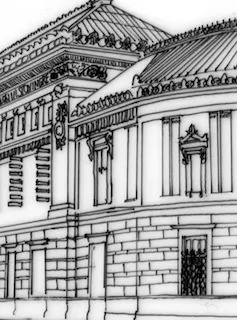
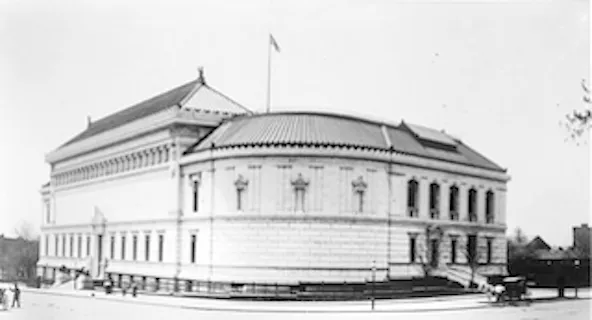
She returned to Washington in early fall and, at the age of forty-one, was admitted on October 1, 1909 to the faculty of the Corcoran School of Art. Established in January 1890 as an annex to the Corcoran Gallery—founded in 1874 by banker William Wilson Corcoran to house his personal collection—the school continued to train students at its original site until 1896, when it relocated to the new building constructed to accommodate both the Gallery and the school in January 1897. Critcher remained as instructor until 1919.
- January 1910: Girls of the South, exhibited at the Pennsylvania Art Academy, and later at the Albright Gallery in Buffalo.
- February 1910: Served on the organizing committee for the memorial exhibition for John K. Souther at the Washington Club, where more than thirty artists contributed paintings. Frames were donated and proceeds from the exhibition benefited Souther’s children.
- March 1910:
- Exhibited in the nineteenth annual exhibition of the Washington Society of Artists, held at the Corcoran Gallery: portrait of a young man; portrait of Mrs. Richard Gibson; Go Away, depicting a child with coat and hat holding a traveling case; Felice, woman reclining on a bed.
- Miss Alice Reading in the exhibition for the benefit of the House of Mercy building fund at Continental Hall.
- Students at the Corcoran Art School exhibited a painting caricaturing a work by Critcher in the "Fake Show," organized in the Mud Room.
- April 1910: Painted a small portrait of a young girl with a black fur hat and brushes in her hand, seated in front of an easel. Also painted a life-size portrait of a woman in blue.
During the summer of 1910, Critcher traveled to Europe via Le Havre with Elizabeth M. Janney, with whom she appears to have shared a close bond—evidenced by her frequent visits to Janney’s home on Cameron Street in Alexandria through around 1915. While little is currently known about Janney beyond her membership in the Mount Vernon Chapter of the Daughters of the American Revolution, their travels suggest a shared cultural or artistic interest. The specific itinerary of their trip remains uncertain, but Critcher did exhibit at the Salon in May:
- May 1910: Portrait de Becky Sharp (n° 479) in the Salon des artistes français at the Grand Palais. She listed her address as 255 boulevard Raspail in the Montparnasse district (erroneously identified as the 1911 Salon in the Base Salon).
She returned to Washington in October, where she completed a portrait of Professor Crawford and joined her sister Lullie at their Woodley apartment.
- March 1911: Exhibited two works at the twentieth annual exhibition of the Society of Washington Artists at the Corcoran Gallery: Fascination, depicting a baby sitting on the floor contemplating her reflection in a brass jardinière, and a portrait study of a lady seated on a garden bench, accompanied by her dog.
- April 1911
- Fascination in exhibit at the Peabody Institute.
- According to the Evening Star, she showed the portrait of Mrs. Charles H. Wright, [Helen S. Wright], author of The Great White North: The Story of Polar Exploration (1910), in a Paris Salon (April 29, 1911, p. 23), though we have not been able to corroborate the information.
- Summer 1911: Painted a portrait of a girl wearing a pink kimono, The Pink Lady.
- November 1911: Painted the following: a portrait bust of the Veerhoffs’ young son; a three-quarter-length portrait of a girl with light brown hair wearing a light blue evening gown; a full-length portrait of a woman with auburn hair wearing a copper gown;
Critcher spent the winter of 1911 with her sister, Lullie. Together, they operated the Critcher Art School on Connecticut Avenue, where both taught.
- March 1912: Exhibited The Pink Lady, depicting a young girl dressed in a pink kimono before her dressing table, as well as a portrait study of a young girl with black hair wearing a red cap in the twenty-first annual exhibition of the Washington Society of Artists at the Corcoran Gallery.
That June, Critcher again traveled abroad for several months, though it is unclear where she went. She returned to Washington in early September and spent the winter with her sister, Mrs. James B. Gatewood.
- November 1912: Participate in the first autumn exhibition of the Society of Washington Artists at Moore’s Galleries in Washington, which the Times Herald claimed was “one of the most representative collections of local art ever shown in the city” (November 27, 1912, 4).
- December 1912: Showed The New Tea Gown oil painting in the fourth biennial exhibition of contemporary American painters at the Corcoran Gallery in Washington, D.C., which removed its entire permanent collection to feature 246 oil paintings from across the U.S.: “[...] almost every tendency of the present days is fully illustrated. The exception is that of the so-called post-impressionists of Paris who are certainly not to be taken seriously or regarded as factors in a forward movement” (Evening Star, December 16, 1912, 8).
- February 1913:
- Completed a life-size portrait of Rev. Bishop A.M. Randolph of the Virginia Southern Diocese.
- Exhibited Roumanian Gypsy at the Peabody Gallery in Baltimore, Maryland.
- March 1913: Served as art critic and instructor at the Corcoran Art Gallery.
- April 1913:
- Served on the jury selection committee for the twenty-second annual exhibition of the Washington Society of Artists at the Corcoran.
- Hosted a "Studio Tea" with a private preview of her recent work, including portraits of Bishop Randolph and Miss Alice Miller of Milwaukee, as well as My Grandfather’s Desk.
After spending the winter with her sister, Mrs. Gatewood, Critcher traveled to Brittany in June 1913 where she participated in Richard E. Miller’s four-month outdoor painting class at Saint-Jean-du-Doigt. Richard Miller, who usually stayed in Giverny, had settled in Saint-Jean from 1912 to 1914 where he organized painting sessions for American women. The artists usually stayed in the local hotel and could work in the small pavilion that served as a billiards room and an artists’ studio, the Maison des peintres (House of the Painters), built on the heights of the park, overlooking the village, the church enclosure, and the sea.
It seems this would be Critcher's last trip to France, as WWI loomed on the horizon. She returned to Washington in November/December, bringing back a series of new works, including paintings of a little girl standing near a blooming plant, the same child near a bed of nasturtiums, and a mother seated by a window with a sleeping baby in her arms—all rendered in the luminous style influenced by Miller.
Washington D.C. and Beyond
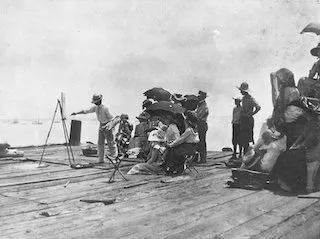
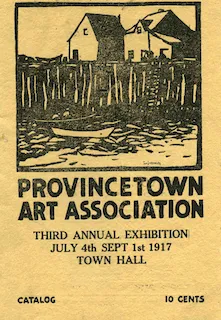
Upon her return from France, Critcher continued to reside at the Woodley Building at 1851 Columbia Road, N.W., while teaching at the Corcoran School of Art. By 1914, Critcher had begun spending her summers in Provincetown, Massachusetts—often referred to as the "American Barbizon" due to its flourishing artist colony. From 1914 through 1917, she shared a cottage with Chicago artist Elizabeth Howland and painted extensively alongside fellow artist Sarah Monroe. In both 1915 and 1916, she enrolled in the outdoor painting class of portrait and genre painter Charles W. Hawthorne, held along Provincetown’s waterfront. Founded in 1899, Hawthorne’s school was considered the first to teach outdoor figure painting and attracted up to 90 students from across the country. In July 1915, she was among the 44 artists featured in the first exhibition organized by the Provincetown Art Association at the Town Hall, where she exhibited a painting titled In the Park. There is no record of her participation in the 1916 exhibition. However, in July 1917, she was again represented in the Third Annual Exhibition at the Town Hall, displaying two paintings: Francis and Still Life.
In October 1916, Critcher was appointed an officer on the newly formed Women’s Advisory Board of the Arts Club of Washington. The club, created to promote the arts across multiple disciplines—including painting, sculpture, music, literature, architecture, and drama—was headquartered in a historic mansion once occupied by James Monroe.
Critcher resigned from her teaching position at the Corcoran in 1919 and went on to found her own school in Washington, D.C., known as the Critcher School. The institution offered one- and two-year courses in both fine and commercial art, with instruction across a range of styles and disciplines. Her sister, Louisa Kennon “Lulie” Critcher—also an artist—helped administer and teach at the school, along with sculptor Clara Hill, who joined the faculty in 1922. In 1924, the school became known as the Critcher-Hill School of Art and was located at 1603 Connecticut Avenue (Times Herald, Oct. 22, 1924, p. 4). The curriculum included classes in drawing, painting, interior decoration, clay modeling, costume design, and commercial advertising. Hill left the school in May 1926 due to other professional commitments, and it was subsequently renamed the Critcher School of Painting and Applied Arts, offering courses in painting and drawing, portrait and life classes, design, interior decoration, costume design, and poster advertising. It also advertised classes for children. Critcher remained the school’s director until 1940, when she chose to dedicate herself fully to painting.
In November 1919, Criticher and artists Miss Hale and Miss Clements converted old stables into studios in St. Matthew’s Alley in Washington, D.C., as did artists Miss Hale and Miss Clements. Sculptor George-Julian Zolnay’s studio was also located nearby.
Between 1914 and 1920, Critcher completed numerous portrait commissions, served on exhibition selection committees, and exhibited her work in the following shows:
- December 1913: Participated in a traveling exhibition organized by the American Federation of Arts, with venues including Columbus, Mississippi; Montevallo, Alabama; and Louisville, Kentucky.
- February 1914: Exhibited The Artist at the Fourteenth Exhibition of the Louisville Art Association, held at the Louisville Public Library.
- March 1914: Exhibited at the Twenty-third Exhibition of the Society of Washington Artists at the Corcoran Gallery; awarded third prize (bronze medal) for her portrait of Aline Solomons. Leila Mechlin, who reviewed the show in the Evening Star, offered nothing but praise for the execution of the canvas:
- Miss Critcher's portrait of Miss Solomons, as all will agree, is exceedingly clever, fresh in color and treatment, and in style quite out of the ordinary. It does not flatter but it is an unmistakable likeness and possesses the personality of the sitter to a great degree (April 8, 1914, 13).
- October 1914: Exhibited a portrait previously shown at the Paris Salon at the Arnot Gallery, organized by the American Federation of Arts.
- December 1914:
- Exhibited the portrait of a young man at the fifth biennial exhibition of Contemporary American Paintings at the Corcoran Gallery, which presented 330 paintings of living American artists.
- Served as chair of the organizing committee for the Society of Washington Artists’ exhibition benefiting Belgian war sufferers, held at the gallery at Moore’s Gallery, 725 17th Street. She also contributed a painting to the show of 88 paintings, 16 etchings, 8 cartoons and 20 sculptures.
- March 1915: Participated in the first exhibition of the Virginia Fine Arts Society at the Blue Ridge Club; her portrait of Miss Mary Miller Wood received the third honorable mention.
- April 1915: Showed The Sport, depicting a fashionable woman; The Red Gate, showing an old European gateway; and a small figure study in the annual exhibition of the Society of Washington Artists at the Corcoran Gallery.
- May 3, 1915: Exhibited twenty two canvases—portraits, landscapes, and out-door scenes done in Alexandria and France—at Moore’s Gallery, 725, 17th street. They included: Society Knitting, The Green Couch, Grandmother‘s Bonnet; Deserted House; Red Gateway; From Bear Rock; Old Christ Church, Alexandria; Church at Guimec [sic, Guimaëc], France; From Dupont Circle; In the Park; In the Garden; Old Virginia cabin; Over the Way; Spring in Georgia, and portraits of Otto L. Veerhoff, Jr., a little girl named Betty, Mrs. Charles, H. Wright; Miss Mary Miller Wood; Mr. Frank Daingerfield; Latin Quarter Type; Minna Booker; A Sport. Sarah Sewel Monroe also showed 29 canvases.
- October 1915: Commissioned to paint the portrait of Judge T.R.B. Wright, intended to be installed on a court wall around 1917 (likely Fredericksburg, Virginia).
- November 1915: Exhibited at the MacDowell Club in New York, showing: Society Knitting; Latin Quarter Type; An Old Italian; Betty; portraits of Mrs. Charles Hewitt Wright and Aline Solomons; outdoor scenes and A Corner of Provincetown.
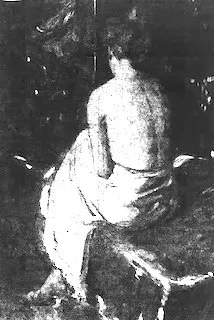
- February 1916: Exhibited a nude painting at the Twenty-fifth Annual Exhibition of the Society of Washington Artists at the Corcoran Gallery.
- May 1916: Participated in a competitive fundraiser at the Willard Hotel for the planned Arts Club of Washington; afterward, painted pastel portraits of the three highest bidders.
- November 1916: Painted a portrait of Mrs. Newhauser, wife of the treasurer of the Arts Club of Washington.
- December 1916: Showed a portrait and still life at the Arts Club exhibition
- January 1917: Exhibited at the newly established Arts Club of Washington.
- February 1917: Served on the jury selection committee for the Twenty-sixth Annual Exhibition of the Society of Washington Artists at the Corcoran Gallery; exhibited portraits of Mrs. Newhauser and a child.
- March 1917: Showed Bohemian Girl at an exhibition held in the YMCA assembly hall.
- May 1917: Donated a painting to an exhibition organized by the Washington Arts Club for the benefit of the Red Cross, held in the Fairfax Room of the Willard Hotel.
- December 1917: Participated in the Society of Washington Artist's twenty-seventh annual exhibition at the Corcoran gallery.
- May 1918: Held a joint exhibition with Clara Hill at Hill’s studio in the Belasco Theatre Building, Washington, D.C.
- February 1919: Exhibited at the Twenty-eighth Exhibition of the Society of Washington Artists at the Veerhoff Gallery, showing the portrait of Mr. Many and a study of a young girl titled Mary. She also served on the selection committee.
- March 1919: Exhibited at the Second Annual Showing of works by members of the Washington Arts Club.
- November 1919: Following in the footsteps of sculptor George-Julian Zolnay, who settled in St. Matthews alley in Washington D.C., Criticher and artists Ellen Day Hale and Gabrielle P. Clements converted old stables into studios. Later, other artists joined the community, like Eben Comins and Louise Goff. This alley came to be known as a Washington counterpart in spirit to New York’s MacDougal Alley. It appears that Critcher left the studio sometime between 1923 and 1924.
- February 1920:
- Solo exhibition in Charleston, North Carolina.
- Organized an “Heure intime” at the residence of E.M. Underwood on Jefferson place in Washington, where she exhibited several of her portraits. The event also featured Clara Anderson, a well-known storyteller of plantation tales, who gave a talk titled “Dixie, Darkie Dialect”—a title that, while reflective of prevailing attitudes among some segments of society at the time, is now recognized as offensive and racially insensitive (Times Herald, February 15, 1920, 11).
- Summer 1920: Traveled and sketched in Ocean City, Maryland and Asheville, North Carolina.
- October 1920: Portrait of George-Julian Zolnay, her studio neighbor; also created a number of flower studies.
The Later Years
In the early 1920s, Critcher remained active in Washington’s art scene, regularly exhibiting at the Arts Club of Washington and with the Society of Washington Artists. She also hosted talks in her studio on St. Matthews Alley. According to the Times Herald (June 11, 1922, p. 17), she left her apartment at the Woodley to take up residence in the Arts Club’s building at 2017 I Street, where she remained through the end of that year (Times Herald, January 7, 1923, p. 28).
The same Times Herald article notes that she was awarded the silver medal at the Society of Washington Artists’ exhibition at the Corcoran Gallery for her seated, three-quarter-length portrait of fellow artist and Arts Club member Madison Brown. In May 1922, she also held a solo exhibition at the Arts Club, where she showed still lifes along with Our Marine, a portrait of a soldier recently returned from overseas. In January 1923, she exhibited Portrait Head of Frances Dawson.
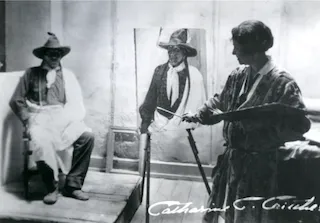
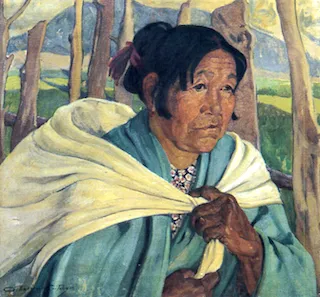
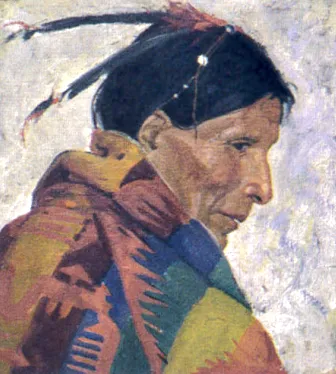
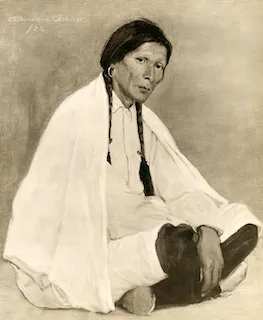
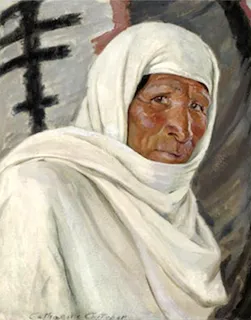
Critcher made her first trip to New Mexico in the summer of 1922. Though she had originally planned to travel to Italy, she changed course: “I went instead to California and New Mexico, because I decided that we have in America scenes as inspiring as can be found in Europe” (Times Herald, January 21, 1923, p. 12). She would go on to spend her summers in New Mexico and, in 1924, became the first woman accepted into the Taos Society of Artists. During this period, she produced a substantial body of work, including figure paintings of Native Americans.
Her work continued to gain recognition and was exhibited in numerous shows along the East Coast, including a solo exhibition of sixteen portraits and still lifes at the Corcoran Gallery in 1940. In 1949, a special exhibition of her work was organized by the Washington County Museum of Fine Arts.
Critcher never married, devoting her life to art and education. Her time in France was formative and played a crucial role in shaping her artistic and educational career. Although there is no indication that she returned to France after her early years of study, she maintained her connection to French culture and the Francophone community by attending events at the Alliance Française in Washington, D.C.
She died at the age of 95 in June 1964.