A.R.C. Studio for Portrait Masks
In a 2014 article, Marie-Andrée Roze-Pellat reminded us that the memory of World War I "[...] persists in time because, in no other war, did the fighting inflict such damage to the bodies of the soldiers. The face injured long remained forgotten in this history. Who remembers their delegation to the ceremony for the signature of the Treaty of Versailles, and the words addressed to them that day by Georges Clémenceau: 'You were in a bad place; it shows'" (41, translated from the French).
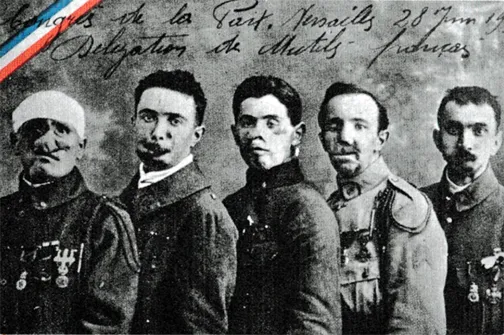
The estimated number of French victims of machine-gun fire and bomb or grenade explosions numbered between 15,000-20,000. Colloquially known as “les gueules cassées” (shattered faces), these disfigured soldier returned from the front only to become victims of social stigma, even within their own families. Though many were abandoned, living as recluses and night owls, some had recourse to different forms of facial reconstruction.
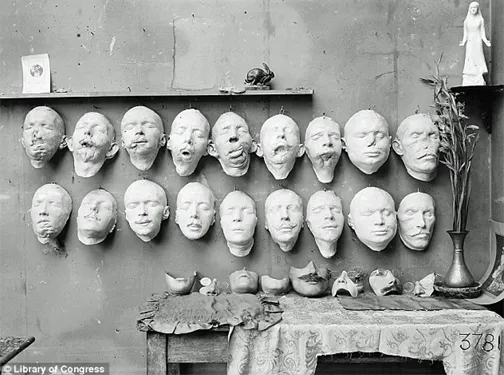
In Paris, one woman was recognized for her pioneering work in aiding such victims: Anna Ladd, an American artist who used her talents as a painter and sculptor to fashion face masks that would provide these traumatized soldiers with internal and external healing, and surely a bit of the self-esteem that had been stripped from them through the horrors of war.
When the American Red Cross settled at 4 rue de Chevreuse, it also rented apartments in the immediate vicinity for nurses, orderlies, and other staff. In 1918, one of those rentals was Janet Scudder's studio at 70 rue Notre-Dame-des-Champs. This studio, which ran under the auspices of the American Red Cross's "Bureau de Reconstruction et de Rééducation des Mutilés de Guerre," became the setting of a very special project led by Anna Ladd, a precursor of what we now call anaplastology. Known as the Studio for Portrait Masks, this is where, as of January 1918, Ladd welcomed innumerable French and American soldiers who had been disfigured in combat. Also assisting in the studio’s efforts were:
- Jane Poupelet, another American Red Cross volunteer, French sculptor and sketcher, who had studied at the Beaux Arts in Bordeaux, the atelier of Denis Puech, the Académie Julian, and with the sculptor Julien Schnegg
- Diana Blair, curator of specimen at Harvard Medical Laboratory
- Mary Louise Brent, French-American sculptor, who had served with the American Fund for French wounded in Lorraine
- Robert Wlérick, French sculptor and friend of Poupelet who had worked in a facial surgical unit in Bordeaux

Born on July 15, 1878 near Bryn Mawr, Pennsylvania to John and Mary Watts, Anna Ladd was a self-styled sculptor who shied away from formal training in art schools. Instead, she drew and modeled from life. For 25 years she lived in Paris and Rome, working in studios and soliciting criticism from such sculptors as Ettore Ferrari and Emilo Gallori in Rome, Auguste Rodin in Paris, Charles Grafly in Philadelphia, and Bela Lyon Pratt in Boston.
On June 26, 1905, she married Dr. Maynard Ladd, specialist in the diseases of children, in the Salisbury Cathedral, England. They moved to Boston, where Maynard joined the Harvard Medical School and Anna sculpted in earnest while raising two children. She produced bronze fountain figures, portraits, and also wrote two novels published in 1912 (titles of books). Between 1907 and 1915, she had solo exhibitions at the Gorham Gallery in New York, the Corcoran Gallery in Washington D.C., and the Pennsylvania Academy of Fine Arts in Philadelphia. Her works were also exhibited in Rome, at the Paris Salon, the Chicago Art Institute, the Boston Museum of Fine Arts, the National Academy of Design, and the National Sculpture Society (Boston Daily Globe 12). Several of her bronze sculptures were shown at the 1915 Panama-Pacific Exposition in San Francisco.

According to the San Francisco Chronicle (1918), Ladd became acquainted with the idea of facial reconstruction through British art critic C. Lewis Hund. He introduced her to the work of Francis Derwent Wood a sculptor who had " [...] become the expert on sculpting prosthetic faces. He was a pioneer in the field of developing tin masks by taking casts of the wounded man’s face and smoothing over the areas that had been damaged beyond surgical repair" (Prichard 38). In 1917, she visited Wood in the "Tin Noses Department," which he had established in 1915 in the Third London General Hospital (San Francisco Chronicle). He encouraged her to do the same kind of work in Paris.
Ladd moved to Paris after her husband was appointed to direct the Children's Bureau of the American Red Cross (A.R.C.) in Toul and serve as its medical adviser in the dangerous French advance zones. Inspired by Wood's work, Ladd decided to join the war effort and turn her art to practical use. She volunteered with the A.R.C. and convinced the War Department to let her establish a studio for disfigured soldiers in Paris, using mainly her own funds.

Men who came to her studio had already been given hospital care, many of whom came from the Hôpital du Val de Grace where they had undergone surgery.
"Our work begins when the surgeon has finished. We do not profess to heal. After the wounded man has been discharged from the hospital we begin our treatment. Of course, the chief difficulty in making these masks is to accurately match both sides of the face and restore the features so that there will be nothing of the grotesque in the appearance of the covering. A mask that did not look like the individual as he was known to his relatives would be almost as bad as the disfigurement" (cited in the San Francisco Chronicle).

Soldiers were referred to her by officials of the A.R.C. and she would determine whether or not she could be of assistance. The men would then have to sit for a plaster casting for a few hours, then wait for several weeks before a final product in copper or silver was produced. Lastly, they would sit for the painting and fitting.
In order to obtain a real likeness in the reconstruction, she would request several photos of each soldier pre-injury. Ladd would then make a plaster cast from which clay or plasticine squeezes were made. The squeeze would then be sent to the silversmith Christofle who made a galvanized copper prosthesis, which was painted to match the soldier's skin tone with washable enamel paint. Eyes, a mustache or beard made of metallic foil were sometimes added to the mask, which would be attached to the face either with glasses, or an almost invisible strip hooked over behind the ears, or even a small amount of spirit gum. The mask could be removed when the person needed to eat or sleep, and the lips were left slightly open so the person could speak or smoke (cf. Mainz, n.p.).
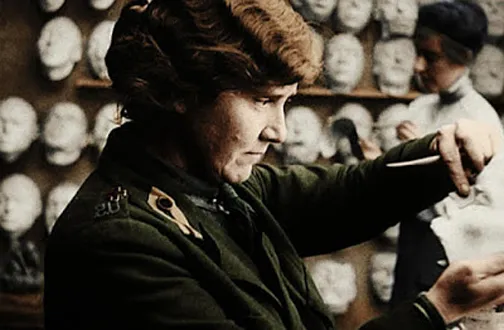
According to the American Magazine of Art, only an artist could have executed such a complex undertaking:
"These masks are of the thinnest, lightest metal and are produced by a system of electrolysis from casts. They are, moreover, painted with a celluloid paint, in exact imitation of the flesh. The lips are always modeled slightly open so that the wearer can smoke and speak. Of her subjects Mrs. Ladd made careful study. Where photographs were obtainable she followed them, but where they were not she gave expression to the features which seemed in harmony with the character of the man. None but an artist who had given much time to portraiture and was peculiarly gifted along these lines could have accomplished such satisfactory results" (309).

The effectiveness of these masks was highly contested (Feo 25), especially since soldiers received only one such mask, which had a limited shelf-life. Even Ladd was skeptical about their effect, though she received numerous letters from grateful soldiers. In the immediate aftermath of the war, they seem to have had a positive effect:
"A masking was considered successful when the patient could walk down a Parisian boulevard without being noticed. Earlier, after their multiple surgeries were complete but before they were fitted with masks, the men had gone on supervised forays into the city, accompanied by their nurses, only to find that onlookers gawked at them and sometimes even fainted. The men called this the Medusa effect. The masks allowed them to regain some measure of the social visibility they had forfeited because of their ghastly wounds" (Lubin 2008, 11).
After working assiduously for eleven months (Lubin claims her studio made 97 masks; Alexander claims she made 185; others say 70), Ladd returned to Boston in December 1918 because she lacked the funds necessary to continue her efforts. In addition, the Children's division of the Red Cross was progressively shutting down activities and Maynard Ladd could return to his pre-war practice.
The Studio for Portrait Masks continued its projects under the direction of Marie-Louise Brent seconded by Poupelet, but circumstances were less than satisfactory. In a letter dated May 7, 1919, Janet Scudder, whose studio had been the epicenter of the portrait masks, entreated Ladd to return to Paris, painting a rather disastrous operation:
"It is one grand pity that you left Paris and I wish that you could come back. Your great work for the French mutilées is in the hands of a little person who has the soul of a flea. I suppose Mlle Poupelet has written you frequently and that you know how the work you started in Paris has grown and how more and more mutilées apply for missing features. Often there have been as many as 18 people in the studio at one time, there is not room to turn about in it. Since your departure the place is closed every day until around 2 o’clock and the mutilées are not allowed to enter until that hour. One poor thing came all the way from the provinces to get fixed up. He had just enough money to get here and back, arrived on Saturday afternoon, place was closed until Monday at 2, he did not have money enough to stay, so he went home" (Archives of American Art, Smithsonian Institution).
In the same letter, Scudder said she wrote a long report to military officials, which wended its way into the hands of Brent who said "the report was a deliberate exaggeration, written for the purpose of regaining possession of the studio!" (Archives of American Art, Smithsonian Institution).
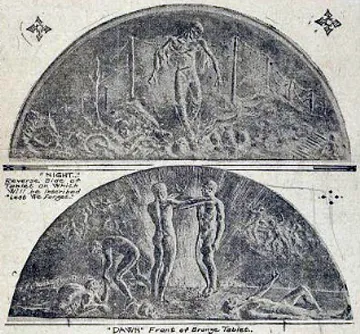
Ladd chose not pursue her endeavors with the Red Cross and returned to sculpting, working in Boston and Beverly Farms, Massachusetts, in the studio she called "Arden." The magnitude of suffering she had witnessed in WWI had a significant impact on her sculptural work, which shifted away from her lighthearted pre-war bronzes. She designed several war memorials (Indiana, Michigan, Massachusetts), including at least two the American Legion.
In 1923, Ladd was granted an honorary Master of Arts degree from Tufts University.
In a May 5, 1925 address at a Plaza dinner for the American Women's Association Club, Ladd said the following about the art of sculpting:
"Sculptors, to be any good at all, have to touch all sides of life. They deal in material and in spirit. The grace of the figure they model is based on the accurate mechanism of armatures. They must have the physical strength of a blacksmith, the skill of a carpenter, the precision of a dentist, the knowledge of anatomy and psychology of a physician. Not only this but they must have training in archaeology, mythology, history, and architecture, for the relation of the part to the whole is of the most vital importance in sculpture. [...] they must have the soul of a poet and the creative energy of a god [...]" (Library of Congress).
Interestingly, the noted French sculptor Antoine Bourdelle echoed these very words in 1926 during his workshop at the Académie de la Grande Chaumière:
“Bourdelle said to-day—during his criticism at the Chaumière—‘A sculptor must be the composite of many contrary things. He must have the knowledge of a philosopher, the simplicity of a child—the soul of a poet and the science of a mathamatician [sic].’ Something to live up to, n’est pas?” (Gregory 95).
Ladd was made Chevalier of the Legion of Honor in 1934 in recognition of her contributions to the well-being of French soldiers.
Anna Ladd died of illness in 1939 at the age of sixty, shortly after she and her husband had moved to Santa Barbara, California.
Sources
- Alexander, Caroline. “Faces of War.” Smithsonian Magazine, February 2007, online,
- "An American Sculptor's Splendid War Work." American Magazine of Art, 1919, pp. 309-310.
- “An Awakening in Decorative Sculpture.” Harper's Bazaar, 52, 4, April, 1917, p. 60.
- Bainbridge, William Seaman. Report on Medical and Surgical Developments of the War. U.S. Government Printing Office, 1919, pp. 85-91. Google Books.
- Feo, Katherine. “Invisibility: Memory, Masks and Masculinities in the Great War.” Journal of Design History, 20, 1, 2007, pp.
- Gregory, Angela and ... A Dream and a Chisel
- Kedey, J. "Masks for the Maimed." San Francisco Chronicle, May 5, 1918, p. 3. ProQuest Historical Newspapers.
- Ladd, Anna Coleman. Papers. Archives of American Art, Smithsonian Institution
- Lubin, David. Grand Illusion: American Art and the First World War. Oxford University Press, 2016. His footnote 34 identifies documentary sources for Ladd's work.
- Lubin, David. "Masks, Mutilation, and Modernity: Anna Coleman Ladd and the First World War." Archives of American Art Journal, 47, 3-4, Fall 2008, pp. 7-8.
- Mainz, Valérie and Griselda Pollock. Work and the Image: v. 2: Work in Modern Times - Visual Mediations and Social Processes, Routledge, 2018.
- "Mrs. Anna C. Ladd, Sculptor, is Dead: Rebuilder of Soldiers' Faces." New York Times, June 4, 1939, p. 48. ProQuest Historical Newspapers.
- Muir, Ward. The Happy Hospital, 1918. A work Anna Ladd kept in her studio.
- "New England Women." Boston Daily Globe, Nov 2, 1915, p. 12. ProQuest Historical Newspapers.
- Prichard, Brenna K. Boys on Blue Benches: Disfigured Veterans of the First World War. Louisiana State University and Agricultural and Mechanical College, MA thesis, 2016.
- Roze-Pellat, Marie-Andrée. "La réparation des gueules cassées." Corps, 1, 12, C.N.R.S. éditions, 2014, pp. 41-48.
- The Works of Anna Coleman Ladd. Seaver-Howland Press, 1920. From the Library of the Fogg Museum of Art, Harvard University.
- Tutwiler, Julia R . “Women who Achieve Anna Coleman Ladd." Harper's Bazaar, 50, 3, March, 1915, p. 39. ProQuest document.
- “Two of the Foremost American Sculptors.” Harper's Bazaar, 52, 10, October, 1917, p. 56. ProQuest Historical Newspapers.
- Vaillant, Franz. 11 novembre : ces femmes qui réparaient les "gueules cassées," Terriennes, TV5 Monde, 2019.
NOTE: "Ladd kept a copy of [... ] Wood’s Lancet article and Muir’s The Happy Hospital among her possessions in the studio" (Prichard 44).