American Girls' Art Club (1893-1914) - Cloned
"To come from the contentious, evil-thinking city into its atmosphere of love and mutual help is like finding "home."
-Caro Lloyd, Outlook, July 1894
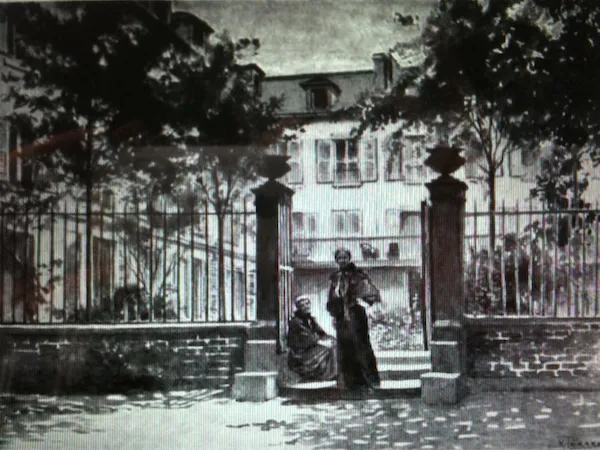
In 1893, Elisabeth Mills Reid, living in Paris while her husband, Whitelaw Reid, served as the United States Ambassador to France, opened the American Girls' Art Club at 4 rue de Chevreuse. She envisioned the Club as a safe, nurturing haven in which American women art students could easily access the studios and academies of bohemian Montparnasse. The Club functioned like a dormitory, with comfortable, affordable living quarters, a restaurant in which the students could take meals, a several-hundred volume library, and a beautiful garden, hidden from street view, in which they could sketch, paint, and enjoy each other's company.
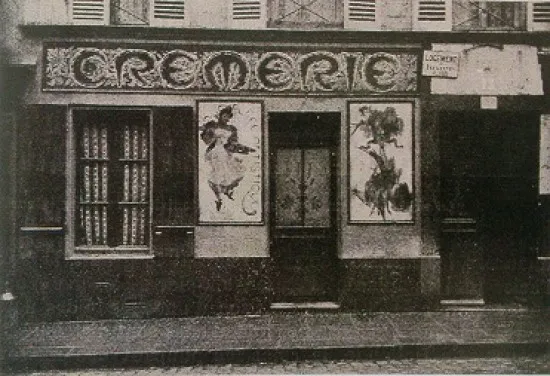
Mrs. Reid was not alone in her endeavor to support the throngs of American women students in Paris. She partnered with her friend, Mrs. William W. Newell, whose husband, Rev. William W. Newell, presided over services in St. Luke's Chapel, affectionately known as the "Little Tin Church", located in the back garden of the Girls' Club. The Newells had themselves founded a club in 1891, hosting teas and informal get-togethers for American students in Paris in an apartment at 19 rue Vavin, just a short walk from rue de Chevreuse within the so-called 'American corner' of the neighborhood. Caro Lloyd, in a July 1894 article for Outlook, says of Rev. Newell, "He was known as 'the Student's Friend,' which justly describes the beauty of feeling between him and them." (52) The Newells thus established a support system and vibrant community that were significantly enhanced with the introduction of Mrs. Reid's financial backing and subsequent creation of the large-scale Girls' Art Club at 4 rue de Chevreuse, steps from the Luxembourg Gardens and nestled within the heart of the artists' 'colony' of the 6th arrondissement.
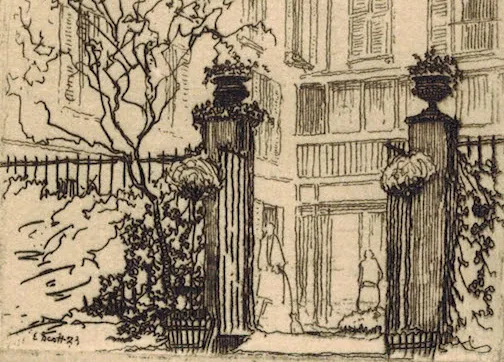
In the early years of the Club, there were about 40-50 rooms, ranging from a handful of very small and inexpensive rooms on the fourth floor to larger, more spacious rooms with windows, some which of could be shared by two students to defray the costs. Each room was equipped with a coal stove and, according to a November 1894 article in Scribner's Magazine by Emily Meredyth Aylward, the girls purchased their own weekly sacks of coal and bundles of wood, choosing to light, extinguish, and rekindle their own fires for the sake of economy . The restaurant, located on the ground floor of the Club, was lauded in the early years for not operating as a table d'hote, enabling each student to "order as little or great a variety as she chooses, according to her appetite or purse." (p. 600) China and linen, donated by the American expatriate community of Paris, lent an air of sophistication to the dining room. An 1898 article published by E.L. Good in The Catholic World tells us just how cheaply the art students could live in the Latin Quarter in this period: "An American boy or girl may live very comfortably at the American Girls' or Boys' Club for sixty cents a day 'tout compris.'" The Boys' Club referenced by Good is likely the American Art Association of Paris (AAAP), founded by A. A, Anderson a few years before Mrs. Reid leased the property at 4 rue de Chevreuse. The AAAP, located at 74 rue Notre-Dame-des-Champs off Boulevard Montparnasse, offered a space and resources for (male) American art students living in Paris to congregate and exhibit their work. And as both the AAAP and the American Girls' Art Club continued to grow into the 20th century, both institutions maintained cordial relations due to their shared mission of supporting young American artists in Paris.
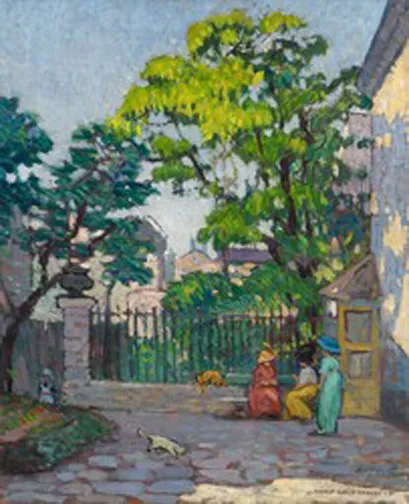
Not much is known about the leadership of the Club in this period, though The American Register's 1905 edition of Who's Who in Paris: Anglo-American Colony, lists the Directress as Miss Acly, probably Julia H.C. Acly, who had previously run the American Cathedral's school for girls in Paris, St. Margaret's. More information about the residents of the Club can be gleaned from Caro Lloyd's aforementioned July 1894 article in Outlook. Lloyd tells us:
The community has a charming variety- New York Art League girls, college girls, a pupil of Guilmant the organist, an enthusiastic decorator who returns from the Bon Marché with exquisite and expensive draperies which she has to sell the other girls to repair the fatal damage to her allowance. One of the quietest is a passionate explorer, the only woman who has penetrated the lower Mackenzie. Her room is adorned with presents from the Eskimo, and a wonderful Norway fish-net. The graduates of Vassar, Wellesley, and Michigan there say that the life reminds them of their college days. (50)
Social events were held regularly at the Club, including daily tea at 5pm in the large reception room, known for its tasteful red furnishings, piano and silver urn. Residents of the Club were allowed to invite guests and everyone enjoyed tea, sandwiches, and cake, relaxing in the garden or on the first-floor veranda when the weather permitted. Another important social feature at the Club was exhibitions, both of art by residents and, on special occasions, established artists living in Montparnasse like Sargent and Whistler. A Club tradition emerged from the annual exhibition in December: one lucky artist had their picture bought by the Club to be displayed in the reading room until the next year's exhibition, when a new work would be acquired and featured for the coming year.
Countless women passed through the Club's doors from 1893 until 1914, when the outbreak of World War I made it impossible for American women to come study art in Paris. Wishing to do her part to help the French, Mrs. Reid transformed the Girls' Art Club into a hospital. But evidence of the Club's lasting importance remains even today. The Whitney Museum of American Art in New York City owns a 1908 painting by Anne Goldthwaite, former resident of the Club, called simply "4 Rue de Chevreuse".
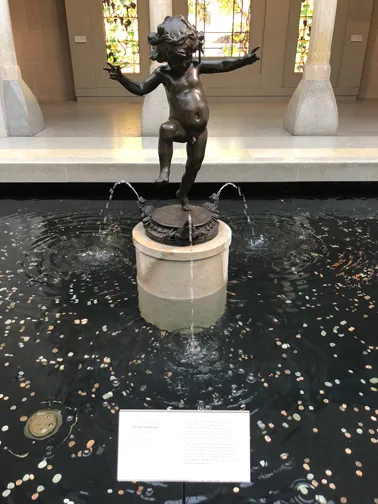
Janet Scudder, a renowned sculptor who established herself while working in the Paris studio of Frederick MacMonnies (and whose 'Frog Fountain' can be seen today in The Metropolitan Museum of Art's American Wing), recalls with fondness her time spent living at the Club in her 1925 autobiography, Modeling My Life:
"I have always felt a personal gratitude to Mrs. Whitelaw Reid for having started that Girls’ Club...It was a delightful old house in the Rue de Chevreuse, under the direction of a charming French lady who took a personal interest in the young women there and mothered each one of us individually. The students who lived in the house represented every branch of art--painting, sculpture, music and architecture; and just the mere fact of living there, surrounded by so many of them, all working with enthusiasm, was tremendously stimulating. We were made extremely comfortable, had the privilege of using the large library and were often entertained with musical parties and exhibitions got up by the more advanced students; but best of all was the fact that the expense was so little that even I was able to live there until I left Paris.” (110-112)