American Girls' Art Club (1893 - 1914)
The American Girls' Art Club gave its residents security and the comforts of home in what was the epicenter of the art world at that time - Montparnasse. As Butlin rightly described it: "The founding of this facility points to the apprehension North American families had for the welfare of their daughters studying abroad. American periodicals and newspapers expressed concern that, freed from family supervision, these young women would plunge into the bohemian art-student life" (39).

"To come from the contentious, evil-thinking city into its atmosphere of love and mutual help is like finding 'home'" (Caro Lloyd, Outlook, July 1894, 60).
In 1893, Elisabeth Mills Reid, a wealthy American philanthropist with long-standing ties to Paris (her husband, Whitelaw Reid, had just served as U.S. Minister to France from 1889 - 1892), opened the American Girls' Art Club at 4 rue de Chevreuse. Her intent was to provide American women in Paris not only with secure housing, but also with "a circle of proper sociability" and "association with young women of their own ideas and ideals." (San Francisco Call, November 21, 1909). Indeed, many young American women had come to the embassy with tales of woe and difficulties; numerous contemporary newspaper articles pointed to the pitfalls that awaited unchaperoned American women: "She realized the need of a home or center for these often lonely and unattached girls... [She is a] fairy godmother whose loving care and thoughtfulness is a real benediction" (Miss Kilbourne Cowles, The Advance, April 1, 1909).
Mrs. Reid was not alone in her endeavor to support the large numbers of American women studying in Paris. She was backed by church leaders and associates who, as Alan Albright aptly states, "set out to promote missionary-type volunteer activities among students in the name of Saint Luke, ‘artist and physician’” ("American Volunteerism in France," 1993).
Reid partnered with Mrs. William W. Newell, who was deeply concerned about the moral welfare of the growing population of young American women living in the "disreputable" neighborhoods of the Left Bank. She and her husband Rev. William W. Newell "open[ed] the doors of their apartment on Rue de Rennes to American students for informal religious services and homelike fellowship" (Albright, 1993). As Caro Lloyd describes it, they:
"[...] began by inviting the students to their home Sunday evenings, and many came. If there were not chairs enough, they sat on the floor. Mr. Newell gave a talk, and then there were singing, refreshments, and a sociable time afterward" (The Outlook, July 14, 1894, 60).
In 1891, they established an "American Girls' Reading Room" (Allen, 2013, 453) in an apartment at 19 rue Vavin within the so-called "American corner" of the neighborhood, where they hosted teas and informal get-togethers for the ladies in the American colony in Paris.

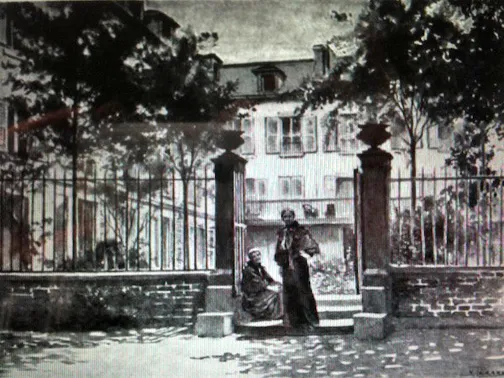
Perhaps not coincidentally, Rev. Newell presided over services in the recently-opened St. Luke's Chapel. Steps from the Luxembourg Gardens and nestled within the heart of the 6th arrondissement, the rue de Chevreuse was an ideal location for students of the arts. Paul Cezanne, among others, was living just across the street at number 5 rue de Chevreuse, while Whistler had his studio behind the garden on the corner of rue Notre-Dame-des-Champs and rue de la Grande Chaumière. The property, still owned by the Keller family but now vacant, was described by Dennison (2005, 33) as a "rambling yellow structure, which had a large courtyard and garden" that was well-suited for the type of enterprise Mrs. Reid had in mind.
"Inspecting the property at 4 rue de Chevreuse, Mrs. Reid, like so many before her, was enchanted by the quiet courtyard and the old garden extending to 5 rue de la Grande Chaumière. She also responded to the artistic ambiance of Montparnasse [...]. Typically, Mrs. Reid saw the house in terms of social usefulness [...]" (Allen, 2013, 453).

She leased the property for several years, overhauling and creating a comfortable, cozy setting. The Club quickly developed into a vibrant community of young women with shared interests and passions.
But its early success was almost derailed by infighting. The Chicago Daily Tribune reported on March 4, 1894 "a long series of quarrels and intrigues" that ended with "the disappearance of the matron, Mrs. Irvine" (10). The article describes the Club's early governance by a board of American women living in the colony, led by a certain Mrs. Monroe. It then described Mrs. Newell as a board-appointed "monitor in the establishment." Through "incessant bickering and heartburning," Mrs. Newell apparently "demoralized the servants and prejudiced the creditors," which put Irvine in a difficult position. Both Irvine and Newell fled Paris, and Newell sent her 20 year-old son to defuse the situation. He seemed to make matters worse by claiming that a portion of the Club's furniture belonged to his mother while ignoring creditors' demands for repayment and servants' pleas for unpaid wages. Mrs. Reid or another member of the board must have intervened because the Club remained open and continued to welcome women art students.
In its early years at the end of the 19th century, the Club doubled from 25 residents to around 50. The dorm rooms ranged from a handful of very small and inexpensive nooks on the fourth floor to larger, more spacious accommodations with windows that could be shared by two students to defray costs. Caro Lloyd describes one such room: "A typical room is that of two Vassar girls who, through much traveling, have learned to quickly make homelike quarters: the beds disguised as divans, the washstand screened, the writing-table where the long home letters are written, and everywhere curios gathered in their wanderings - peasant hats, Syrian scarfs, Dutch mugs" (Outlook, July 14, 1894, 60). Each room was equipped with a coal stove and, according to Aylward (1894), the girls purchased their own weekly sacks of coal and bundles of wood, choosing to light, extinguish, and rekindle their own fires for the sake of economy.
The Library was much appreciated by both residents and women non-residents, who were given visiting privileges in the early 1900s. The library and reading room were:
"[...] open early morning until ten o'clock, p.m. Besides files of the leading American and French papers, the current magazines are supplied and the room is lined from floor to ceiling with book shelves which harbor a fine and comprehensive library, with two valuable divisions devoted to French literature and art" (Town & Country 16).
The restaurant, located on the ground floor of the Club, was lauded in the early years for enabling each student to "order as little or great a variety as she chooses, according to her appetite or purse." (Aylward, 600). China and linen, donated by the American expatriate community of Paris, lent an air of sophistication to the dining room.
According to an article in the Washington Post (1900), the club served as a meeting ground for many Americans in the neighborhood who came for the traditional 5 o'clock tea subsidized by a "charming American woman," Mrs. Luckemeyer. The Club seems to have benefited from many gifts from the American community, including a grand piano bought with funds raised by General "Jack" Gowdy, Consul General.

An 1894 article published by E.L. Good in The Catholic World tells us just how cheaply the art students could live in the Latin Quarter in this period: "An American boy or girl may live very comfortably at the American Girls' or Boys' Club for sixty cents a day tout compris" (60).
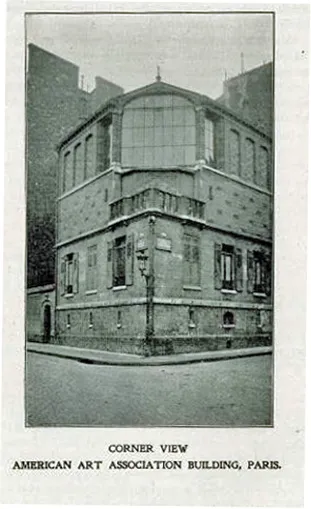
The Boys' Club referenced by Good is likely the American Art Association of Paris (AAAP), which was first presided by Rodman Wanamaker. It was founded in 1890 by A. A. Anderson a few years before Mrs. Reid leased the property at 4 rue de Chevreuse. Whitelaw Reid was among the guest speakers at the opening celebration. Located at 74 rue Notre-Dame-des-Champs off Boulevard Montparnasse, the AAAP offered space and resources for male American art students to congregate and exhibit their work: exhibition galleries, a library stocked with over 4000 volumes, reading rooms, a restaurant, a billiard-room. In the Who's Who in Paris Anglo-American Colony, it is cited as providing "exhibitions of paintings and sculpture [...] at regular intervals, and each month members are given entertainments in the way of musical and literary evenings, as well as by smokers, monotype evenings and dances, to which friends are invited" (1905, 126-127). As both the AAAP and the American Girls' Art Club continued to grow into the 20th century, the two institutions maintained cordial relations due to their shared mission of supporting young American artists in Paris.
In his informative history of the Montparnasse milieu during this period, Chez Charlotte and Fin-de-Siècle Montparnasse (2003), John Crombie describes the impact of the nearly simultaneous founding of these institutions on the young Americans in the community as "virtually sealing off the transient proto-expatriates from the world around. The self-imposed language barrier - English-speakers only were welcome at their services and functions - together with the primary allegiance paid by most American students to strict academic canons, combined to turn what was initially a loose throng of individuals into a cohesive and self-contained monoglot colony, all but proof against the innovatory currents" (45).

In “Revising Bohemia: The American Artist Colony in Paris, 1890 - 1914," Emily Burns describes "tensions between acculturation and insularity," as these American artists' clubs "emphasized an insular experience" and "sheltered American artists from the foreign landscape" (2015, 99). The wealth of firsthand accounts from young women who chose not to live at 4 rue de Chevreuse because they wanted to know French people and immerse themselves in French culture corroborate Burns and Crombie's perspective on the seclusion that the AAAP and the Girls' Art Club guaranteed. Even Club residents recognized its rather maidenly, closed-minded ambiance:
"The club-house is cheery and quiet. At most, it accommodates thirty-five girls. Its simple stipulation is that a girl must be studying one of the four arts. Widows and married women are excluded. Besides these rules there are no restrictions on individual freedom, and yet there are no irregularities. This, no doubt, is because the club presents nothing to appeal to the tastes of other than the refined and serious. Indeed, I think that those wishing to leave the straight and narrow path for a gambol on the highway would find the club an appallingly virtuous place" (Rowland 758).
Yet, the very same resident, who does not seem to have lived-up to her aspirations, recognized the Club's beneficial impact: "Thus, living in a beehive of ambition and work, I feel myself alive with activity, able, in fact, to ride to the finish both my hobby and my desire to become a great painter" (758).
Little is known about the Club's directorship in the early years. The aforementioned matron from 1893 - 1894, Mrs. Irvine, left no archival traces. When she parted, it seems the place "ran itself" and started showing signs of wear and tear (de Forest, 1899). A journalist who reviewed the 1899 exhibit at the Club explained that a certain Julia H.C. Acly had been approached on several occasions to head the Club. Acly directed St. Margaret's, the American Cathedral's boarding school for girls and could not take on the responsibility until 1899 when St. Margaret's became a day school. According to the same journalist, everything changed when Acly came on board and began upgrading the facilities:
"The entire house was put in a state of perfect repair and cleanliness. New floors were even laid down. In one of the rooms that was being repapered, under the cloth that covered the wall six different wall-papers were found. [...] Best of all Miss Acly took over her own cook, and the cuisine is excellent" (de Forest, 1899).
An editorial published in The Independent in 1900 says, "Miss Acly is in Paris, as usual, doing her quiet service to the refinement of student life" (volume 32, p. 1815). An article in Gil Blas lists Miss Acly (referred to as Miss Atlee by the Chicago Daily Tribune (May 7, 1899, 9) as the director in 1903 (February 3, 1903, 3), and the 1905 Who's Who in Paris Anglo-American Colony (129) lists her name as Miss Ackley. It is unclear when she officially left the Club.
On September 8, 1907, The Baltimore Sun identifies the Club’s director as Jean Moffat: "The old-fashioned Girls' Club of the rue de Chevreuse has always been sustained by Mrs. Whitelaw Reid. Its present managress (sic!), Miss Moffatt, a charming maiden lady from New England is her sole and all-deciding representative. Whenever the garden is photographed, she sends a copy to Mrs. Reid: 'Would Mrs. Reid like this? Would Mrs. Reid approve that?'" (15). Another article, published on November 21, 1909 in the San Francisco Call, praises
"Miss Jeannette Moffit [sic!] and her assistants. They can tell you anything, these skilled ladies. The addresses of stores either in Paris or at home in the States, how to find missing friends or relatives, where this teacher is located and what his prices are, who is best for this or that special course of study, information as to theaters, operas, concerts, points on how to travel from Paris to various points, what it will cost and what comforts can be expected, in short everything that could be of value to a girl far from home is within the scope of this most skilled department."
The same person, referred to as "Miss Jeanette Moffett of New York, the delightful matron," is mentioned in a Town & Country article about the Club in 1909 (17). Anne Goldthwaite, who lived at the Club between 1906 and 1913, describes her as someone with the "strictest morals" who "disguised the fact with so much splendor of living that everybody desired an entrée." She goes on to say that she "ordered everything in the grand manner" even renting "chairs of crimson satin for a holiday dinner" (quoted in Denisson 2005, 34).
Mrs. James Van Allen Shields became the directress of the Art Club in 1911. According to Susan Myers (The Key, 1915, 33), she was born Ella Roselle Lathrop on December 24, 1877 in Bridgeport, Connecticut. After studying at Barnard College, she received a B.A. and M.A. from Columbia University in classical languages and archaeology (1898). She then went to study archaeology in London where she married James Van Allen Shields in 1900. The two traveled extensively throughout Europe and settled in Paris, where Roselle took oversight of the Club. In addition to organizing art exhibits and lectures by eminent scholars, she oversaw the extensive renovations conducted on the property from 1911 - 1913, and its transformation into a hospital for the French, then the American, Red Cross. It is unclear when she left the directorship, though her correspondence (RH archives) clearly shows she was still on-site in 1918. The Barnard Alumna Magazine (Winter, 1967, 20) states that she had been interned by the Germans in France during both World Wars and died at the age of 98 in Wellesley, Massachusetts on June 22, 1967. Truth be told, Roselle Van Allen Shields lived to be 100 years old.

Sources
- De Forest, Katharine. "Our Paris Letter." Harper's Bazaar, January 7, 1899; 32, 1, p. 3. American Periodicals.
- Rowland, Geraldine. The study of Art in Paris: Illustrated by H.W. Faulkner. Harper's Bazaar, September, 1902, 36, 9, pp. 756-761. American Periodicals.
- "The American Girls' Club in Paris: Founded in 1891 [sic] by Mrs. Whitelaw Reid." Town & Country, 64, 18, Jul 17, 1909, pp. 16-17. Women's Magazine Archives.