Alice Searle, 1869 – 1926
Early Life and Career in Brooklyn
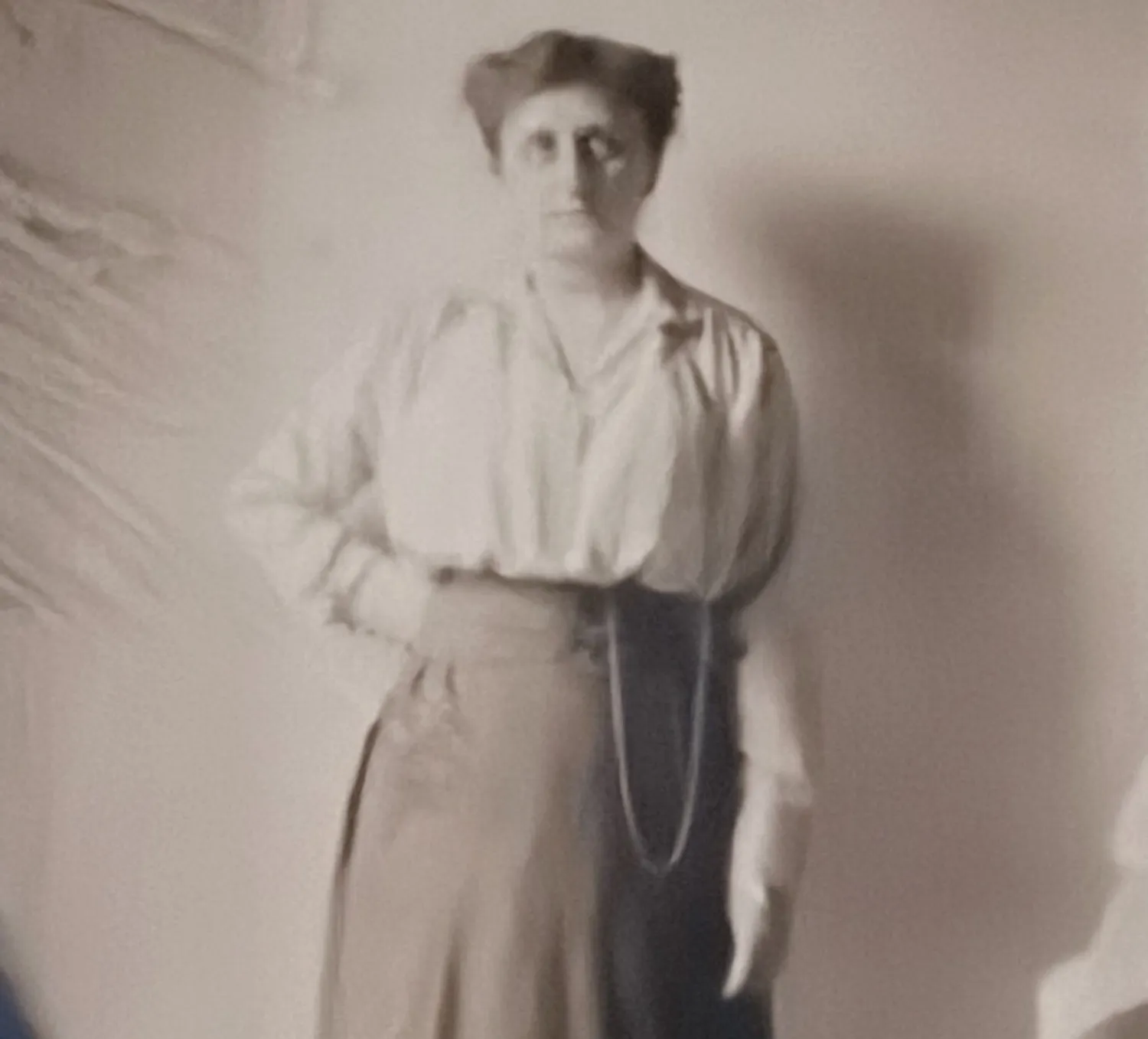
Accomplished miniature painter and art critic Alice Tillinghast Searle was born on February 8, 1869, in Troy, New York. She was the daughter of Dr. William Smith Searle and Corinthia Annis Filley Searle, who moved to Brooklyn Heights shortly after Alice’s birth. There, her father established a permanent combined residence and medical practice at 132 Henry Street. A prominent homeopathic physician, he was a close friend and trusted personal and family physician of the famous Brooklyn preacher Henry Ward Beecher, as well as a founder and longtime vice president of the New York State Board of Medical Examiners. Alice had three younger siblings: Carrie Field Searle (1871–?); Jeannette Filley Searle (1873–1944); and Alexander Holley Searle (1880–1953). A miniature by Alice captioned Miss Jeannette F. Searle, reproduced in Brooklyn Life on April 24, 1897, depicts her younger sister, who later married architect Charles H. Hall, son of the late rector of the Church of the Holy Trinity on Clinton Street, later known as St. Ann & the Holy Trinity.
During the 1880s and 1890s, Searle appears to have received artistic training in Brooklyn, although the exact institution remains to be established. Period sources variously refer to the Brooklyn Art Guild, the Brooklyn Art School, and the Brooklyn Art Academy, which were not necessarily the same organization. This training provided her with a grounding in sketching and classical painting techniques. It seems that she later continued her studies at the National Academy of Design in Manhattan, where the curriculum placed considerable emphasis on life drawing and the study of human anatomy.
In the late 1890s, Searle opened a studio in the Ovington Building at 246 Fulton Street in Brooklyn Heights. The building was owned by the Ovington brothers, well-known merchants of luxury goods and china, whose large retail establishment occupied the ground floor of the seven-story building. The upper floors, with their large windows and desirable northern exposure, were designed and marketed specifically as artists’ studios, attracting artists able to lease these premium spaces. Another tenant was Eleanor Cuningham Bannister, who would later go to Paris and study at the Académie Julian.
As a specialist in miniature portraits on ivory, Searle attracted clients from wealthy families in Brooklyn Heights and Manhattan who came to her studio to sit for their portraits. By 1897, she was already gaining considerable recognition for her work. A profile published in The Brooklyn Daily Times on December 18 of that year described her as one of the artists working in the Ovington Building and emphasized both the quality of her portraiture and the growing demand for her miniatures:
One of the busy colony of workers domiciled in the Ovington building is Alice T. Searle, the young miniature artist. She’s coming to the fore very rapidly in this most delicate, but fascinating branch of art. Her miniatures on ivory are not only considered most accurate likenesses of the subject, but are definitely painted in a consistent manner idealistic, yet in a proper degree realistic. Miss Searle has a quality in some of her portraits that is distinctly worthy. It matters not whether it be the smooth creamy complexion of the child’s face or the youthful beauty of the maiden or the strong characteristic of the man’s features, she sees the salient individuality which looks forth from eyes and brows and fixes it on the ivory tablet before her. A very excellent portrait of the late Dr. Smith was nearly completed. This was to be in the possession of his wife within a few days. Miss Searle is fortunate in having many orders to fill and much of her recent work has been for other cities (The Brooklyn Daily Times, December 18, 1897, p. 11).
The article is particularly revealing because it establishes that, several years before her departure for Paris, Searle was already recognized as a professional miniature painter with an active portrait practice and commissions extending beyond New York. Her work was also beginning to appear regularly in group exhibitions outside her own studio. Among those documented in the contemporary press were:
- November 1898: Two miniatures at the tenth annual exhibition of the New York Water Color Club, held at the Fine Arts Building, 215 West 57th Street, Manhattan.
- January 1900: An exhibition at the Knoedler Gallery, Fifth Avenue and 34th Street, Manhattan, organized by the newly formed society of miniature painters, which included ten members.
- February 1901: The annual exhibition of the Miniature Society of Manhattan at Noé’s.
- February 1901: An exhibition at the Knoedler Gallery.
By January 1900, Searle had moved her studio to the Barnard Club’s multistory clubhouse at 132 Remsen Street in Brooklyn Heights. The Barnard Club was an exclusive social, literary, and cultural organization for affluent, educated women and served as a progressive center for artistic and intellectual collaboration. A philanthropic organization, it hosted formal receptions, musical performances, and scholarly lectures addressing emerging academic subjects, politics, and international artistic trends. Its members included early alumnae of Barnard College. To foster the local cultural scene, the club also leased or provided studio spaces within its building to prominent women artists.
From Brooklyn to Paris
The American Girls’ Art Club
From 1901 to 1902, Alice Searle lived and worked at the American Girls’ Art Club in Paris. She traveled to France on the SS Deutschland and landed at Cherbourg on Wednesday, October 9, 1901. After a long train journey to Paris, she stayed at the Hôtel Terminus before taking up residence at the Girls’ Art Club the following day, Thursday, October 10.
The Club was located at 4 rue de Chevreuse, between the boulevard du Montparnasse and the rue Notre-Dame-des-Champs. Its location was particularly advantageous for art students. The property shared a back wall with the rue de la Grande-Chaumière, and rather than walking around the block, residents could use a private doorway in the rear wall of the courtyard to pass directly from the Club into the neighboring street and its art schools. The doorway also provided access for those attending services at St. Luke’s Chapel, which stood in the gardens of 4 rue de Chevreuse. Affectionately nicknamed the “Little Tin Church” or “St. Lukes in the Garden,”the chapel was a prefabricated iron building erected in 1892 by the American Episcopal mission on the Left Bank to serve the rapidly growing population of English-speaking students in the Latin Quarter. It functioned not only as a place of worship but also as an important social center for the English-speaking community.
At the time of Searle’s arrival, the Club was headed by Julia H. C. Acly (often referred to in press accounts as Miss Atlee, Ackley, or Acley), who had been appointed by Elisabeth Mills Reid in 1898 to restore order and raise standards after a period of mismanagement. An experienced educator known for her administrative abilities as head of St. Marguerite’s school for girls in Paris, Acly appears to have substantially improved both the Club’s facilities and its management. A contemporary account described the transformation:
The entire house was put in a state of perfect repair and cleanliness. New floors were even laid down. In one of the rooms that was being repapered, under the cloth that covered the wall six different wall-papers were found. [...] Best of all Miss Acly took over her own cook, and the cuisine is excellent (De Forest 1899, 3).
Acly is perhaps best known in secondary accounts for having refused Meta Vaux Warrick residence at 4 rue de Chevreuse because she was “not white.” Some sources have suggested that Acly did so in order to protect Warrick from the racist attitudes of wealthy Southern women then residing at the Club, although this interpretation remains questionable (see Meta Vaux Warrick Fuller’s profile).
Searle and other residents nevertheless portrayed Acly as an enthusiastic supporter of the young women’s artistic endeavors and as actively engaged with the American Woman’s Art Association (AWAA). During the Club’s 1898 annual exhibition, for example, landscape painter Mary Williams reported that Miss Acly “quite went into raptures” over her pastels. Acly also sought to facilitate purchases of the women’s work, expressing her intention to buy a piece herself and attempting to enlist other private buyers in support of the artists.
Searle’s own letters home provide a vivid account of her first encounter with the Club and its residents:
At last, we turned into a narrow street and stopped before a door in a stone wall. Kosher got down and rang the bell, and when the door was opened, I saw another picture. Acquaint old woman, standing in an arched doorway, all of stone and beyond a large open court filled with flowers and plants. She took my card and the trunks were put inside… after a while the concierge returned and opening another door in the wall, told me to go to room 38. I couldn’t find it, but discovered a delightful little parlor, and went in and sat down and waited until I made appeared. She showed me 238. The place was much larger than I thought and the first impression is that it is the cleanest place imaginable. But it will take me some time to get used to the quaintness of it all. My room window opens on the little court, and I have the morning Sun third floor from the street. It has a painted floor with carpet rugs, neatly bound, a couch bed, enormous bureau, and Center table, a wardrobe, and a couple of easy chairs. Everything has been freshly painted and calcium mind. There is a nice little stove in which I can burn wood or coal. Miss Acly came in while I was investigating and welcome to me most cordially. She is a middle-aged woman with a very nice face and kind and pleasant manners. She took me all over the place and even into her own apartments, which are delightful. The library where I am now riding is always heated, also parlors in winter. It is a long narrow room and all the papers and magazines and a nice library is there. Mr. Vanwinkle is here and came in while I was talking with Miss Ackley, the director of the chapel, you remember, an old man with a very pleasant ways then I met Miss Peterson from Brooklyn, the happiest thing yet for I feel I am now with friends. She is a packer girl: was in Sadie Hall’s class. Does some kind of literary work and is here this winter on the scholarship, she won her room is right next to mine and she is just as good and kind as she can be. At lunch, I sat at the French table where there is always a French lady who keeps the girls speaking the language. For $.10 a week one has the privilege. This afternoon, I unpack my trunks and settled so that the large trunk can be taken to the trunk room. Then I had a delicious nap on my dear little pillow and under my steamer rug. I forgot to say that Miss Ackley is a sister of Mrs. Daniels of Brooklyn. At five, Miss Peterson called and asked me down to the tea room. A very interesting old room restored. Six or eight people were sitting around the center table and at another large table a girl pouring tea. A very lovely lady and daughter came in with whom I had a delightful talk. She seemed to know Brooklyn people, but I was not introduced. Shall probably see her again. The club is not yet real full, but the girls are returning every day from the country, and most of the studios are open. The food seems simple but wholesome and well cooked. Hot soup, beef, and beans, salad, and cup custard for dinner. To show that Miss Ackley takes a personal interest in the girls, I heard today of a Miss Williams, who has nervous prostration. She is from California and Mr. Vanwinkle and Miss Ackley are sending her home and arranging to have her met in New York and managing everything for her… I am delighted with the class of girls here. They seem mostly very refined and rather superior girls. Of course, there are a few sloppy artists as Carrie calls them, but the majority are nice. (Letters 13–16)
Her initial enthusiasm did not diminish as she settled in. Searle described the American Girls’ Art Club as the finest and most thoughtfully organized institution she had ever known, providing affordable and comfortable accommodations together with a supportive community that she considered far superior to ordinary French pensions:
I wish I could in some way let Mrs. Reid know just what I think of the club. It seems to me the most beautifully planned and best organized and altogether helpful of institutions I have ever known we have scrupulously, clean rooms, good wholesome food, enough, but no variety, a cherry library with a good selection of books to be circulated. Miss Ackley to take personal interest and supervision and the pleasant social meetings adjust the Lonesome hours when one most needs them. All this for seven dollars a week the past few days I was continually asking myself what did refined girl art students do before this was started. I cannot imagine Miss Peterson says that this is paradise compared to ordinary French pensions (Letters 25).
The Club also placed Searle at the center of one of the most active artistic districts in Paris. In October 1901, the Vavin neighborhood, straddling the 6th and 14th arrondissements, was undergoing a period of significant cultural transformation. It was a bustling, transitional Left Bank district in which established Parisian craftsmen increasingly shared the neighborhood with an international population of artists and students, including figures who would soon become associated with the avant-garde. Students from the nearby Latin Quarter moved through streets populated by artisans and workshops; among the latter was the Maison Voignier, which manufactured organ pipes.
While rue de Chevreuse offered the comparatively sheltered environment of the Club, the nearby rue Notre-Dame-des-Champs, nicknamed “the royal road to painting,” was closely associated with the artistic life of the neighborhood. Its numerous studios had housed, or would soon house, prominent French and international artists. William-Adolphe Bouguereau would establish his studio at No. 75, while Jean-Paul Laurens would work at No. 73. James McNeill Whistler had taken a large sixth-floor studio at No. 86 in 1892; although he had largely returned to London by the time of Searle’s arrival, his former studio remained part of the street’s recent artistic history. At No. 58, the German painter and collector Richard Goetz, who had settled in Paris in 1900, was living and working in a home-studio by 1901 and becoming involved in the city’s German expatriate artistic community. Earlier, Camille Claudel had maintained a studio at No. 117, which she shared with other young women sculptors.
Immediately behind the Club, the rue de la Grande-Chaumière, known as the “Artists’ Alley,” offered an even more concentrated artistic environment. This short, narrow street was crowded with art schools, studios, workshops, inexpensive lodgings, and models hoping to be hired to pose for artists. The nearby crèmerie Chez Charlotte was a meeting place for artists; in the late 1880s, Paul Gauguin and Alphonse Mucha met there, and the two later shared a studio at 8 rue de la Grande Chaumière from 1893 to 1894. Although Mucha subsequently moved elsewhere, he began teaching decorative arts at the Académie Colarossi in 1900, which stood at No. 10 rue de la Grande Chaumière. One of the most important private art academies in Paris, it welcomed foreign students and it also permitted women to draw from nude male models. At No. 6 was the stained-glass workshop of Félix Gaudin, who had acquired Eugène Oudinot’s establishment there in 1890. The Norwegian painter Christian Krohg returned to Paris with his wife Oda in 1901 and began teaching at Colarossi the following year. The Académie de la Grande Chaumière, which would later make the street still more famous as an artistic center, was established at No. 14 in 1904, after Searle’s residence in Paris.
Life in Paris
A bound copy of the letters Searle wrote to her family and friends during her Paris stay was given to us by Dr. William H. Janeway, her great-nephew. What emerges from this correspondence is not simply the record of an American art student abroad, but the portrait of a woman increasingly immersed in the daily rhythms of expatriate and artistic life in Paris. Her letters reveal a demanding schedule that combined instruction in several ateliers with independent work, museum study, and a full program of evening and weekend activities. They also demonstrate that Searle understood her artistic education as extending well beyond the walls of the academies: she took every opportunity to explore the city, its museums, monuments, neighborhoods, and artistic communities.
One of the first things Searle did after arriving in Paris was to register at the Paris office of the Brooklyn Daily Eagle, where she met Emma Bullet, the newspaper’s legendary longtime Paris correspondent, who held that position for more than thirty years, from 1882 until her death in 1914. Around 1901, the Eagle’s Paris bureau, managed by Bullet, was located at 53 rue Cambon, near the boulevard de la Madeleine, in one of the most central districts of Paris. The bureau provided an important point of contact for Americans abroad, offering access to hometown newspapers, writing facilities, mail services, and information useful to travelers and expatriates. Under Bullet, it also became a significant meeting place for members of the American community in Paris, including writers, performers, artists, and art students.
Searle continued to visit the Eagle bureau and Bullet, who in turn attended receptions and dinners at the American Girls’ Art Club. These connections formed part of the extensive social network that Searle developed remarkably quickly after her arrival. At the Club itself, she immediately formed a friendship with “Miss Peterson” (most likely Kate Peterson), who occupied the room next to hers and joined her at the French table in the dining room. Since the women at the Club generally referred to one another by their surnames, Searle rarely provides first names in her letters, making some identifications difficult. Outside the Club, one of her closest artistic companions was Elisabeth Kruseman Van Elten, who did not reside there but regularly participated in its activities and played an important role in helping Searle orient herself within the Paris art world. As the year progressed, Searle also became close to Catherine Critcher, who often accompanied her to the Académie Julian, and Mary Wyatt, with whom she attended Billemont-Chardon’s class. Her letters record outings and activities with Mary Barringer, Mabel Packard, Miss Powell, Miss Church, and Imogen Coulter, among others.
Equally striking in the correspondence is the breadth of Searle’s social life beyond the Club. Friends and acquaintances invited her to dinners, accompanied her to the opera and theater, and joined her on visits to artists’ studios, including that of André Castaigne, and to exhibitions at galleries such as Georges Petit and Durand-Ruel, as well as the Grand Palais and the Musée de Cluny. Her friend Lee, apparently associated in some way with the Eagle bureau, visited her soon after her arrival and regularly invited her to the theater, opera, and other events. Her correspondence suggests that she quickly established herself within a broad community of American expatriates while simultaneously moving through the artistic circles of Paris.
Much of her daily social life nevertheless remained centered on the American Girls’ Art Club, which her letters portray less as a boarding house than as a collegiate residence. She describes receptions and afternoon teas, Christmas dinners, concerts and dances, informal gatherings in students’ rooms, and conversations around the French table at meals. The Club provided not simply accommodation but a ready-made community through which friendships, professional contacts, and invitations circulated.
The Club’s receptions and festive dinners provided particularly valuable opportunities for building such relationships, since they frequently brought the residents into contact with prominent figures in both the American expatriate community and French cultural circles. At one reception in 1902, Searle encountered the young American opera singer Geraldine Farrar, a former resident, whose rapidly developing European career clearly impressed her:
Geraldine Farrar, the grand opera singer from Berlin who used to be one of the humble students here, was at the reception last night. She is only 20 and has been the favorite singer in Berlin this winter. They have regular Farrar nights at the Opera House and the Germans have gone crazy over her. Miss Acly was much pleased to have her come and was introducing her to everyone (Letters 311).
Searle also describes the informal gatherings that regularly took place in the students’ rooms. These could develop into more elaborate entertainments organized among small circles of friends, revealing something of the convivial and often playful social life that flourished within the Club. One Saturday evening, Searle and Mary Wyatt organized what they called a “winter picnic”:
Saturday evening, Miss Wyatt and I gave our winter picnic in her room while my room was used as a dressing room. We called it a picnic because there were not chairs enough: 12 in all, so we provided cushions and sat in circles on the floor. When supper was served, a huge copper basket packed with picnic fair was hauled into the center and each one helped herself, sandwiches, crackers, olives, lemonade from a pale, and a huge French cake which had been stocked with a ring, thimble, a button, and a piece of money. In our written invitations, we had asked each one to come provided with a lie, the one telling the biggest to get a prize. These were very funny. Miss Church won the prize, a violin which we dubbed a LYRE for a liar. The joke of the evening was when Miss Coulter came in late from her lesson and began to tell us the most plausible story about her delay and fruitful this all for no one suspected that it was fiction. She is the most sanctimonious person and goes by the name of Easter Lily, so a real lie from her was rich fortunately, we had a second prize for her several came in costume, one in bloomers and imitation of Buck Smith’s type and another as a French demoiselle of the quarter the evening ended with song and PAS SEULS. All voted our winter picnic a great success.
These informal get-togethers beautifully complement the more formal receptions, offering us two facets of Club sociability, from encounters with someone like Geraldine Farrar to twelve women sitting on cushions on the floor telling competitive lies.
Interestingly, the women enjoyed considerable freedom in their evening activities and could remain out quite late, with arrangements in place for their return after the Club had otherwise closed for the night. Searle describes the system with some amusement:
Ambroise always sits up when people are out, which is nearly every night. He sleeps in a little room by the gate, and we can see him through the window when we come in, with a gate rope around his wrist. When we pull the rope he looks sleepy, pulls on the cord and so opens the gate. There seem to be no keys to houses here. All seem to be managed in this way. [...] Our little home certainly is a paradise in comparison with the stuffy boarding houses. [...] I was glad indeed to come back to our sweet, clean, airy little club” (Letters 186–187).
Searle also had family connections in Paris. Cousins lived on the rue de Villejust (now rue Paul-Valéry), near the avenue du Bois-de-Boulogne, in a very different social environment from the student and artistic world surrounding rue de Chevreuse. At the turn of the century, the area surrounding this street and the Avenue du Bois-de-Boulogne was the absolute center of high society, wealthy expatriates, and bohemian artistic wealth. She became particularly close to Mimi Filley, her first cousin on her mother’s side, who visited her regularly at the Girls’ Art Club, invited her to dinner at her home, and sat for a portrait by Searle.
Her letters also reveal how thoroughly she explored Paris and its surroundings. Walks through the Luxembourg Gardens and excursions to Versailles, the Arc de Triomphe, the Champs-Élysées, the Place de la Concorde, the Panthéon, the Bois de Boulogne, and Père-Lachaise Cemetery were interwoven with her artistic activities. Shopping was equally part of the practical life of a working artist: she went to the Marais in search of ivory, to the Bon Marché for clothing, and to commercial galleries around the Louvre, while visits to museums and exhibitions formed a regular part of her schedule. The distinction between artistic education and everyday experience was therefore often blurred; studying, looking at art, obtaining materials, socializing, and exploring the city formed interconnected parts of her Paris life.
Religion constituted another important element of Searle’s experience. Although she visited several of Paris’s major churches, including Notre-Dame, Saint-Sulpice, La Madeleine, and Holy Trinity, she preferred attending services at the small Episcopal chapel immediately behind the Club. The simplicity of St. Luke’s seems to have appealed to her more strongly than the grandeur of the city’s monumental churches. She was particularly impressed by the Reverend Mr. Van Winkle, whose work among the students of the neighborhood she admired:
At 10:30 I went into the little chapel to service. I should think there were 30 or 40 present. Mr. Van Winkle is a dear old man with almost pure white hair and beard. He is from New York. Has a wife and two daughters here. The former is on her way now to America. The little church certainly does a lot of good in this quarter. I believe Mr. Van Winkle is a hard worker in spite of his years. He is especially interested in the young men students who come here to study and has opened a reading rooms for them (Letters 38–39).
A few pages later she expressed even more directly what the chapel meant to her:
I must say I feel much more worshipful in the little Chapel here which is quite rough and bare, than I do in any of the great Churches (45).
Artistic Training in Paris
If the Club provided Searle with a social base in Paris, her first weeks were equally devoted to determining how best to organize her artistic training. Rather than immediately committing herself to a single teacher or institution, she investigated several possibilities. Accompanied by Elisabeth Kruseman Van Elten, she visited three of the city’s leading private art academies: the Académie Delécluze, the Académie Julian, and the Académie Colarossi, the latter situated immediately behind the Girls’ Art Club on the rue de la Grande-Chaumière. Although she says nothing about her initial visit to Delécluze, her first reaction to Julian was decidedly mixed. Despite the academy’s reputation, she found it “overcrowded and badly ventilated, and too long a distance” from the Girls’ Art Club (Letters 30). By contrast, she found that Colarossi was conveniently located and better suited to her immediate needs, and she began attending a morning drawing class there around October 14, 1901.
I enjoyed the work at this studio this morning, in a way, the first day is always difficult. I shall draw from life, and charcoal, for two months anyway, and shall probably not start the lessons in miniature painting until November. This class at Colarossi numbers about 30, I should say, all girls and a very good class. It is a nice large room and everything is much more comfortable and pleasant than I expected (40).
The decision to begin with drawing from life and charcoal suggests that Searle regarded miniature painting not as an isolated specialty but as one that depended upon broader training in observation, draftsmanship, and the representation of the human figure. Determined to continue her specialization in miniature painting, she also called on Mme. Hortense Richard, the distinguished miniaturist who had been awarded a bronze medal for her miniatures at the 1900 Exposition universelle. She soon discovered, however, that Richard did not maintain a regular teaching studio but accepted only private pupils, charging the considerable fee of twenty francs per hour. Although Searle respected Richard’s technical ability, she was not personally impressed, writing, “I do not like this woman at all, but her work is strong and good; no refinement, however, in her portraits.”
Searle also wrote to Gabrielle Marie Joséphine de Billemont-Chardon inquiring about instruction. At the time, de Billemont-Chardon (1860–1957) was vice president of the Association des femmes peintres et sculpteurs and one of the foremost French miniaturists, portrait painters, pastel artists, enamel painters, and painters of decorative fans of her generation. In 1901, she was awarded a Salon medal, after which she became hors concours, a status reserved for artists who had achieved significant professional distinction and no longer had to submit their work to the Salon jury for acceptance.
De Billemont’s teaching career is in fact one of the most interesting and least appreciated aspects of her life. Beginning in 1885, she established a private atelier at 7 Rue Duperré, in Paris’s 9th arrondissement, where she accepted foreign women students. The documented list includes French, Swedish, British, Russian, and several American students. Her 1909 textbook, La Miniature sur ivoire: Essai historique et traité pratique, provides an overview of her philosophy and technique.
While awaiting Billemont-Chardon’s response, Searle enrolled in a miniature class at the Académie Julian, joining Madame Laforge’s class for one month in the hope of benefiting from the school’s serious artistic environment. There, she continued to develop her miniature painting while assessing the advantages of formal instruction in Paris:
Went first to the Julian Studio to see about a miniature class which meets there three times a week. The famous old atelier is in the funniest old passage just off the Boulevard des Italiens. One has to twist and turn down queer little alleys with funny shops on either side to get there, and when you are there, the studios are not elegant! After a good deal of coaxing, the old concierge allowed me to go into the miniature class, which works in the same room as the life class. There were about 10 working from a very fair model. I think I shall try it for a month, for I rather like the atmosphere of the place and shall probably see good work. Cannot seem to find a teacher who teaches from life (41–42).
Although initially attracted to the reputation and atmosphere of the Académie Julian, Searle quickly became ambivalent about her experience there. She appreciated Laforge’s emphasis on careful drawing, composition, and finish, and she repeatedly received enthusiastic praise for her draftsmanship, technique, and artistic sensitivity. Yet she remained dissatisfied with the atelier’s highly “stippled” approach to miniature painting, which she considered lifeless. Ultimately, she concluded that she was making very little progress. Although Laforge encouraged her to exhibit at the Salon and publicly praised her work before the class, Searle decided to abandon her studies at Julian’s in December 1901 in favor of de Billemont’s atelier.
After an initial delay in receiving a reply to her request for admission, Searle was accepted into Billemont’s large miniature class of thirty-eight students in December 1901 and quickly concluded that it offered far superior instruction to that of Mme. Laforge. She later remarked that she placed far greater value on the instruction of Gabrielle de Billemont-Chardon than on Laforge’s opinions. She even discouraged other miniaturists from enrolling at the Académie Julian, believing that it offered little benefit despite its prestigious reputation.
Among the various components of her artistic training in Paris, Searle appears to have regarded her studies with Gabrielle de Billemont-Chardon as particularly rewarding. She admired Billemont-Chardon’s refined technique, strong draftsmanship, and mastery of painting on ivory, while recognizing the limitations imposed by the size of the class and the teacher’s insistence on her own methods. Although critiques were infrequent, Billemont-Chardon consistently encouraged Searle’s work, at one point telling her that she had reached “the most important period of miniature painting” and comparing her progress to her own artistic development. She also encouraged Searle to prepare work for the Salon, while her fellow students emphasized the importance of remaining in Billemont’s atelier through the Salon season because of her influence in the miniature section.
Searle devoted herself to increasingly ambitious compositions, hoping to produce an exhibition piece. Despite occasional frustrations over working conditions and uncertainty about Salon acceptance, she repeatedly affirmed the value of Billemont-Chardon’s instruction. She praised Billemont’s drawing as “fine and strong” and wrote that she could do the “most marvelous things with the ivory” (124). At the same time, Searle was not uncritical of her teacher. She observed that Billemont was a “stickler for her methods” (138) and later complained that she did not “encourage the American girls as much as she does the French and, as a rule, says very little to me, good, bad, or indifferent” (188–189). Nor did she approve of Billemont’s tendency to use the same palette “for painting everybody—man, woman, and child,” adding that “her painting of the hair is too Frenchy” (124).
This critical independence extended beyond Billemont-Chardon to Searle’s assessment of French miniature painting more generally. Although she greatly admired her teacher’s technical abilities, she remained convinced that the strongest American miniaturists were producing superior work. After attending an exhibition of the Société des Femmes Artistes, where Billemont-Chardon displayed her miniatures, she wrote:
The exhibition last night was great fun, the people not the pictures. I invited Miss Critcher to go with me; Miss Wyatt asked Miss Boyd (a second-year old girl) as jolly as she is stout, which is considerable. It was an exhibition of the women artists club of Paris [Société des Femmes Artistes] and the display was a very poor one, on the whole. Only one American represented and hers were the most interesting of the lot – a miss Este, a friend of Miss V. The latter was there with her father; Miss Acly; Mrs. Green and her daughter, and swarms of French people, the women in the most marvelous costumes. Each artist received by her special group of pictures. Madame de Billemont presided over her case of miniatures, the best there, a purple hat of roses on chemical bronze hair and diamonds galore. Was glad to see her work on public exhibition, and am of the same opinion that it cannot compare with our best —Miss Hill, Mrs. Fuller, or even Mr. Baer (129–130).
Her reaction to an exhibition of the Paris miniature society at the Georges Petit galleries was similar. Searle was disappointed by what she perceived as the dominance of Billemont-Chardon’s methods and the resulting lack of individuality:
In the evening, we four, Wyatt, Packard Watson, and I went over to the George Petit galleries to see the exhibition of the miniature Society of Paris. I had mailed an invitation to Mimi and expected her to meet her there, but there was such a crowd that we did not meet…. I was quite disappointed in the miniatures. It seemed to me an exhibition of Madame de Billemont and her former pupils for there was little if any original or unique work shown, but all was done in the same way and in Madame’s methods. Neither Madame Richard nor Mademoiselle Schmidt, nor others equally strong were represented, so it cannot be called affair, exhibition of Paris miniatures. still, I am of the same opinion, that the American work is in the lead (148–149).
Searle’s commitment to miniature painting did not prevent her from deliberately pursuing work on a much larger scale. Throughout this period she continued her studies at the Académie Colarossi, adjusting her schedule as her other commitments changed. Initially, she concentrated on drawing in the morning. Once she began attending Billemont-Chardon’s class on Wednesday and Friday mornings, she shifted to an afternoon class in large-scale portrait painting. At Van Elten’s recommendation, she also attended an evening class in full-length life drawing, although she abandoned it in early December when the demands of her schedule became too great.
The transition from years of miniature work to large-scale portraiture was not easy. Searle was initially discouraged by what she regarded as her slow progress, but she also understood precisely why she was experiencing difficulty and why the exercise was valuable:
A big canvas or paper seems to phase me, when, if I were doing it on a 3-inch surface, I would have no trouble. I realize, however, that I must expect to find big surfaces in materials, awkward at first, after so many years of small work, and shall not get discouraged for I know even the effort is going to help the miniature work (138).
This observation is particularly revealing of Searle’s purpose at Colarossi. She was not attempting to abandon miniature painting in favor of large-scale portraiture; rather, she regarded drawing and painting on a larger scale as a means of strengthening the miniature work in which she was already experienced.
The international character of Colarossi also made a strong impression on her. Describing one of her portrait classes, she wrote:
Such a queer mixture of nationalities in this class. A little man next to me is a pole. He wears funny, high stock colors, like pictures of little Billy. He is a bright, happy little chappy, and draws beautifully, but cannot paint. There is a Polish girl in front of him who can draw but paints like Velasquez. There are three or four English girls, only two Americans, beside myself, and several Germans. One hears queer languages all around. The Poles are the best workers in the class by far. The French are poor and the English dreadful with the exception of one who does fair work (161).
She was equally fascinated by the models who congregated outside the academy and by the process through which they were selected for classes. Early in her stay, she noted the “swarms of models, all sorts and kinds, mostly Italians, which congregate in front of the Colarossi Studio” (50). The sight evidently remained with her: shortly afterward she described seeing a composition for a large canvas depicting “a group of models, all ages and sizes standing in the street in front of Colarossi’s Studio just as I saw them last Monday” (51). She later described the academy’s weekly selection process:
The selection of models on Mondays is a curious performance. Six or eight come in and put all sorts of quaint costumes and the one by one they mounted the model throne and are voted on. The one winning largest number of votes is kept for the week (139).
Overall, Searle considered her training at Colarossi useful, even when she questioned whether another school might offer greater advantages. At one point she contemplated transferring to Lawton Parker’s school, encouraged by Perkins and Barringer, who claimed to have learned more there in a month than during an entire year at other schools. Searle was tempted but ultimately decided against another change: “I dread the effect of a change on my work. The instructors are just getting so they recognize my work and me” (135). Instead, she continued at Colarossi through March 1902, deliberately “studying just what I feel will help me in my miniature work and let everything else go” (139).
That selectivity increasingly characterized her approach to her Paris training. She eventually abandoned the evening class, in part because of problems with her eyes, but remained committed to the morning work despite periodic discouragement over the pace of her progress:
My morning work at Colarossi is a great help and I am bound to stick to it […]. It is what I most need. The winter study has seemed all too short, and I am periodically discouraged to find the slow progress I have made. I do feel however, that I have put in all the study I could and have made the most of it. Wish my eyes would permit me to join the night class, but I found that out of the question (218).
Her formal instruction was supplemented by an intensive program of independent study at the Louvre. Like many art students in Paris, Searle devoted considerable time to copying works in the museum. She initially chose paintings by Jean-Baptiste Greuze and Anthony van Dyck and later undertook a study of the Winged Victory of Samothrace. Her letters record not only the work itself but also the bureaucratic process required to obtain permission to copy:
Lee walked with me as far as the Louvre where I had to see about getting my permit to copy and decide on which picture to commence. More red tape. I was asked all sorts of impertinent questions, from age to ability as an artist, by a funny little French man in a red fez, who sat behind a screen in one of the galleries, even though I had a fine letter of introduction from Mr. Colarossi. I finally obtained two inscriptions, one for the van Dijk, and one for the Greuze. Think I shall start on the latter next Thursday (105–106).
During December, Searle initially reserved Tuesday, Thursday, and Saturday mornings for work at the Louvre, but the winter cold and the increasing demands of her other activities eventually forced her to curtail these sessions. One particularly time-consuming commitment was of a different nature: Elisabeth Kruseman Van Elten had decided to paint Searle’s portrait for the forthcoming AWAA exhibition and required her to sit regularly.
Searle initially regarded the sittings almost as an unwelcome interruption to her own work:
Today I spent the morning at Miss Van Elten’s posing, much to my disgust for it seems such a waste of time to me. The picture looks like me and she is much interested, but we do not either of us like the expression. Seems so funny to see oneself on canvas. I don’t like it much (132).
As the portrait developed, however, her attitude changed dramatically. After initially resenting the time taken from her studies, she became delighted with the result:
It has been hard to give up time for the sittings, but have managed to give her mornings and this week. She has painted on it at home in a soft light and, as it needed only one more sitting. I gave up after noon class for it. I am so thankful now that I did for whether it was your beautiful, encouraging letter which inspired her or the bright sunny afternoon, and the happier mood in which she found me, or a little bit of both, she did wonders with the portrait and now all are delighted with it. I think it is the finest bit of painting of hers I have ever seen, and though a rather flattering likeness it has lots of character and looks like me. She informed me yesterday that she wished to present it to you and Papa and I could take it home with me…. I have told her, of course, that we would be willing to exhibit it in New York next winter and it might be a good thing for her. She has to take some photos of it in a day or two and if they are good, I will send you one. It will be in the club exhibition, and, if it is as great as success, as I anticipate, she may send it to the salon. Will it not be fine to have a salon picture in our parlor? I should say the canvas was as large as my old still life picture frame, and all (162).
Van Elten’s portrait thus became another point at which Searle’s artistic and social lives in Paris intersected: a friendship developed through the American artistic community resulted in a portrait intended for exhibition at the American Woman’s Art Association and potentially at the Salon, while Searle herself continued the intensive program of study she had come to Paris to pursue.
The American Woman’s Art Association Exhibition
Searle’s formal studies were further supplemented by private work in Elisabeth Kruseman Van Elten’s studio, where, beginning in January 1902, she worked once or twice a week. One of the subjects she undertook there was a small Italian model whom she hoped to paint for the forthcoming exhibition of the American Woman’s Art Association at the Girls’ Art Club:
I worked in V’s Studio this morning and started a study of a little Italian girl. She is six years old, and is in costume, long skirt, white coat shift, little apron, and her head covered with an orange-colored scarf. She has the biggest brown eyes, and is very quaint and cunning. In her hand is a large piece of French bread and a stick of chocolate, their favorite tidbit. Hope I can make something of it for it would take as a show picture (143).
The little girl returned for subsequent sittings, although the practical difficulties of working with a child model occasionally complicated matters. On one occasion she arrived without the yellow kerchief she had previously worn because, as she explained, her mother was posing in it elsewhere that week. Searle was fascinated by the child’s ability to remain still for extended periods and observed that these young Italian models “really pose from babyhood.”
Van Elten’s studio thus provided Searle with another setting in which to pursue her own work, while their close professional friendship extended into other aspects of her Paris experience. Searle also continued to visit artists’ studios and exhibitions elsewhere in the city. Among these was a visit with Wyatt and Boyd to the studio of the French painter and illustrator André Castaigne. At the same time, she remained conscious of the financial realities of professional artistic life and considered undertaking a commissioned portrait of Mrs. Nichols from photographs in order to earn additional money.
The approaching 1902 exhibition of the American Woman’s Art Association increasingly occupied Searle and the other artists at the Club. Already in early December, she had attended an organizational meeting in the Club salon and recognized the exhibition’s potential importance for her own work. She was particularly struck by the previous year’s record: according to her account, thirty of the ninety-two works exhibited had subsequently been accepted at the Salon. With Mary MacMonnies absent, Van Elten presided over the meeting, and the exhibition was scheduled to open on February 15 and remain on view for two weeks.
Searle exhibited several miniatures, while Van Elten contributed the large portrait of Searle on which she had been working during the preceding weeks. Searle was initially irritated by the placement of the miniatures in a small room adjoining the tea room, interpreting their marginal position as evidence that miniature painting did not command the same respect in Paris that it did in the United States. Her annoyance intensified when she learned that the miniatures had apparently not been subjected to the same jury process as the larger works:
The miniatures are hung together in a little side room, badly lighted and poorly heated, and if I allowed myself to think about it, I should be much annoyed at the lack of respect and consideration shown to them. I am very careful, however, to say nothing except to Miss V. for when she told me that miniatures were never passed upon by the jury, but all accepted as a matter of course because they were small and easily hung, I boiled over, and well, I told her a few things. The idea that a miniature should not stand the same examination as a large picture!!!! They do things much better in New York.
The incident is particularly revealing of Searle’s professional identity. She was not merely defending her own work but insisting that miniature painting should be judged according to the same artistic standards as larger paintings—an issue about which she would remain outspoken. Despite her dissatisfaction with the hanging, her own miniatures attracted considerable attention. She reported that visitors repeatedly asked the price of the little Italian girl, although she had decided not to sell it, believing that it would be more valuable to her as an exhibition piece once she returned to the United States.
Searle was enthusiastic about the exhibition as a whole, which she considered markedly stronger than the previous year’s show and notably free of the appearance of “schoolwork.” Van Elten’s portrait of her provoked considerable discussion, particularly over what some viewers regarded as insufficient color in the face. The opening also brought Searle into contact with established figures in the Paris art world. Among those she recorded as attending were Walter Shirlaw, Carolus-Duran, Alphonse Mucha, and Eduardo León Garrido. She was particularly amused by her introduction to Mucha, whose pupil Imogen Coulter assembled a group of about ten young women to be presented to him in turn. Searle found him immediately appealing, describing his “kindest eyes and quietest manners” and noting his popularity as a teacher.
The exhibition also allowed Searle to observe visitors responding to both her work and Van Elten’s portrait of her. She enjoyed watching people move between the portrait and its sitter, “compare notes,” and discuss the likeness. Miss Acly subsequently told her that visitors from across the Seine had “admired my miniatures exceedingly.
Preparing for the Salon
Once the AWAA exhibition ended, attention at the Club shifted almost immediately toward Salon submissions, a concern that runs like a leitmotif through Searle’s letters. She initially considered submitting the little Italian girl but eventually decided to send only a miniature of a young boy. The practical requirements were considerable: each miniature needed its own cabinet or shadow box of prescribed dimensions, and Searle did not have time to have another made. Billemont-Chardon, moreover, apparently did not favor submitting the Italian girl. Searle repeatedly insisted to her family that she had almost no expectation of acceptance: “I have only one chance in 1000 and have not set my heart on it at all.”
Her pessimism was reinforced by Billemont-Chardon, who explained that even in the previous year, when she had known several members of the jury, only two of her pupils had been accepted; in 1902, she knew no one on the jury. Nevertheless, Searle decided that submitting a work was worthwhile simply for the experience.
At the same time, she prepared work for Billemont-Chardon’s exhibition of her pupils. Of the pieces she was considering for the Salon, she ultimately selected a small study she called Jean, which Billemont declared “the best thing I have done.” Works intended for Salon submission were then sent from Billemont’s studio.
Searle was keenly aware of the distinction between the two principal Paris Salons. As she explained to her family, there were now “two salons”: the older Champs-Élysées Salon and the smaller and more exclusive Champs-de-Mars. Her own “tiny head” went to the larger Salon, while several other women at the Club submitted works to the Champs-de-Mars. The entire house waited eagerly for the results: “All the girls are much excited over the fate of their several works. About every artist in the house sent something.”
Italy and the Meaning of her Paris year
As the Salon submissions went forward, another question increasingly preoccupied Searle: whether she should interrupt her studies to travel to Italy. Each Easter, a number of women from the Club apparently made an inexpensive excursion there, traveling third class and spending about fifty dollars for three weeks. Searle initially considered joining them but hesitated after Van Elten warned her that the journey would be exhausting and unnecessarily uncomfortable.
Around March 22, approximately sixteen Americans set out from the Club without her. Searle joined the lively send-off at the station and momentarily regretted not accompanying them as flowers, fruit, roasted chickens, bread, and other provisions were piled into their compartments.
The situation changed when Van Elten unexpectedly found herself able to afford the journey. A generously prepaid portrait commission prompted her mother to tell her, “now you can go to Italy!” Van Elten proposed that she and Searle travel independently, an arrangement that appealed to Searle because the two women were similar in endurance and would have greater freedom than they would as members of an organized party.
The decision nevertheless forced Searle to confront the tension between travel and formal study. She worried that six weeks in Italy would make “a great hole” in her studies and leave her with little tangible evidence of what she had accomplished during the winter. Yet her reasoning also reveals how broadly she had come to understand the purpose of her European experience:
You must remember that it will not be so much what I accomplish as the influence the study and experience will have on my future work (202–203).
Ultimately, the opportunity proved irresistible. She and Van Elten planned a six-week journey at a maximum cost of $125, intending to leave around April 1. Although Searle regretted abandoning some of the projects she had planned in Paris, she concluded that “this is one chance in a lifetime, and I should be foolish, indeed, not to take the Opportunity.”
This willingness to place experience alongside formal instruction captures something essential about Searle’s Paris year. From beginning to end, she treasured the freedom and opportunities it afforded her. Early in her stay she playfully described herself as “Alice in Wonderland”; elsewhere she reflected more seriously on what the experience meant for her artistic future: “This life makes me seem so selfish, but it does seem like a God-send to me, for I am convinced my work will be both strengthened and benefitted, and I shall be so much better satisfied” (102).
By the time she contemplated returning to Brooklyn, that experience had also begun to alter her ideas about the conditions under which she wanted to work. She was increasingly reluctant simply to resume her former studio arrangements at the Barnard Club:
I suppose you have received my postal in which I said not to keep it for me and expect you were surprised. There will be timing enough on my return to make plans for the winter and talk them over with you and it is very difficult to say what I would like on paper, only that I am strongly impressed that it is not wise to go back to the Barnard again. Everything seems to make it advisable to bring about a decided, change and work and surroundings. I have several rather indefinite plans in my head, which circumstances will settle or alter on my return (209).